

I stepped onto a crowded A train the other day, heading from Brooklyn to Manhattan, and was confronted with a microcosm of people with their different styles: contractors and construction workers (Carhartt and utility jackets), well-heeled, corporate pragmatists (slim suits, printed sheaths), fashion students (wearing their own creations), and art-world peacocks (prints on prints, layers atop layers).
There’s no better way to get a sense of what people really wear than on a morning commute. If you drop in at 8:00 a.m. on the Paris metro, the tube in London, the U-Bahn in Berlin, Singapore’s MRT, or the Shanghai subway, you’ll see a tightly packed sardine can filled with disparate modes of nine-to-five dressing. But recurring motifs appear, particularly on those women who look like they’ve really got it together: a sleek camel overcoat paired with crisply creased trousers and a great T-shirt, or a pair of jeans and a sharply tailored black blazer. This is the no-fail, get-it-done-and-look-good-doing-it city uniform, and much of its history can be traced back to Max Mara, which celebrates its 75th anniversary this year.
Max Mara Resort 2027Gorunway.com
This is why the brand, despite its Italian origins, chose to show its resort collection in Shanghai this past summer. “Max Mara has always been a metropolitan phenomenon,” Ian Griffiths, the label’s longtime creative director, tells me on the eve of the show. “After 75 years, that’s what Max Mara is all about. It’s about urban chic; it’s about a woman who really wants to engage with a city.” For Griffiths, just as modernity defines Shanghai, so too does it underscore Max Mara’s longevity in fashion’s rapidly shifting ecosystem.
The show was held at Shanghai’s Long Museum West Bund, an art exhibition space housed inside a brutalist concrete building on the western side of the city. The skies that day were filled with dense gray fog and windy, misty rain, veiling the famously illuminated skyline just enough to look like a scene from Blade Runner.
“There’s something about Max Mara that works really well against the background of brutalist architecture,” Griffiths says. “It’s like the city itself, and Max Mara’s luxury is kind of a foil to this hard city landscape.”
Outside the museum, an entirely new neighborhood was going up. Luxury apartment buildings, restaurants, and gyms were all being erected by clusters of giant cranes placed precariously close together. Inside the Long Museum, guests were time-warped back to Max Mara’s beginnings in 1951, when Achille Maramotti founded the brand with one coat and one suit. He revolutionized sportswear in Italy by mass-producing classically tailored garments at a time when most men and women purchased their clothes directly from independent tailors and dressmakers. In many ways, Maramotti was an early proponent of modern sportswear and one of the first to translate it from its American origins to more distinctly European styles.
Max Mara Resort 2027Gorunway.com
One of the most dominant themes on the runways in recent years has been this idea of wardrobing: effortless pieces that can be endlessly remixed, whether it’s a jean and a blazer accessorized with a printed silk scarf, a boxy knee-length skirt suit, or a fluid dress made from cotton jersey. Juxtaposed with recent trends like heavy embellishment, texture, and eccentric shapes and silhouettes, these updated takes on classics offer a way to play with your personal style if the more idiosyncratic stuff isn’t your thing. With Max Mara, though, it has never been about trends. Instead, the brand has held fast to the idea that real taste is inherent, not plucked from the internet, and that clothes should enhance rather than inform who you are or want to be.
It’s why Max Mara has long appealed to women in power who need to be heard and armored. See: Nancy Pelosi in the fiery-orange coat she wore following a confrontational meeting with President Trump in 2018 or Meghan, Duchess of Sussex, looking poised and polished in white jeans and a cashmere camel trench in 2023, a look built to withstand public scrutiny. Katie Holmes said at the show that she loves Max Mara because of its “classic elegance” and its ability to “fit into any wardrobe.” Fashion editor Tonne Goodman, who has styled many Max Mara shows and campaigns, is well known among fashion obsessives for her unimpeachable taste and rigorous uniform; she always wears some version of a chic silk scarf, sweater, and loafers.
“The clothes understand the realities of a woman’s life today,” says society fixture and designer Nicky Hilton, a longtime Max Mara client. “You can put on a beautiful coat or a perfectly tailored suit and immediately feel pulled together. But it never feels overly precious. The feeling of confidence and ease is incredibly consistent. The Teddy coats and camel coats have been staples in my closet for years.”
From left: Michelle Yeoh, Maude Apatow, and Katie Holmes at the Max Mara Resort 2027 show in ShanghaiCourtesy Max Mara
Max Mara clients wandered the exhibition space alongside newer Gen-Z acolytes like Olympic freestyle skier Eileen Gu and filmmaker and actor Maude Apatow. Laura Lusuardi, who has been the house’s fashion coordinator since the 1960s, was also there, dressed in a tunic, wide-leg pants, and sculptural statement jewelry. “Over 75 years, women’s lifestyles have changed dramatically, and Max Mara has always closely observed and accompanied that evolution, especially through pivotal moments such as the rise of the ‘working woman’ in the 1980s,” Lusuardi explains. “Our incredible archive serves as a constant source of inspiration, allowing us to rethink our heritage through a contemporary lens.”
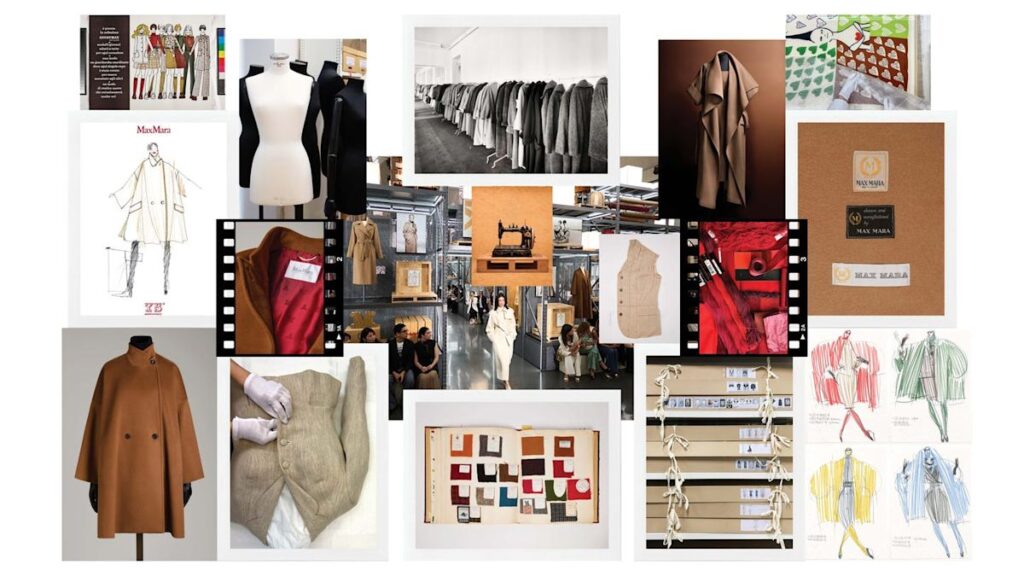
In tandem with the resort show, the brand staged an exhibition in the same space, curated by fashion historian Olivier Saillard, that re-created its archive in Reggio Emilia, Italy. The space was packed with floor-to-ceiling industrial shelving that featured wooden shipping crates, shoe and hat boxes, spools of thread, and historic ephemera from the Max Mara universe, including Maramotti’s original sewing machines, advertisements dating back to the 1950s, and the original prototypes of some Max Mara coats. Through the archives, Saillard was able to highlight Maramotti’s fashion origins as the son of a mother who wrote sewing manuals and great-grandmother who started a dressmaking school in the 1850s. “Within that origin lies everything fashion has to say: transmission, true elegance, the timelessness of a garment one makes oneself or holds dear,” he says.
The show opened with a nod to streamlined glamour: a sequined ivory trench coat styled with a white turtleneck underneath and a pair of beige T-strap pumps. More monochromatic looks followed, including a boxy black miniskirt suit and a sumptuous white wrap coat cinched with a wide, decorative belt, which would appear in several playful iterations throughout the collection, including with black-and-white-striped sequined short shorts. Griffiths referenced the Bauhaus art and design movement (the original factory in Reggio Emilia was designed in a Bauhaus-inspired style) with dizzying graphic patterns applied to cardigans and pencil skirts, as well as injections of royal blue, mustard, and Max Mara’s signature red.
Clockwise from top left: Gwyneth Paltrow and Alexa Chung at the Max Mara Resort 2026 show in Caserta, Italy, Nancy Pelosi in 2018, Meghan, Duchess of Sussex in 2023.German Larkin, Shutterstock, Backgrid
The Shanghai collection was a reflection of Max Mara’s unique ability to infuse newness and even some novelty (à la the short shorts, sequins, and belts) into its repertoire. As Griffiths explains, “It’s about offering a curated choice that allows every Max Mara woman to find her style, her look, her silhouette.” He adds, “Everyone has a desire for some kind of novelty, so you can’t erase it from the offer, but within the context of a wardrobe or within a collection, there can be one or two pieces, and hopefully those pieces have longevity too.”
Still, the aim, Lusuardi explains, is “not to be just ‘in fashion’ ” but to “go beyond trends.” She adds, “The essence of the Max Mara look lies in its essentiality.”
After the show, walking back out through the exhibition space, you could see their points articulated: young women wearing their ivory silk button-downs and tailored pants with multiple layered belts in mixed metals; older clients dressed in vintage Max Mara skirts and jackets, styled with a cardigan over their shoulders or a decorative minaudière. The brand was all around, but you noticed the people in the clothes.
“Over the years, creativity in fashion has evolved into something tied deeply to personal style,” Lusuardi explains. “It’s how a woman wears and interprets a piece that truly makes the difference. Max Mara offers a versatile foundation that adapts seamlessly to every woman’s unique lifestyle.” In other words, there’s no better—and more modern—uniform than one that’s truly your own, whatever city or subway car you’re making your way through.
Opening image top center: Max Mara Resort 2027. All others, surrounding: “The Max!” 75th-anniversary exhibition and behind-the-scenes images shown at the Long Museum West Bund, Shanghai.
You Might Also Like
Source link