

“Hearst Magazines and Yahoo may earn commission or revenue on some items through these links.”
Justin Theroux carefully holds the brush perpendicular to the sheet of paper. For the last twenty-odd minutes, he’s been learning how to press, glide, press a single Japanese kanji character: 永, eternity.
The fifty-five-year-old actor has been practicing each one methodically, including a particularly tricky “airplane” maneuver in which he must hold the brush outward, away from his chest, and guide it gently across the sheet to make a tail that broadens as it travels before ending on a punctuating point at which he must deftly lift his hand away.
Advertisement
Advertisement
Despite praise from his instructor, a renowned Japanese calligrapher called Mamimozi—”Sugoi!” she exclaims, which means amazing—Theroux groans at his subpar airplane attempts. He’s not satisfied with good enough, especially now that the stakes have heightened: He’s been handed a thicker sheet that, once it’s inked with 永, will be framed as a gift to take back home to New York after this trip to Japan.
On this particular journey, he’s partnered with the Luxury Collection, a wide portfolio of award-winning hotels and resorts like the Gritti Palace in Venice, or the Royal Hawaiian in Honolulu, to curate experiences like this calligraphy session as a gateway beyond Japan’s typical touristy activities.
Travelers who undertake Justin Theroux’s curated Japan experience can expect to try their hand at Japanese calligraphy, too.JASMIJN VAN BUYTENE
“I always feel bad when you see your buses pull up to places, and you see people file out, they take pictures, then they get back on the bus, and they go somewhere else,” he tells Esquire. “Anytime you can get access behind walls to a place—that’s what truly unlocks any travel experience.”
The actor has visited Japan numerous times, and over the course of those visits, has connected deeply with Japanese culture. As a “global explorer” and face of the Luxury Collection Expeditions campaign, Theroux has shaped those life-changing travel experiences into two itineraries.
Advertisement
Advertisement
First, there’s the Global Explorer Edit: Tokyo with Justin Theroux, based out of the five-star Prince Gallery Tokyo Kioicho hotel, which offers panoramic views of Mount Fuji when the weather’s right. If travelers want to branch out beyond Tokyo to Japan’s imperial capital, the Global Explorer Edit: Kyoto with Justin Theroux offers a different perspective of the Land of the Rising Sun. Guests stay at Hotel the Mitsui, a Michelin three-key accommodation, where modern comforts and historic sensibilities collide for a beyond memorable stay.
There’s a noticeable theme to Theroux’s itineraries, visible even in the mundane experience of day-to-day Japan. Everyone here, from the citizen on the street to the service worker to the artist, aims to do their very best, much like Theroux does as he makes his first attempt at 永 on the thicker sheet. The streets are litter-free, despite—or because of—the lack of public garbage cans, and the public transit is perpetually, impeccably, on time.
Though Theroux fails to land the airplane this time, there are a few more sheets lying around, a few more chances to try again—and afterward, a few more stops along his itinerary.
The Tokyo Edit
It’s late morning on a partly cloudy September Saturday when Theroux and company—press, PR, friends, guides—leave the Prince Gallery for a speakeasy hidden on the third story of a nondescript building in Tokyo’s Shibuya district. The calligraphy experience awaits inside.
Advertisement
Advertisement
After Theroux decides on his best 永 to frame, Mamimozi, the artist, prepares to perform. She steadies a brush as big as her forearm before making decisive motions, quickly and smoothly, across a sheet the size of a side table. Her movement is entrancing, engrossing—and then, snap, it’s over.
Mamimozi, pictured here making large, sweeping brush strokes on a delicate sheet of paper, has been perfecting her craft since she was a small child.JASMIJN VAN BUYTENE
“How does she decide she’s pleased?” Theroux asks Mamimozi’s translator, who passes the question on.
Normally, Mamimozi would do 100 of these before she decides on the best one, the translator relays. This particular character, though? She’s about “92 percent” happy.
“If I ever get to 100 percent,” Mamimozi says through the translator, “that’s the end of my pursuit.” She’s always trying to grow as an artist.
Advertisement
Advertisement
“Same,” Theroux replies.
Theroux is presented with his calligraphy in a sturdy frame. For Mamimozi to have taught Theroux from this particular kanji—永, eternity—suddenly makes a whole lot of sense. “I approach everything artistically, whether it’s writing or acting, as a monastic experience where you’re never going to be completely pleased with everything you do—but you’re always striving for something,” he tells Esquire.
The next pursuit? Scoring fashionable vintage wear, of which Tokyo supplies in high volume. Theroux’s Tokyo Edit ensures that travelers are able to take advantage of the spoils of one of the world’s premier fashion markets, focused on four of his favorite shops: Portration, Visvim, Old Joe, and Brackets, all in close proximity in Shibuya. Theroux and co. then attend the Nanzuka contemporary art gallery, also in Shibuya, but travelers should expect a visit on the earlier side of their itinerary.
Pop art covers the walls at the Nanzuka contemporary art gallery in Shibuya. Explorers receive a private tour at the beginning of their Tokyo itinerary.JASMIJN VAN BUYTENE
If shopping makes guests hungry, Theroux’s itinerary recommends Yoroniku, an omakase that serves world-class wagyu. But on this particular trip, Theroux and co. first head to Bar Centifolia, where “samurai bartender” Yuzo Komai puts on a show that’s earned him the title of world’s best cocktail artist.
Advertisement
Advertisement
When an order for a smoked old fashioned is received, the house lights go down, leaving a spotlight on Komai. He unleashes a big blue fan and blows air on a large, perfectly clear ice cube to sweat it just a little before unsheathing a katana and chopping it into a trapezoidal prism, which he slides neatly into a rocks glass. Next he pours in a sweet tincture and Beyoncé’s signature SirDavis whiskey and stirs them together with a cocktail spoon. Then, he places a circular cut of wood atop and lights the whole damn thing aflame with a blowtorch.
A billow of smoke arises from the concoction, which tastes of sweet and smoky caramelized popcorn. For those less adventurous, the bar owns dozens of rare Japanese whiskies, so delicate and floral and complex that they make the perfect nightcap to relax the shoulders after a dizzying, rewarding day.
“Samurai bartender” Yuzo Komai twirls a cocktail spoon in an old fashioned that will soon be smoked and served.JASMIJN VAN BUYTENE
The Kyoto Edit
To begin the Kyoto itinerary, Theroux finds himself sitting cross-legged in the home studio of third-generation lacquerer Nishimura Keikou. His bowls and cups—which go for $650 a pop—begin their lives as a base of wood whittled to a thickness of less than a millimeter before he begins to layer lacquer, a brownish sap that’s extracted from the tree of the same name. It’s a precious resource, “like the blood of a human,” Keikou says through a translator. The trees do not give much, and once depleted, they die. A single piece of lacquerware can take an entire year to craft, as each of the requisite fourteen layers must dry completely before another can be shellacked over top.
Unlike Mamimozi, the calligrapher, Keikou doesn’t consider himself an artist. He doesn’t create because he has an innate need to express; he creates because clients request his goods. Theroux feels a connection nonetheless, especially when Keikou mentions the plight of the woodworkers who make the base of his pieces. They’re behind the camera, so to speak, receiving little glory or credit. Theroux, who is not just an actor but a writer, seems to internalize this as Keikou hands him a bowl as a gift.
Third-generation lacquerer Nishimura Keikou and his wife gift Justin Theroux a lacquered bowl, which takes the craftsman an entire year to make.JASMIJN VAN BUYTENE
Next up on Theroux’s Kyoto itinerary: sushi. His preferred spot, Otachidokoro Sushi Ki, is a stand-up joint where guests can order à la carte or in a set menu. Guests are encouraged to eat with their hands here, which they can rinse between bites using spouts of water that trickle from below a raised edge on the sushi bar.
Advertisement
Advertisement
Theroux’s sushi artisan, befuddlingly, is an Italian immigrant from just outside Milan. How the hell did he get here?
“I came here by plane,” Francesco jokes. Seven years ago, at twenty-seven years old, he committed himself to making sushi at its highest level. Where to go to complete his training? Kyoto, of course, without a return ticket. Now, he’s serving Justin Theroux scallop over soy sauce-soaked rice with a sprinkle of salt and a zest of lime on top.
Bellies full, it’s time for a Zen garden tour. Kyoto is home to many temples and shrines and gardens of both Buddhist and Shinto origin, Japan’s two national religions. But this garden—situated in the Konchi-in Buddhist temple and named, simply, the Crane and Turtle Garden after the shapes of its central rock formations—doesn’t get much foot traffic. It’s more peaceful than the bigger, more popular, tourist-mobbed shrines, ideal for a thoughtful traveler like Theroux.
It’s probably “97 out of 100” in terms of popularity, says tour guide Andrew William. Like the sushi chef from earlier, William is not from Japan. He is from Maryland, not too far from Washington, D.C., where Theroux grew up. Like Francesco, he uprooted himself to perfect his art elsewhere, though instead of making sushi, he designs and builds gardens. He’s worked on big projects in the past, including Ben Stiller’s estate on the north shore of Kauai, Hawaii. William’s pursuit, however, belies the reality of chasing dreams: they often turn to nightmares.
Because of its pristine quiet, the Konchi-in Buddhist temple is an ideal place for travelers to reflect on their journey to Japan.JASMIJN VAN BUYTENE
William once wanted to be head groundskeeper of this idyllic garden. But it’s not so easy for foreigners to rise in Japanese hierarchies. He claims to have suffered abuse at the hands of his employers and endured long working hours for low pay—”a lot of bad things to maintain beauty,” he says, still apparently chewing on the irony.
Advertisement
Advertisement
Theroux is no stranger to that feeling. Sometimes, he says of acting, “… you’ll have a miserable experience that’s received very well. And you think, God, I was so miserable on that job. And yet the product was so good, cause so many craftsmen are bringing their talents to bear on it. The editor really helped it, the music really helped it, the director was very good—although they might have been an asshole.”
The good remains, despite the bad.
Theroux and William sit side by side on a broad wooden step that leads into the temple and overlook the amorphous stony shapes of the crane and the turtle. He and Theroux are perched, William says, on what Buddhist philosophy considers the ship of life. Out directly in front of them is an expanse of pebbles raked into a motif of alternating swirls and straight lines, an ocean of respective rough and smooth seas. On the other side, the crane and turtle await, representing the harmony that anticipates us at the end of our earthly journey.
There is still an evening of activities to go: A visit to the temple. Matcha and handmade sweets in the temple’s tearoom. An intimate geisha dinner complete with drinks, cultural conversation, and traditional Japanese food. All of which prove to be enriching experiences for travelers. Yet it is here, facing the crane and turtle, where visitors can meditate on their journey and appreciate the unique experience on which they’ve embarked.
Advertisement
Advertisement
“There’s tourism, and there’s travel,” Theroux says. “And I think they are two totally different things.”
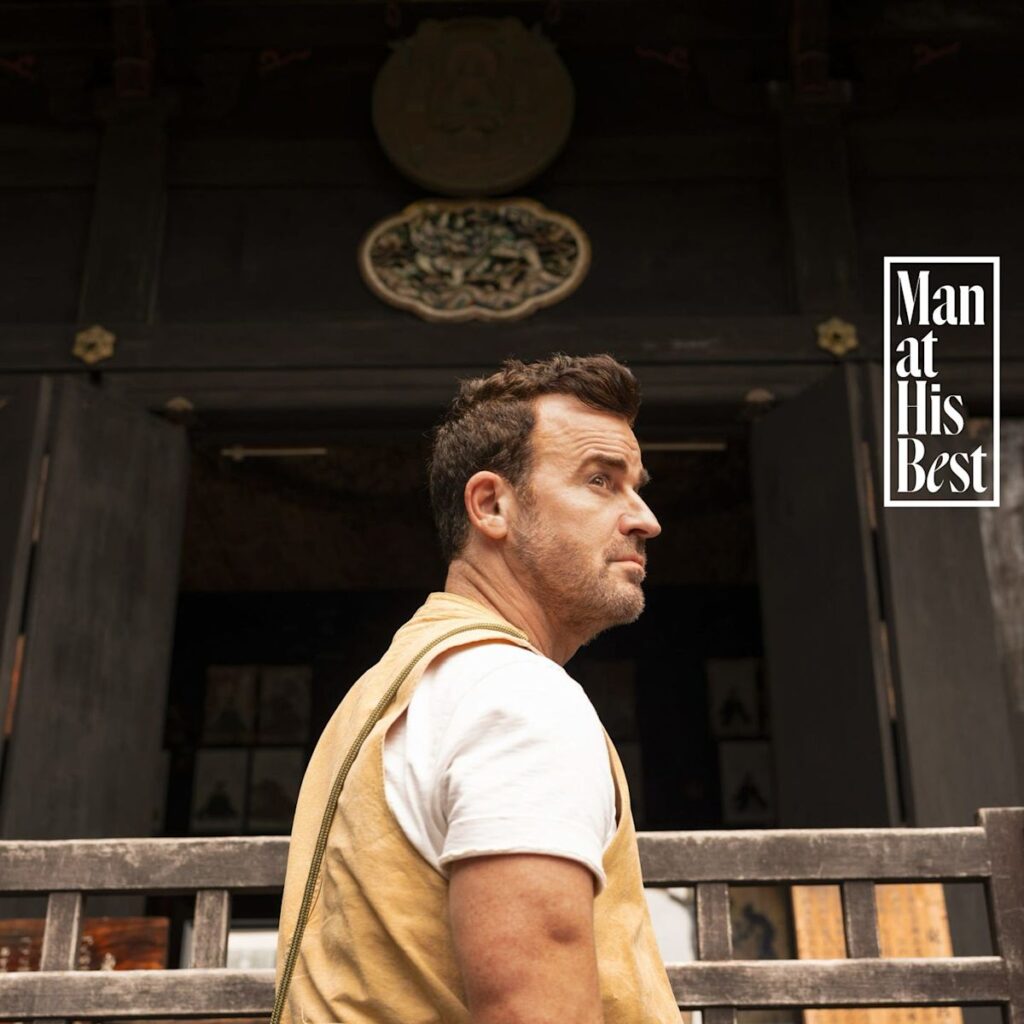
“Book your tickets, plan a couple highlights, but leave a good 40 to 60 percent for improvisation—saying yes to things you wouldn’t normally say yes to,” says Justin Theroux, pictured here in front of five-star Hotel the Mitsui in Kyoto. “That’s what makes any satisfying travel experience.”JASMIJN VAN BUYTENE
Tourism is hoofing it from place to place, checking boxes. Seen that, did this. But travel, Theroux’s travel, is different. It’s about meeting people, making friends beside the worker at the front desk or the technician at the spa, and engaging with their lives, their realities, on a deeper level.
“Anytime you can have access to something unique or an area of interest—whether that’s craftsmanship, arts, music, dance, knives, enamel ware, things like that—you’re always going to get a little peek into a country or city that you didn’t know existed,” he says.
Like all his endeavors, Theroux’s Japan Expeditions aren’t perfect—if they were, there’d be no reason for visitors to come back—but they’re as close to perfect as it gets.
Advertisement
Advertisement
Both of Justin Theroux’s Tokyo and Kyoto Global Explorer Edits are available for booking on the Luxury Collection Expeditions website. The Tokyo Edit is a day-long experience that costs $9,505, while the Kyoto Edit, also a day-long experience, costs $13,145. That price includes a guest, a one-night hotel stay, a private guide, and transportation.
You Might Also Like
Source link