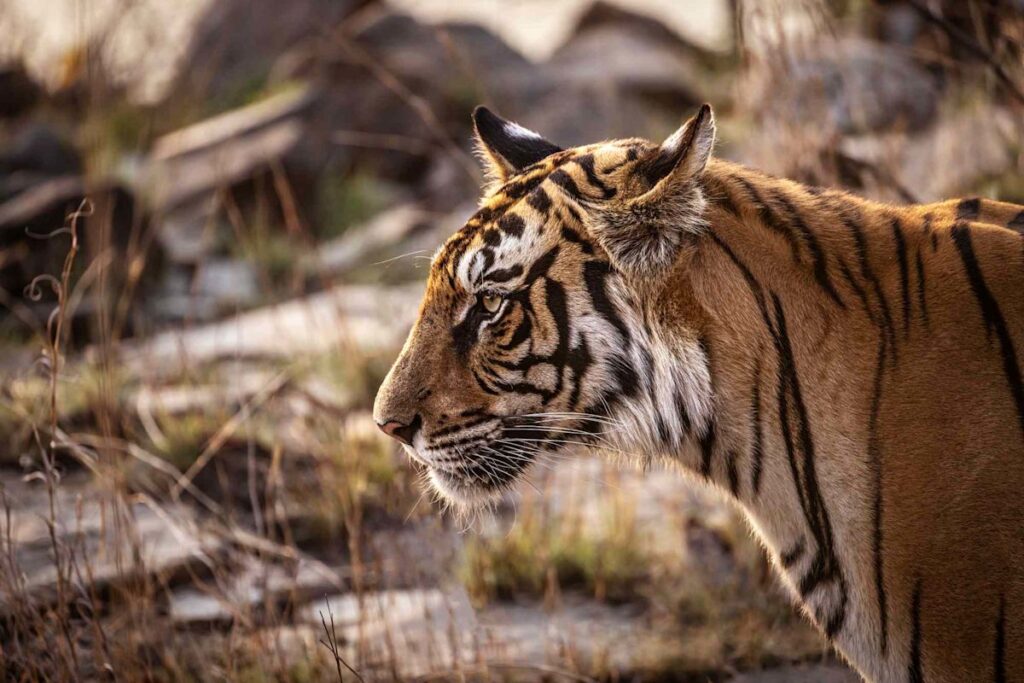


I trained my binoculars on the mouth of the cave. Samrat had disappeared, but Suryanshi Thakur, our naturalist, counseled patience. A moment later the tiger’s front paws emerged, and we watched, awestruck, as he padded slowly out to the rocky ledge, where he locked eyes with us. Then he turned, showing off every stripe along his side, and descended into the gully. Our driver moved the jeep around the point, and Samrat climbed up to a higher ridge. He strolled along parallel to us in full view, shoulders rippling, some 50 feet through the sandy grassland, then dropped down the shady slope.
This was our first extended tiger sighting, at 8:45 a.m. on April 16 at Bandhavgarh Tiger Reserve, in the central Indian state of Madhya Pradesh. Two hours earlier we’d briefly glimpsed the female tiger the rangers call Dotty (for the dots that mark her face), when she and her two cubs bounded across the dirt track in front of our jeep. We’d been actively searching for her; nonetheless her appearance startled us so completely that we simply pointed and gasped, failing to raise our cameras before Dotty and the pair of smaller tigers disappeared into the trees. When I studied my photos that evening, I realized that I’d actually caught two of them, their pale, striped hindquarters perfectly camouflaged by light and shadow.
From left: An assortment of dishes at the Oberoi Vindhyavilas hotel, near Bandhavgarh National Park; a tented suite at the Oberoi Vindhyavilas.
Credit: Aparna Jayakumar/Travel + Leisure
Before, when I pictured tigers in the jungle, I had in mind a thick canopy, the great cats all but invisible behind lush shields of green. But the word jungle derives from the Sanskrit jangala, which refers to a savanna-like terrain more resembling the grasslands of the Serengeti; from there it traces to the Hindi and Urdu jangal, which denotes a forest. And the trick to seeing tigers in an entangled forest is to visit the national parks of Madhya Pradesh in the dry season: less foliage masking their movements; more prey drawn to water, which draws the predators too. So we planned our safari for mid-April, when the temperature in central India rises above 100 degrees in the afternoon (we notched a high of 109) and the tigers, if you’re lucky, move visibly amid the brush and out to the watering holes, streams, and rivers that persist through dry conditions until the monsoon.
Advertisement
Advertisement
I’d landed in New Delhi, via a direct flight from New York City, on the evening of April 13. My brother, Chris, a history teacher and experienced birder with more than 1,100 species on his life list, had already arrived at the Oberoi, New Delhi, as had photographer Aparna Jayakumar, who would be documenting our journey. Both of them packed long lenses, a standard accessory in the world of tiger reserves. I had purchased a point-and-shoot expressly for the occasion.
From left: Local musicians welcome guests at the Oberoi Rajgarh Palace; the lobby of the Oberoi Rajgarh Palace.
Credit: Aparna Jayakumar/Travel + Leisure
In November 2025 the Supreme Court of India banned mobile-phone use by visitors in several of the country’s core tiger-habitat areas, a response to conservationist concerns about jeep traffic (caused by excessive geolocating), noise pollution, and potentially dangerous selfie attempts with animals. As a result, our game drives were welcome throwbacks to a time before humans became their own preferred subjects in the wild. With no phones to tempt us, our focus stayed on the sal trees and clumping bamboo, the storks and flycatchers, the spotted deer and gaur, or Indian bison, and of course the magnificent Bengal tigers. Twice during our game drives we found ourselves holding a tiger’s gaze as it beelined directly toward our jeep, a heart-stopping experience during which the only audible sound was the rhythmic whirring of our camera shutters, a substitute for breath.
At Indira Gandhi airport in New Delhi, I was met by Puneet Dan, our guide for the duration of our trip and an experienced tiger hand; he’s seen more than a hundred in his 25-plus years working for Micato Safaris. We drove through the city’s dark, leafy streets, and my fatigue from the flight was counterbalanced by delight at the familiar sounds and scents of India: the chatty, high-pitched beeps of auto-rickshaws (in India, vehicle horns are deployed conversationally, not aggressively) and the smoky tinge to the air. I first came to India as an infant, when my mother brought me and my older sister to her childhood home in Bombay. Our family visited annually for a decade, until the sudden onset of severe asthma knocked me out of the regular rotation. More recently, having outgrown the asthma, I had toured Rajasthan.
From left: Sandstone carvings on the exterior of a Khajuraho temple; the red sandstone gateways of Agra Fort.
Credit: Aparna Jayakumar/Travel + Leisure
Now I was back for another adventure, this time with my brother, who hadn’t been to India for more than 20 years. I was excited for time with Chris, for tigers and birds (having begun birding a few weeks earlier, I was the proud owner of a new pair of Nikon Monarch binoculars), and for the chance to see a part of India I’d only read about in The Jungle Book. The Micato team, longtime safari experts who place a premium on comfort and attention to detail, had stocked our room in New Delhi with supplies for the journey ahead: a handheld chargeable fan, insect repellent, brightly colored quilted tote bags, and an updated itinerary for our trip. It combined two days each at two tiger reserves, Bandhavgarh and Panna, with visits to the famed temple complex of Khajuraho, a stop at the magnificent Orchha palaces and fort, and, to cap it off, a night at the Oberoi Amarvilas, Agra and a sunrise viewing of the Taj Mahal.
Advertisement
Advertisement
The following evening found us seated in the library at the Oberoi Vindhyavilas, Bandhavgarh as Suryanshi Thakur, one of the hotel’s superlative team, projected a map of Madhya Pradesh onto a large screen. The tigers can cross from park to park, she explained, gesturing toward the nine reserves scattered throughout the southern and eastern quadrants of the state. Male tigers, highly territorial, require some 20 to 25 square miles of their own, so young males must often travel far to establish new turf. Bandhavgarh, with a total area of nearly 600 square miles, is home to around 160 tigers (only a fraction is open to tourists).
A jungle babbler in Bandhavgarh National Park, in Madhya Pradesh, India.
Credit: Aparna Jayakumar/Travel + Leisure
The crescent moon was still up when we left our rooms at five the next morning, the temperature a comfortable 70-something degrees. After coffee and a slice of tea cake at the bar, we were on our way, riding in our van to the Khitauli section of the park, where we’d transfer to an open jeep. We drove through the still mostly sleeping village of Tala, dodging a stone-colored cow meandering across the road and passing a clutch of black-faced langurs and spotted deer. Women in saris crouched at the roots of a mahua tree, bathed in rosy light as they gathered the scented flowers, which they would dry and use for a local alcoholic drink.
Before we even pulled through the Khitauli gate, we spotted an orange-headed thrush on the ground among the sal trees. From then on, our first hour in the park was a festival of birds, so enticing that not even the lure of big cats could prevent me and Chris from stopping and exclaiming over each one. I scribbled a list as we went: a prehistoric-looking lesser adjutant stork; a black-crested Indian paradise flycatcher; a resplendent jewel-toned Indian peacock; a red-wattled lapwing on spindly legs; an Indian roller with spectacular Tiffany-blue markings on its wings. I spotted a pair of Asian green bee-eaters high up in the trees—feathery lime-hued bodies with rust-colored crowns and chic black eye masks. A white-throated kingfisher silhouetted on a high branch showed off its jungle kill, holding a lizard in its beak and smacking it mercilessly against the tree.
From left: The marble façade of the Taj Mahal at morning; the entrance to the Oberoi Amarvilas, Agra.
Credit: Aparna Jayakumar/Travel + Leisure
We stopped at 8:30 to eat our picnic breakfast, spread out on the hood of the jeep: masala tea, watermelon juice, chia pudding, bananas, cheese, and dried fruit. By the time we set off again the sun had become noticeably stronger, the birdsong quieter. And then, suddenly, an electrifying sequence of events: alarm calls—the vocal signals from deer and monkeys that warn of a threat nearby—followed by an abrupt turn of the jeep and a bumpy drive, like a cross between riding a roller coaster and galloping on a horse, to a little road where half a dozen other vehicles were already stopped. With his bird-spotter’s eye, Chris located the tiger first. We moved forward and I glimpsed her through the trees, the curve of her body graceful as she walked farther away.
Advertisement
Advertisement
For our second day of game drives at Bandhavgarh, Thakur joined us, and she turned out to be a lucky charm, leading us first to Dotty and then to Samrat. That afternoon, back at the hotel, I asked her how she’d come to her profession. She told me she’d grown up near the Kanha tiger reserve in southern Madhya Pradesh and nurtured a childhood love of snakes. After earning undergraduate and master’s degrees in environmental studies, she took a certification course to qualify as a naturalist. This was her second year at Bandhavgarh.
A mahout guides his elephant alongside wildlife watchers in Bandhavgarh.
Credit: Aparna Jayakumar/Travel + Leisure
When she talked about the park’s tigers, it was as if she was describing a beloved branch of her own family tree, although one containing particularly spicy relationships. (Just get her on the subject of Bajrang’s son making a move on his father’s old girlfriend.) “We do a lot of gossip about the tigers,” she said with a smile—but it’s all in the interest of learning their patterns and personalities. If she had seemed to manifest Samrat prowling through the jungle and emerging from that cave, perfectly framed by yellow-green sal leaves, that was because she and the other naturalists had been observing him carefully over the previous couple of weeks as he and a powerful rival male vied over territory, motivating Samrat to cover more ground. There’s luck involved in spotting a tiger, but more important, there’s tenacity and expertise.
“We are just like storytellers,” Thakur said of her work. She sounded a note about the tigers that would be repeated by all the naturalists we encountered: “The moment we think that now we know them,” she said, “they’ll just do something surprising.”
Two days in the jungle and we were addicted. What would the tigers do next? Perhaps to keep us from going off the deep end, our itinerary steered us next toward a stationary destination: the UNESCO World Heritage site of Khajuraho, a temple complex dating to the 10th century.
A pool suite at the Oberoi Rajgarh Palace.
Credit: Aparna Jayakumar/Travel + Leisure
A five-hour drive brought us to the Oberoi Rajgarh Palace, Khajuraho, an exquisitely renovated former fortress turned royal residence, dating from the Rajput rulers of the 17th century, that sits in the Maniyagarh hills overlooking the valley of Khajuraho and Panna National Park. If the Vindhyavilas resort channels the luxury safari experience in close communion with nature—a lodge house, airy tents that open onto private yards and patios, and a peaceful landscape of native trees and soft blue-green grasses—the Rajgarh reflects the Oberoi tradition of grand, architecturally ambitious properties, in this case with an impressive layer of history. With its cascading terraces, ornate turrets, latticed balconies, and intricately carved arches framing the view, the palace has been retrofitted to make guests feel like a rajah or rani, but with all the modern conveniences.
Advertisement
Advertisement
Like tiger-spotting, temple-viewing rewards early risers. The next morning, we entered the Khajuraho complex at six sharp. Most of the temples face east, and the imposing Lakshmana Temple was designed so that the sun’s first rays fall on the feet of the statue of Vishnu that presides over its inner sanctum. Our guide, Dhirendra Singh “D. S.” Rajput, who has been leading tours of Khajuraho and the region for 38 years, showed us scenes from Hindu life carved on the temple’s outer walls: a woman wringing water from her freshly washed hair as a swan at her feet swallows the drops; a married woman applying red powder to the part along her scalp. Below these were the famed erotic sculptures depicting scenes from the Kama Sutra. Rajput flashed his laser pointer at them, cheerfully noting, “Nothing to explain!” In context, they do read like a natural extension of the vitality that characterizes all the sandstone carvings. Rajput reminded us that Hinduism is a way of life, hence the broad range of secular human activity depicted alongside the gods on the temple’s outside walls, while the interiors are reserved for spirituality.
From left: Langurs in Bandhavgarh National Park, in Madhya Pradesh, India; tigers in late afternoon at Panna.
Credit: Aparna Jayakumar/Travel + Leisure
In the village of Khajuraho, we visited an artist named Dinesh Singh who practices a folk-art painting style called gond. Local flora and fauna are depicted in bold strokes and bright colors, their outlines filled in with graphic patterns. Singh showed us his playful compositions of birds with big round eyes perched on green trees; a peacock and its long tail; a flying elephant, patterned in oranges, pinks, and yellows against a baby-blue background. His daughter-in-law brought tea, and we admired the work of his late father, who painted in the miniature style. Chris and I both left with a small gond painting each—I got the flying elephant—carefully rolled and wrapped in newspaper.
Back at the hotel’s lakeside restaurant, Neerangan, for a late breakfast, we shared dosas, coin-size idli—tangy South Indian rice cakes—and keema seviayaan, a fried egg over vermicelli mixed with spicy chicken mince, plus a selection of delectable pastries. The morning safari-goers trickled in, reporting their sightings. Tomorrow we would return to the hunt. We spent the next hour and a half with Deepkul Chhetri, the Rajgarh’s head naturalist, who walked us through the history of the tiger in India and its revival at Panna National Park.
A covered walkway at the Oberoi Rajgarh Palace, Khajuraho, near Panna.
Credit: Aparna Jayakumar/Travel + Leisure
A century ago, India had an estimated 40,000 to 50,000 tigers. But as its human population exploded in the 20th century, the tigers, which require so much territory to thrive, were squeezed out. In 1972, with the numbers reduced to a mere 1,800, Prime Minister Indira Gandhi pushed forward the Wild Life Protection Act, banning the hunting of endangered species and laying a foundation for a wider network of national parks. The following year she launched the conservation initiative Project Tiger, focused specifically on saving the animal emblematic of India. Still, by 2006 the national count dropped to an all-time low of 1,411. And at Panna in 2009, the official number hit zero.
From left: Artist Dinesh Singh points out details on a traditional gond painting; local women walk toward a sacred river ghat for a ritual bath, on a road between Khajuraho and Orchha, India.
Credit: Aparna Jayakumar/Travel + Leisure
The shock of the tiger’s disappearance from Panna led to changes in the ministry in charge of forestry, designed to foster a mutually beneficial ecosystem that included the people who were long accustomed to living cheek-by-jowl with the jungle’s top predator. Decades ago, even a small payoff made it worth the risk of fines or imprisonment for local villagers to poach tigers. Now local residents drive safari vehicles and staff the park lodges; their prosperity is tied to the tiger’s survival. Friction still arises from villagers and tigers occupying the same area—humans, too, are territorial, and understandably reluctant to cede land and livelihoods that have run in families for generations for the creation of tiger sanctuaries. Poaching tigers carries serious penalties, of course; on the other hand, the government swiftly recompenses livestock deaths caused by wild animals.
The author (right); her brother, Chris; and naturalist Deepkul Chhetri scan the cliffs of Panna National Park in Madhya Pradesh, India, for birds.
Credit: Aparna Jayakumar/Travel + Leisure
Advertisement
Advertisement
To resurrect its tiger population, Panna imported a female tiger from Bandhavgarh. She was called T1, T for “translocated.” A second female tiger, T2, came from Kanha, and then T3, a male, from Pench on the Maharashtra border. Tigers have a short gestation period, about 100 days, which helped facilitate the rapid rise of new generations at Panna. That said, there is a cap: because of the space tigers require, the most that modern India, a nation of nearly 1.5 billion people, can sustain will number only in the thousands. A census is taken every four years, using a mix of foot surveys, camera traps, habitat studies, and other data analysis. The 2022 report estimated a minimum of 3,167. Results from this year’s census are due in 2027. In the meantime, according to Chhetri, all of Panna’s wildlife is thriving, with more than 200 leopards, 80 sloth bears, and 70 tigers.
The Oberoi Rajgarh Palace, Khajuraho, set in the Panna forest of Madhya Pradesh, India.
Credit: Aparna Jayakumar/Travel + Leisure
Panna means “emerald” in Sanskrit, and Chhetri assured us that in the fall, right after monsoon season, the park more closely evokes its name, with a broad-leaved canopy. The forest, much of it teak, looked dry and brown from the terraces of the Oberoi, but once there, we were struck by the verdant grasses and low trees along the banks of the Ken River. Chris and I added new birds to our lists: an Asian openbill stork by the water; multiple species of vulture roosting on the ledges of a massive cliffside; a shy brown painted spurfowl, stippled with white spots, in the waterlogged undergrowth near a little dam; and a crested honey buzzard, circling high overhead. We saw a delicate Indian gazelle stepping out of the shadows, and a pair of jackals cooling off in the muddy banks of a watering hole.
And we saw tigers. As we drove up to a high plateau for our first Panna sunrise, masks on to keep the red, iron-rich dust out of our lungs, Chhetri cupped his hand to his ear: “The jungle is telling us something. Let’s follow the jungle’s call.” With every new sighting—our final tally reached 13—we appreciated even more the quiet focus of that listening, the adrenaline rush of the chase, and the thrill of finding the tiger, or letting the tiger find us.
I wouldn’t have thought to link our exhilarating game drives with a mellow stroll at sunrise around a wonder of the modern world. But like our tigers, the Taj Mahal mesmerizes from every angle. Even as a teenager on a family trip in the 1980s, I recall marveling at how it seemed to hang suspended from the sky. Now, as the rising sun illuminated Moghul emperor Shah Jahan’s marble memorial to his wife Mumtaz, who died in 1631, every new view required another burst of appreciation. The legacy of Shah Jahan himself was utter chaos—I won’t rehearse it here—but the monument he left radiates solidity, calm, and peace.
Advertisement
Advertisement
The Yamuna River flows behind the Taj Mahal, and our guide Puneet, who grew up in Agra, had mentioned that it could be an excellent site for birding. So Chris and I brought our binoculars along; we used them to identify a river lapwing and a black-headed ibis in the Yamuna’s shallows, but we also scored a closer look at the inlay patterns and calligraphy that adorn the Taj’s façade, all the way up to its domed roof.
I remembered something Thakur had told me about dream sightings. All the naturalists have them, she said—a set-piece vision of a tiger in a particular place, doing a particular thing. We had joked during our trip that the bar for Aparna’s photographs rose higher with every triumphant sighting. At first it was satisfying enough to see a tiger in the distance. Then we wanted a close-up. Eye contact. A mother with cubs, a tiger bathing, a male making a kill.
From left: Intricate stone sculptures at the Khajuraho temple complex; the entrance to Orchha’s central fort.
Credit: Aparna Jayakumar/Travel + Leisure
The truth is that any view of a tiger in its natural habitat is a dream come true. But at the end of our final afternoon drive at Panna, we were granted a magical last sighting. We had parked a little ways up from the banks of the Ken, where the water ran in rivulets around islands of grasses and stone. A female tiger, P151, was crossing the river to the far side with her adolescent cubs. The pair, around 14 or 15 months old, cavorted midstream, climbing on rocks, separating and racing. Occasionally their mother, walking ahead, glanced back to check on their progress.
We watched them quietly for 45 minutes, losing and finding them with our binoculars as they strolled along the opposite bank. The sun slid through a layer of low clouds, the water reflected its buttery glow, and the greens, grays, and browns of the landscape faded into the muted tones of dusk. It grew too dark for pictures. Three tigers disappeared noiselessly into the trees. The light was nearly gone, and it was time to go home.
Micato Safaris can organize a 15-day guided itinerary through Madhya Pradesh, as well as the city of Jaipur in neighboring Rajasthan.
Read the original article on Travel & Leisure
Source link