


Fifteen-minute circuits built around fundamental movement patterns deliver serious strength gains with consistency. (Rachel MacPherson)
Short on time but know you should be lifting weights? That’s no longer a valid excuse! Research indicates that even small amounts of weekly resistance training correlate to lower mortality rates and reduced risk of heart disease and cancer. The most significant health gains occur at around 1 hour (total!) per week.
If you’re tight on time, just 15 minutes of lifting done four days per week will get you there. Short, focused sessions are a great alternative to longer workouts — especially if you tend to skip the gym when life gets hectic (a simple desk-side gym set-up makes this even easier). The key with these short “exercise snacks” is choosing exercises that deliver maximum impact. “Fifteen minutes is enough to meaningfully move the needle if you choose the right patterns,” says Devin Trachman, clinic director and physical therapist at Physical Therapy Central. “In a short session, I’m always thinking in movement patterns, not random exercises, so you get the biggest return on investment for strength, mobility, posture and long-term joint health.”
Full-body moves are better than small isolation work because they train more muscle in every rep. “With clients who only have 15 minutes, we focus on big compound moves because they work multiple muscles at once and are incredibly efficient for building strength and burning calories,” says Cori Lefkowith, trainer, fitness influencer and founder of Redefining Strength.
As a certified strength coach who’s designed countless efficient workouts for busy clients, my top recommendation is prioritizing quality reps over rushing through movements. The 15-minute routines below are built around the four foundational movement patterns experts recommend. I’ve structured them with circuits and intervals that keep intensity high without compromising form. You’ll find complete workouts based on this movement-pattern approach, designed with input from Trachman, Lefkowith, Sierra Baker, a certified personal trainer and Lara Heimann, physical therapist and yoga instructor
How to get started with 15-minute, full-body workouts
Structure your session around four essential movement patterns. These engage multiple joints and muscle groups simultaneously, creating greater calorie burn and muscle activation than exercises that work just one muscle at a time:
-
Hinge: Works your glutes (buttocks) and hamstrings (muscles running down the back of your thighs). This pattern mimics real-life actions, such as bending over and lifting things. Examples include deadlifts and Romanian deadlifts.
-
Squat: Develops leg and core strength for daily activities such as getting into and out of a chair, standing up and climbing stairs. Squat movements strengthen your quads (front thighs), glutes and core muscles that stabilize your spine.
-
Push: Strengthens your chest, shoulders and triceps (muscles on the back of your upper arms) while requiring core engagement to maintain stability. This mirrors pushing movements like opening heavy doors or lifting objects overhead. Examples include push-ups and overhead presses.
-
Pull: Targets your upper back muscles and biceps (front of upper arms), helping reverse the hunched-forward posture common from desk work and phone use. Pull movements include rows and pull-downs, similar to pulling open a door or starting a lawnmower.
To incorporate all four patterns within 15 minutes, organize them as a circuit. A circuit means performing one exercise after another with minimal rest, allowing one muscle group to recover while another works. Here’s how to structure it based on your experience level:
Beginner: Set a 15-minute timer. Work through each exercise for 40 seconds, rest 20 seconds, then transition to the next move. Once you’ve completed all four exercises, you’ve finished one round. Aim to complete 2 to 3 rounds total. Begin with lighter weights or no weight at all, and modify exercises as needed to match your current ability. Push-ups can be done against a bench or kitchen counter to make them easier, and resistance bands work great as a substitute for dumbbells in rowing movements. Prioritize controlled, deliberate form over moving too quickly.
Intermediate: Complete 8 to 12 repetitions of each exercise, rest briefly for about 15 to 30 seconds or just long enough to transition and prepare, then move to the next exercise. Aim for 3 complete rounds through all four movements. Select weights that make your final 2 to 3 reps feel challenging — around a 7 or 8 on a difficulty scale of 1 to 10 — while still being able to perform 1 to 3 additional reps with good form, if needed.
Advanced: Perform 6 to 8 repetitions using heavier weights, taking brief rest periods of 20 to 30 seconds between movements. Aim for 3 to 4 complete rounds. For an extra challenge without adding time, slow down your movement speed during the final round. Taking 3 to 4 seconds to lower the weights makes the exercises significantly harder and creates greater muscle-building stimulus.
Tips for maximizing your 15-minute sessions
-
Keep your warm-up simple. Spend 2 to 3 minutes doing easy movements like marching in place, a few bodyweight squats and arm circles. This prepares your joints and muscles for the more challenging work ahead without cutting into your workout time.
-
Choose weights that feel challenging but manageable. If you finish a set thinking you could easily do 10 more reps, the weight is too light, so go heavier next time. Focus on moving with control and proper form rather than racing through messy repetitions just to finish faster. Quality matters more than speed.
-
When the workout starts feeling too easy, progress gradually. Add a little more weight, take shorter rest breaks or complete an additional round. Don’t change everything at once, as small adjustments lead to sustainable progress. Aim to complete this 15-minute circuit two to four times per week. On days when you have extra time, add walking, stretching or longer strength-training sessions.
1. Dumbbell or kettlebell Romanian deadlift
The stiff leg deadlift (also known as the Romanian deadlift) is one of the highest-yield moves you can do in a short session, says Trachman. “It trains your hamstrings and glutes, which support your spine, and reinforces a strong hip hinge pattern that protects your back in daily life.”
Starting from a standing position and lowering the weight makes this version easier on your lower back than deadlifts that begin with the weight on the floor. Holding dumbbells or kettlebells at your sides keeps the load centered over your body, which research shows reduces sideways stress (spinal shear) on your lower back while still challenging your hamstrings and glutes. You’ll also strengthen your grip and core as you control the weight’s descent without using a barbell.
Choose a weight heavy enough to feel challenging toward the end of your set, but light enough that you can keep your back flat and initiate the movement from your hips, not your lower back.
How to do it
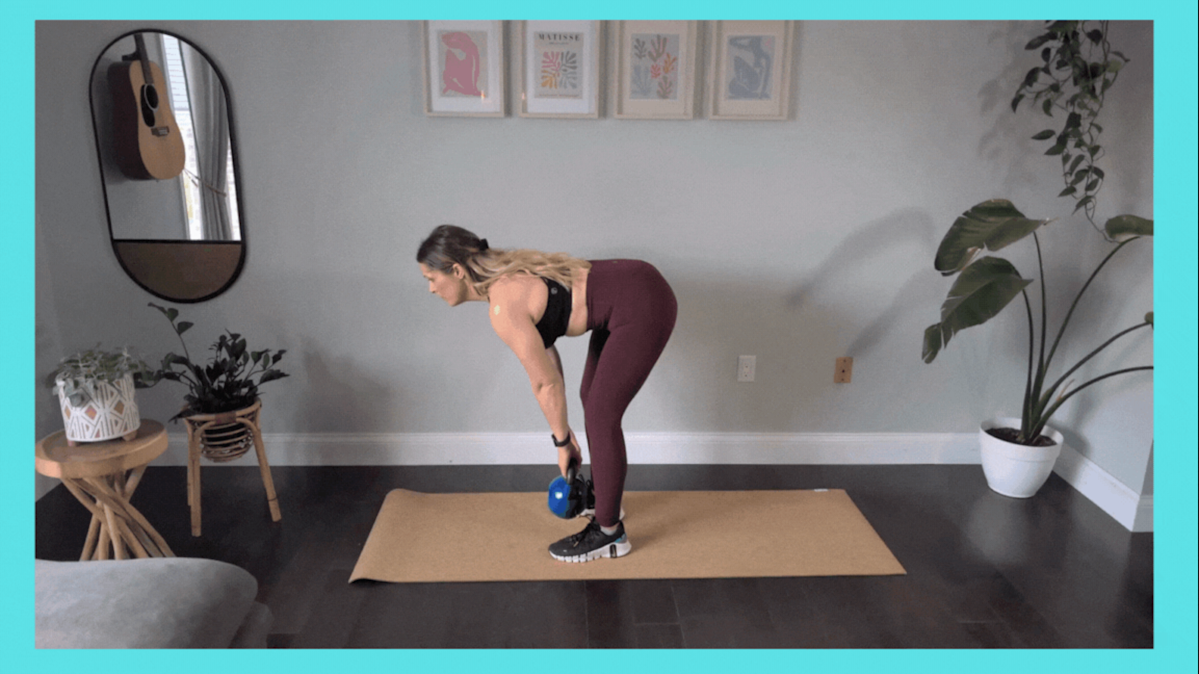
Strengthen your hamstrings and glutes with this dumbbell move. (Rachel MacPherson)
-
Stand with your feet about hip-width apart. Hold a dumbbell in each hand, or a kettlebell in both hands, in front of your thighs, letting your arms hang straight down.
-
Create a slight bend in your knees so they’re not locked straight. Tighten your abdominal muscles and pull your shoulder blades together to keep your chest lifted and open.
-
Press your hips straight backward, as if you’re trying to close a car door with your butt. Keep the weights traveling close to the front of your legs. As your hips move back, your upper body will naturally tilt forward.
-
Continue lowering the weights as you hinge forward. Imagine you’re painting a stripe down the front of your shins and thighs. Keep going until you feel a strong stretch in your hamstrings, the muscles running down the back of your thighs, or until your torso is roughly parallel to the floor. Keep your back flat or maintain a slight arch — never let your spine round forward.
-
Push your feet firmly into the ground, squeeze your glutes hard and drive your hips forward to stand back up to the starting position.
-
Pause briefly at the top to reset your posture with your shoulders back and your core tight, then repeat for the next rep.
2. Goblet squat
“Goblet squats are a simple way to load the squat pattern without needing a barbell setup,” says Lefkowith. “You’re strengthening your quads, glutes and core while practicing the kind of sit-down, stand-up pattern you use every day.” In other words, this exercise mimics the movement you do when sitting in a chair and standing back up, making it highly practical for daily life.
Holding a single weight in front of your chest with both hands also encourages you to keep your torso more upright compared to other squat variations. This upright position can feel easier on your back and helps you squat deeper with better stability, even if you have limited ankle flexibility. If you’re new to squatting, start with a lighter weight or just your body weight, and place a box or chair behind you as a depth target. Lightly touching the box before standing back up helps build confidence and teaches you how low to go.
When you hold the weight at chest level, it encourages you to stay more upright, which is generally easier on your lower back and lets you squat to greater depth with better stability, even if your ankles are stiff. If squatting is new to you, begin with a light dumbbell or no weight. Set a box or chair behind you as a target point. Aiming to touch it with your glutes helps you understand how deep to squat and builds confidence in the movement. While our video demonstrates the movement while standing on wedges, you can perform the exercise with your feet flat on the floor.
How to do it
The goblet squat is a great way to add weight to your squat while prioritizing form. (Rachel MacPherson)
-
Stand with your feet positioned about shoulder-width apart. Turn your toes out slightly, around 15 to 30 degrees, if that feels more comfortable for your hips.
-
Hold a dumbbell vertically by one end at chest height, or cradle a kettlebell upside down at your chest. Keep your elbows pointed downward and close to your body. Your ribcage should stay aligned directly above your hips, not thrusting forward.
-
Tighten your abdominal muscles by bracing your core. Keep your chest lifted and proud.
-
Sit your hips down and slightly backward and begin bending your knees. Your knees should track in the same direction as your toes. Imagine dropping your hips straight down between your heels rather than leaning your torso forward.
-
Continue descending until your thighs are at least parallel to the ground, or go as deep as you can while keeping your heels flat on the floor (or on your wedges) and your spine neutral, without rounding.
-
Push through your entire foot, not just your toes or heels, to stand back up. Squeeze your glutes at the top of the movement, but don’t lean your torso backward.
-
Pause briefly to reset your posture with chest tall and core braced, then perform the next repetition.
3. Chest-supported dumbbell row or banded row
Rowing movements are the antidote to poor posture caused by modern life. “A horizontal pulling pattern is essential for counteracting all the time we spend rounded over phones and laptops,” says Heimann. “Rows strengthen your upper back and help organize the shoulder blades so your posture feels more supported.” These exercises train the muscles that pull your shoulder blades back and together, reversing the hunched-forward position you can develop from desk work and screen time.
A chest-supported row uses an incline weight bench to support your torso, taking strain off your lower back and allowing you to focus solely on pulling with your upper back muscles while squeezing your shoulder blades together. If you don’t have access to a bench, a banded row works just as well. Loop a resistance band around a stable anchor point at chest height and pull it toward you. Choose a weight or band resistance that lets you feel your mid-back muscles, the area between your shoulder blades, doing the work rather than straining your neck or relying on your lower back.
How to do a supported one-arm dumbbell row
Help even out muscle imbalances by targeting one side of your body at a time. (Rachel MacPherson)
-
Set your adjustable bench to a low incline, about 30 to 45 degrees. Kneel on the bench with one knee while placing the hand from the same side against the top of the bench for support. Your other foot stays on the floor for balance.
-
Hold a dumbbell in your free hand with your arm hanging straight down toward the floor, palm facing your body.
-
Tighten your core muscles and begin the movement by pulling your shoulder blade on the working side back and down, not just bending your elbow.
-
Keeping your elbow close to your side rather than flaring out, bend your arm and pull the dumbbell up toward your lower ribcage. Think about driving your elbow back behind you.
-
Pause briefly at the top with the weight near your ribs and your shoulder blade squeezed back, then lower it back down in a controlled manner until your arm is fully straight and you feel a stretch across your upper back.
-
Complete all reps on one side, then switch to the other arm.
How to do a banded row
_(10).gif)
Strengthen your upper back with this resistance band exercise. (Rachel MacPherson)
This exercise can be performed seated (as shown), kneeling or standing. These instructions detail how to perform the exercise while standing.
-
Secure a long resistance band around a stable anchor at roughly belly-button to mid-chest height. Use something solid like a weight rack post or specialized door anchor attachment.
-
Face the anchor point and hold one handle or the end of the band in each hand. Extend both arms straight out in front of your body at approximately shoulder level, palms turned inward, facing each other.
-
Step or walk backward until the band has mild tension throughout, eliminating any slack. Stand with a small bend in your knees, not locked straight, and engage your abdominal muscles by bracing your core.
-
Begin the pull by retracting your shoulder blades, pulling them back and downward first. Then bend your elbows to pull the band handles toward the lower part of your ribcage, keeping your elbows close to your torso.
-
Hold briefly at the completion of the pull, then consciously squeeze the space between your shoulder blades. Reverse the movement by slowly straightening your arms back to the extended starting position while controlling the band’s resistance.
-
Repeat for your target number of reps.
4. Incline push-up or dumbbell chest press
“Push-ups and presses train your chest, shoulders, triceps and core all at once,” says Baker. “If you only have a few moves to work with, that kind of high muscle recruitment gives you a much bigger total-body stimulus than smaller isolation exercises.” This means instead of working just one muscle in isolation, these pressing movements activate several major muscle groups together, creating a greater overall training effect in less time.
An incline push-up is performed with your hands elevated on a raised surface such as a weight bench, while your feet remain on the ground. This angle reduces the weight you need to lift, making the movement more manageable if regular floor push-ups are beyond your current strength level. You can make the exercise harder over time by gradually lowering the surface height and eventually adding a weighted vest for additional resistance.
The dumbbell chest press is an alternative pressing movement where you lie flat on your back on a bench holding a dumbbell in each hand at chest level, then press them upward until your arms are extended. It allows you to precisely control the weight load and works well with a basic flat or incline bench. Choose dumbbells that feel demanding during your last two repetitions while still enabling you to lower them smoothly and with complete control.
How to do an incline push-up
.gif)
The inclined position makes this move easier … but adding a weighted vest makes it harder. (Rachel MacPherson)
-
Stand facing a sturdy, stable surface like a workout bench. Place both hands on the edge of the surface, slightly wider than shoulder-width apart, with your fingers pointing straight forward.
-
Walk your feet backward away from the surface until your body forms a straight diagonal line from the top of your head down through your heels. Your body should look like a plank angled upward. Tighten your abdominal muscles and squeeze your glutes to prevent your hips from sagging downward.
-
Bend your elbows to lower your chest toward the edge of the surface. Keep your elbows at roughly a 45-degree angle from your torso, not flaring straight out to the sides or tucking tight against your ribs. Your entire body should move as one rigid unit, like a plank tilting down.
-
Continue lowering until your chest nearly touches the surface or you feel a mild stretch across your chest muscles.
-
Push firmly through your palms to straighten your arms and press your body back up to the starting position.
-
As your strength improves over time, progress by using progressively lower surfaces, eventually working down to floor-level push-ups.
How to do an incline dumbbell chest press
The incline position targets your chest muscles a little higher than a traditional chest press. (Rachel MacPherson)
-
Set a workout bench to an incline of 30-45 degrees. Lie back on the bench holding a dumbbell in each hand. Position the dumbbells at chest level, elbows bent and slightly below shoulder height, palms facing forward, away from your body.
-
Press your feet flat into the floor and engage your abdominal muscles to prevent your ribcage from flaring upward or arching excessively.
-
Push both dumbbells straight upward over your chest until your arms are nearly fully extended, stopping just short of locking out your elbows. Keep your wrists directly above your elbows throughout the movement, rather than bending backward.
-
Lower the weights back down in a controlled manner until the dumbbells reach the outer edges of your shoulders, or descend as deeply as your shoulder mobility comfortably allows. You should experience a stretching sensation across your chest muscles at the bottom position.
-
Press back up to the starting position.
-
Repeat for your desired number of repetitions.
Our favorite strength training upgrades for your 15-minute workouts
Here are a few of our top picks. See our full list for the best weighted vests, adjustable dumbbells, kettlebells and resistance bands for more editor- and trainer-approved options.
Hyperwear Hyper Vest Elite Weighted Vest
The Hyperwear Hyper Vest Elite is low profile, breathable and highly adjustable, with tiny 2.25-ounce weight increments that let you dial in the load without digging into your shoulders. It comes pre-loaded at 10 pounds in sizes S through XL, and you can choose 15- or 20-pound options with extra weight bricks to progress over time. The stretchy Cordura fabric hugs your torso without restricting movement, and the side bungee straps allow you to personalize the fit for a wide range of body types, whether you’re walking, hiking or doing chores around the house.
Nüobell 580 Adjustable Dumbbells
The Nüobell 580 Adjustable Dumbbells replace up to 16 pairs of traditional dumbbells, with a smooth dial-style handle that shifts the load from 5 to 80 pounds in 5-pound jumps. The knurled aluminum handle offers a secure grip even when your hands are sweaty, and the shorter length at lighter weights makes them feel more like standard dumbbells for presses, rows and curls. While they’re a significant investment and the plate edges can dig into your hands during goblet-grip exercises, the extensive weight range means you won’t outgrow them as your strength increases.
Rep Fitness Adjustable Kettlebell
The Rep Fitness Adjustable Kettlebell comes in three shell sizes: 8 to 16 kilograms, 16 to 24 kilograms or 20 to 40 pounds, each offering five distinct weight settings within a single bell. You adjust the weight by pressing and twisting the top, making it easy to transition between swings, squats and rows without interrupting your workout flow. The internal nylon fastener minimizes plate rattling, the rubber bottom protects flooring and the consistent bell shape feels like more traditional kettlebells. Note that the available weight ranges skew toward heavier weights, so complete beginners may need to start with lighter, standalone kettlebells.
Living Fit Resistance Bands
Living Fit Resistance Bands include six loop bands spanning approximately 5 to 200 pounds of resistance, which can be combined for additional tension as you progress. Lighter bands work well for warm-ups, mobility drills and shoulder exercises, while heavier bands excel for assisted pull-ups or adding resistance to squats, rows and presses using the included door anchor. They’re portable, comfortable to grip and backed by a lifetime warranty. However, the natural latex construction makes them unsuitable for anyone with latex allergies.
FAQs
Can a 15-minute workout be effective?
A 15-minute workout is effective as long as the effort and exercise selection are on point. “Fifteen minutes is enough to meaningfully move the needle if you choose the right patterns,” says Trachman, who builds short sessions around a hinge, squat, push and pull to hit most major muscle groups. Those patterns support strength, mobility, posture and long-term joint health, especially when you repeat them a few times per week. If you lift with focus instead of cruising through easy reps, 15 minutes can be a very productive session.
What is the most effective short workout?
There is no single magic routine, but the experts agree that the best short workouts are full body and built around compound moves. Trachman recommends a circuit that covers four key patterns in one session: hinge, squat, push and pull. Lefkowith leans on moves like squats, lunges, deadlifts, push-ups and rows because they “work multiple muscles at once and are incredibly efficient for building strength and burning calories.” A simple circuit of four compound exercises, done for time or moderate reps (like the workout detailed above), delivers strong results without a long time commitment.
Looking for more ideas? Check out these additional workout routines:
Can I lose weight with 15-minute workouts?
Short workouts can support weight loss by helping you build and maintain muscle, burn extra calories and stay more consistent, which matters more than chasing perfect long sessions. Lefkowith points out that big compound moves are efficient for building strength and burning calories, which matters especially when time is limited. These sessions still have to feel challenging, and weight loss will depend on overall habits, including nutrition, sleep and daily activity. For many people, actually completing 15 focused minutes of exercise beats skipping workouts entirely when a full hour isn’t realistic.
Can you build muscle with a 15-minute workout?
You can build muscle with 15-minute workouts. Muscle growth is achievable in shorter sessions, particularly for beginners or anyone returning to training after time off, as long as the intensity is sufficient and you train consistently throughout the week. Trachman recommends that advanced lifters use heavier weights with lower repetition ranges, emphasizing controlled, high-quality reps rather than rushing through movements to beat the timer. Baker favors heavy compound lifts like squats, presses, deadlifts and pull-ups because they activate a large volume of muscle fibers simultaneously and deliver a strong muscle-building stimulus in a condensed timeframe. Performing a focused 15-minute circuit two to four times weekly with progressive overload — gradually increasing weight, reps or difficulty — can effectively build muscle.
Meet our experts
-
Sierra Baker, CPT, certified personal trainer at The Pack, a group fitness concept in New York City, who coaches busy clients through efficient full-body strength and conditioning sessions.
-
Lara Heimann, PT, DPT, physical therapist and yoga instructor with an advanced degree in neuroanatomy and creator of the LYT Yoga Method, a movement system that blends physical therapy, yoga, anatomy and kinesiology to support alignment and joint health.
-
Cori Lefkowith, NASM-CPT, trainer, fitness influencer, founder of Redefining Strength and author of The STRONG System: Transform Your Mindset and Build Your Best Body at Any Age.
-
Devin Trachman, PT, DPT, clinic director and physical therapist at Physical Therapy Central in Oklahoma City, specializing in outpatient orthopedics, sports rehab and strength-focused physical therapy.
Our health content is for informational purposes only and is not intended as professional medical advice. Consult a medical professional on questions about your health.