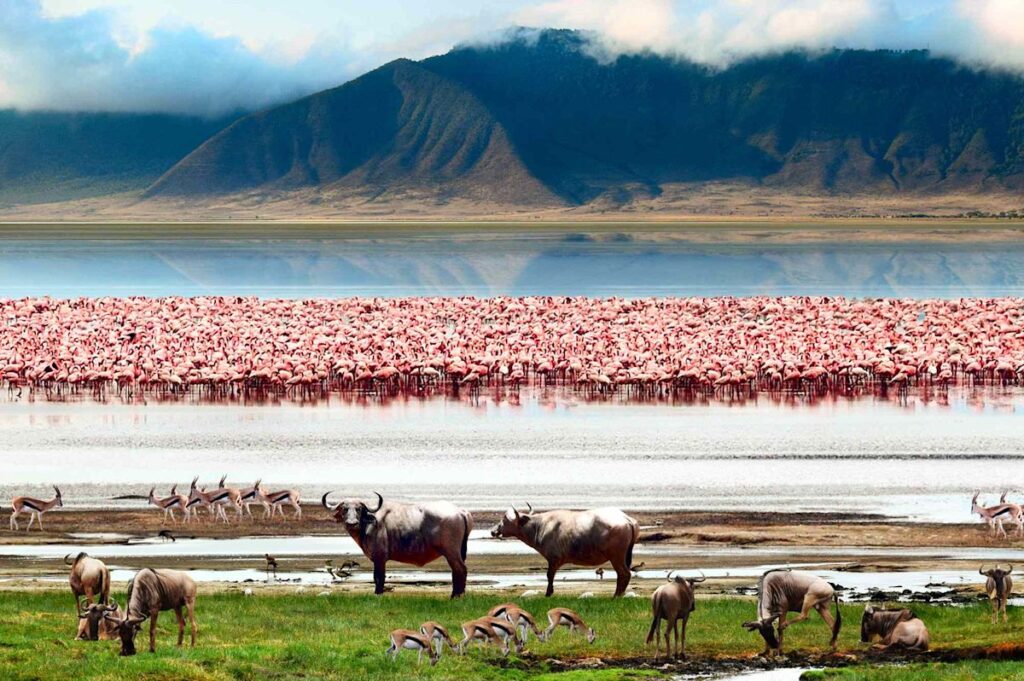
A funny thing happened on our way to the Ngorongoro Crater. The day had dawned cool and clear, anticipation ran high. A UNESCO World Heritage site in Tanzania, the world’s largest inactive caldera shelters within its steep sides an astonishing array of wildlife in a self-contained ecosystem. This dramatic natural stage is a hot spot for viewing the Big 5, the classic safari checklist of animals dating from the colonial-era days of big-game hunting. The Land Cruiser slowed, and our eyes scanned the high grasses for lions, leopards, rhinoceros, elephants, and Cape buffalos.
But George Kamonde, our Micato safari director, instead pointed up at the sky. A black-winged kite hovered, then plunged to earth with deadly precision, grabbing a mouse in its talons. On the lookout for lions, we witnessed a different kind of kill. Another safari vehicle sped past, completely missing the moment. What’s the hurry when a raptor stars in such a gripping natural spectacle?
For many travelers, Tanzania is a bucket-list destination synonymous with the Serengeti’s Great Migration and the perilous wildebeest river crossings. Yet a safari to East Africa can transform unsuspecting travelers into birdwatchers.
Advertisement
Advertisement
“People take these trips for the big mammals,” explained John W. Fitzpatrick, Emeritus Director of the Cornell Lab of Ornithology, “but they come back saying they had no idea how great the birding would be.”
On a family tour with Micato Safaris, named to Travel + Leisure’s Hall of Fame for its 10-year winning streak of World’s Best Safari, our guides opened the doors to an entire bird universe, each species more fascinating than the next.
Take the secretary bird, which Fitzpatrick likens to a “hawk on stilts,” capable of hunting and thrashing venomous snakes. Then there’s the hamerkop, which constructs nests so enormous, they can support the weight of a human. Returning year after year for its home-improvement project, the hamerkop is wildly ambitious when it comes to mansion additions.
Speaking of big, the flightless ostrich is complemented by the kori bustard, the world’s heaviest flying bird, clocking in at 42 pounds. And the lilac-breasted roller, Kenya’s unofficial national bird, “relatively common, yet so spectacular,” explained Fitzpatrick, “is one of the species responsible for turning people into birders.”
Advertisement
Advertisement
Indeed, birdwatching is having a moment. The hobby is witnessing a global surge in popularity, particularly among Millennials and Gen Z, bolstered by the Cornell Lab’s free apps Merlin Bird ID and the citizen-science database eBird.
“Birding becomes accessible—anyone can become an expert,” said Fitzpatrick. Fans embrace the therapeutic, mental-health benefits of connecting with nature.
“Birding is incredibly rewarding,” said Gregg Gorton, a retired academic psychiatrist and former president of the Delaware Valley Ornithological Club. “By seeking birds you are getting out into the world. Whether in a city or in nature, you shift into a more focused and even meditative state of mind. This helps relieve stress, and it also opens doors into other aspects of the living and non-living world, like plants, creatures of all kinds, wind and water, and the whole web of life!”
Of course there’s nothing like seeing big cats in the wild, and Serengeti National Park is renowned as one of the world’s best places to see lions, leopards, and cheetahs. In the Elewana Pioneer Camp, a glorious old-school tented camp that conjures the Hemingway safari era, lions prowl directly outside the camp’s rocky kopje perch. But we also reveled in the birds—the Serengeti is home to 500 recorded avian species.
Advertisement
Advertisement
We gawked at the colorful plumage and affectionate antics of Fischer’s lovebird, an endemic parrot that mates for life, then marveled at the secretary bird’s savannah snake hunt. Overhead the bateleur, a short-tailed eagle named for the French word for “tightrope walker,” appeared to fly backwards because of an optical illusion.
At the Four Seasons Safari Lodge Serengeti, guides from the Discovery Center described the painstaking craftsmanship of the weaver birds knotting and braiding grasses for their hanging nests, which are visible directly from the lodge’s suspended walkways. The artisan-bird often demolishes it if it’s rejected by the courted female.
Vastly underrated, Tarangire National Park is often overlooked in favor of the other destinations on Tanzania’s northern safari circuit. But this bastion of baobab trees and termite mounds is a hot spot for birdwatching. From the hornbills and bee eaters to the flycatchers and kingfishers, it’s an avian extravaganza.
Observing an ostrich pair, I recalled the myriad bird observations of author and naturalist Peter Matthiessen in the acclaimed 1972 book The Tree Where Man Was Born. “Beyond the hills hung the blue haze of Africa, and everywhere were birds,” he wrote. Deeply concerned for the future of the continent’s fragile ecosystems, Matthiessen poetized its wild, awe-inspiring beauty, fearful that the “wild things disappear.”
Advertisement
Advertisement
Today more than a third of Tanzania’s land is protected, and the “ragged kite, with its affinity for man and carrion,” still wheels overhead, one of East Africa’s 100 species of birds of prey.
Read the original article on Travel & Leisure