

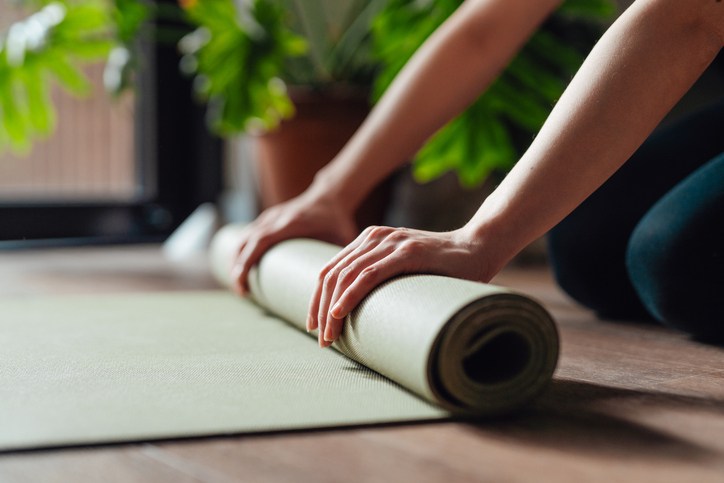
There’s every reason to begin your yoga practice now. A regular practice does more than just make you flexible. Evidence shows it improves strength, balance and sleep while reducing pain and stress levels. It’s truly a powerful way to take control of your health. But some folks feel stuck when it comes to getting on the mat and wonder if it’s really for them.
If you’re worried that you don’t fit the mold, Jessamyn Stanley, online yoga instructor, author and co-founder of The Underbelly, has a simple reality check.”Yoga is for everybody. The only prerequisite is that you can breathe.” To the uninitiated, yoga can seem intimidating — the ancient roots, the multitude of styles, the multisyllabic words, the $200 outfits. But it needn’t be. If 1 in 6 adults in the U.S. can practice yoga, you can too. No initiation or spendy Lululemon apparel required.
You also don’t need a grueling schedule to see results. “Start small! You don’t have to do yoga every darn day to be a good yoga practitioner,” says Ariele Foster, a physical therapist, yoga instructor and the founder of the Yoga Anatomy Academy and Wellilo Clinic.
Ready to start? Yahoo joined forces with Stanley and Foster to answer your biggest questions and help ease you onto the mat.
Choosing the right class
In the West, most physical yoga classes are a form of hatha yoga featuring a series of poses called asanas. Styles of hatha you might see include Ashtanga, vinyasa, Iyengar and power yoga. But don’t worry — you don’t need to know the differences to get started. Our experts have the following tips to help you choose the right class.
-
Start online. Our experts recommend starting with online classes to familiarize yourself with the vocabulary and build confidence in your movements. “Try finding something free on YouTube, Instagram, TikTok,” Stanley says, “or finding a book about yoga and trying out the poses.”
-
Look for beginner-friendly in-person classes. In-person classes can also be great. Foster says, “For physical yoga asana classes, beginners should look first and foremost for welcoming teachers and communities. Classes might be labeled gentle, Yoga 1, beginners, foundations, hatha, etc.”
-
Try what appeals to you and let go of expectations. Stanley is looser about levels: “I don’t think that you have to specifically go to a beginner yoga class. I started with Bikram yoga, which is a very physically challenging style of yoga, and I was almost always the fattest person, very frequently the only Black person. On the surface, you would say a beginner shouldn’t go to that class. Or we tend to think, ‘I need to go where there are people who look like me,’ but I have not found that to be the case. Start wherever you are.” If you feel drawn to a specific class, style or studio, you should feel encouraged to try it. Just chat with the instructor before getting started to let them know you’re new.
-
Consider options for specific needs or populations. There are specialized options if you think you need or want specific support or instruction. For instance, those with limited mobility or balance issues may want to start with chair yoga. If you’re pregnant, stick with prenatal yoga, as the poses are selected for safety reasons. Prefer one-on-one guidance? Consider booking a private session.
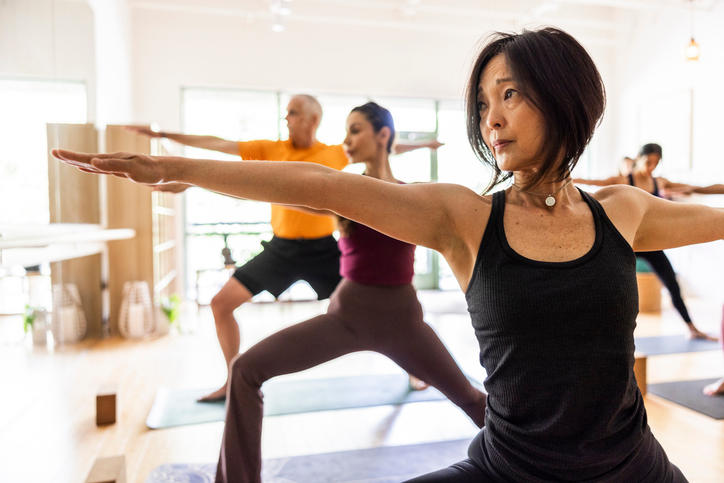
If you can breathe, you can do yoga. No fancy leggings required. (Getty Images)
Preparing for your first yoga class
The right clothing and props can support your practice, but you don’t have to lay out an obscene amount of cash to get started. Let’s be real. Yoga has turned into a multibillion-dollar industry that’ll gladly take your money. However, you likely already have something breathable, flexible and comfortable in your closet that will serve you just fine.
Of course, as your practice grows, you might want to splurge on cute performance gear or props like yoga blocks to help you go deeper. But you don’t need them today. Before your first class, our experts recommend just a few simple preparations.
Select yoga-appropriate clothing
“The most important thing is that you are comfortable. I would not recommend jeans or any stiff fabric,” Stanley says. “I recommend tight-fitting garments. … Baggy clothes can be challenging.” Indeed, a loose, cropped tee is sure to misbehave during downward-facing dog.
Light layers are helpful as your body builds and releases heat. If you have a long-sleeve top over a tank or sports bra, you can simply remove the top layer as your body warms up. You’ll also want to shed those socks once you’re on the mat: “It’s helpful to use the grip of my feet,” Stanley says, and socks without anti-slip features can cause you to slip and slide.
Consider investing in a mat
Yoga mats are designed to provide support during your practice while helping prevent slipping. If you plan to practice at home, it’s a good idea to consider purchasing a mat. Likewise, if you plan to participate in in-studio classes, Foster recommends you bring your own mat and a water bottle. However, if you don’t want to invest in a mat just yet, they’re often available to borrow or rent in-studio — just check with your instructor to see what options you have.
Communicate with your instructor and modify where needed
For in-person classes, arrive early and let your teacher know you’re new to yoga. Notify them of any medical issues or physical limitations you have so they can cue modifications and offer props or alternate poses. For example, if you have glaucoma or are prone to vertigo, you should avoid inversions where you’re positioned upside down, whether that’s in downward-facing dog or a headstand. And pregnant people should skip twists, extreme backbends and forward bending.
“Modifications are for everybody. You taking a modification gives your neighbor permission to also take one,” says Foster. “No single person can do everything. Simone Biles is a GOAT, but even she does not do every single gymnastics move on the planet.”
Stanley agrees: “Always feel comfortable stopping or doing a different posture. Do not submit to the pressure [to do something you aren’t comfortable with]. Listen to your own body. Yoga is inviting you to get to know the teacher in yourself.”
Avoid eating immediately beforehand
Word to the wise: Don’t chow down before you do yoga. “The old advice is don’t eat anything for 2 to 4 hours before practicing yoga asana. That is not always realistic, especially for folks who eat lunch at 12:30 p.m. and then head to yoga class at 6 p.m. Basically, don’t start a physical yoga practice on a full stomach.”
Accept what comes — bodies make noises
Toots happen, joints crack and grunts are unleashed as you twist and turn. So be it. Stanley says, “I recommend farting, burping and making loud sounds. I’m an extremely loud yoga practitioner, and I notice that when I go to classes in person, I’m moaning or yawning and making really big sounds, and no one else in the room is. But I’ve also noted that the teachers often say, ‘Make noise! If you feel uncomfortable in your body, you should make noise.’ So my biggest etiquette point is to make whatever sounds your body wants to make. Do not inhibit your sounds.”
Give yourself room to move
Finding a spot in a crowded class is an art form. You need enough clearance to extend your arms and legs fully without hitting your neighbor. As Stanley puts it, “Don’t set your mat up so closely to somebody that you could kick them.” A good rule of thumb is to stagger your mat. If the person next to you has their mat aligned with a floorboard, move yours up or down a few inches. This ensures you won’t smack hands during a twist or end up with a foot in your face.
Try yoga poses specific to your needs
You don’t even need to sign up for a full class (online or in person) if you don’t think you’re quite ready for it. If you’re looking to ease your way in, start with a few simple poses geared to your specific goals. For instance, I put together poses specific to:
FAQs
Do I need to be flexible to start yoga?
No — flexibility isn’t a requirement. It’s something that often develops after you begin practicing yoga, not before. Many beginners come to yoga feeling stiff, sore or unsure of their bodies, and that’s exactly who the practice is for. “Yoga is about breath, awareness and presence,” says RYT 200 registered yoga teacher Vania Garcia. “If you can breathe, then you can do yoga.” In my experience, students who stop chasing flexibility early on tend to feel more confident and consistent in their practice over time.
What kind of yoga is best for beginners?
That depends less on the style and more on how the class is taught. In general, beginners tend to do well with gentle yoga, hatha, foundations or slow vinyasa, where poses are broken down, and modifications are encouraged. Chair yoga is a great option for people with balance issues, joint pain or limited mobility. That said, some beginners enjoy more athletic styles right away.
Garcia also points out that yoga’s structure itself can be helpful for newcomers. “Most classes begin and end with guided relaxation,” she says, “which helps students associate movement with ease and restoration, not just effort.” That can make returning to class feel less intimidating.
Is yoga good for weight loss or just flexibility?
Yoga is often marketed as a flexibility practice, but it can support your overall health in broader ways and help you maintain a healthy weight. More active styles like Ashtanga build strength and raise your heart rate, while slower practices can help regulate stress and improve sleep, both of which are factors in weight management.
Yoga works best when it’s approached as a long-term, sustainable form of movement, not a quick fix. Many people notice changes over time simply because they’re moving more consistently and tuning into their bodies.
How do I know if I’m doing a pose correctly?
In yoga, “correct” isn’t about how a pose looks — it’s about how it feels in your body. Garcia explains that discomfort and pain aren’t the same thing: “Discomfort might feel like an ache, stretch or mild resistance that remains manageable. Pain tends to feel sharp or intensely distressing and is a signal to stop.” I always tell beginners that using blocks, resting or skipping a pose altogether is part of practicing yoga — not a sign you’re doing it wrong. The longer you practice, the more you’ll learn to trust your own internal cues.
How often should I practice yoga as a beginner?
Even once a week can be beneficial, as consistency matters more than frequency. Many beginners find that two to three short sessions per week feel more realistic than trying to practice every day. As Garcia notes, yoga encourages people to work within what feels available on any given day, which makes it easier to keep coming back.
Meet our experts
-
Ariele Foster, PT, DPT, E-CYT 500, doctor of physical therapy, licensed physical therapist and registered yoga teacher at the 500-hour level, founder of Yoga Anatomy Academy and Wellilo Clinic
-
Vania Garcia, RYT 200, founder of Evani Yoga
-
Jessamyn Stanley, an online yoga instructor with a following of over 570,000 on Instagram, author and co-founder of The Underbelly and author of Every Body Yoga and My Yoga of Self Acceptance
Our health content is for informational purposes only and is not intended as professional medical advice. Consult a medical professional on questions about your health.