

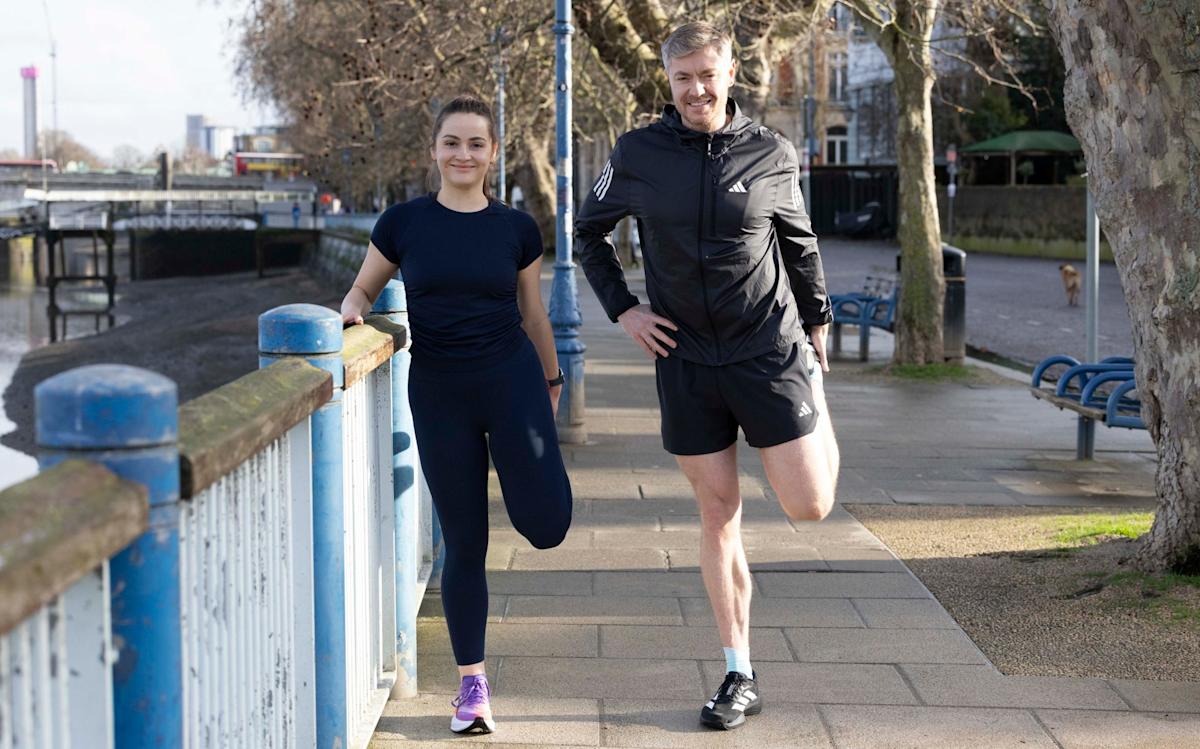
The TCS London Marathon is by far the most popular marathon on the planet. For the 2026 race, there were a record 1.1 million applicants for just 56,000 places, making it statistically harder to get into than Oxbridge.
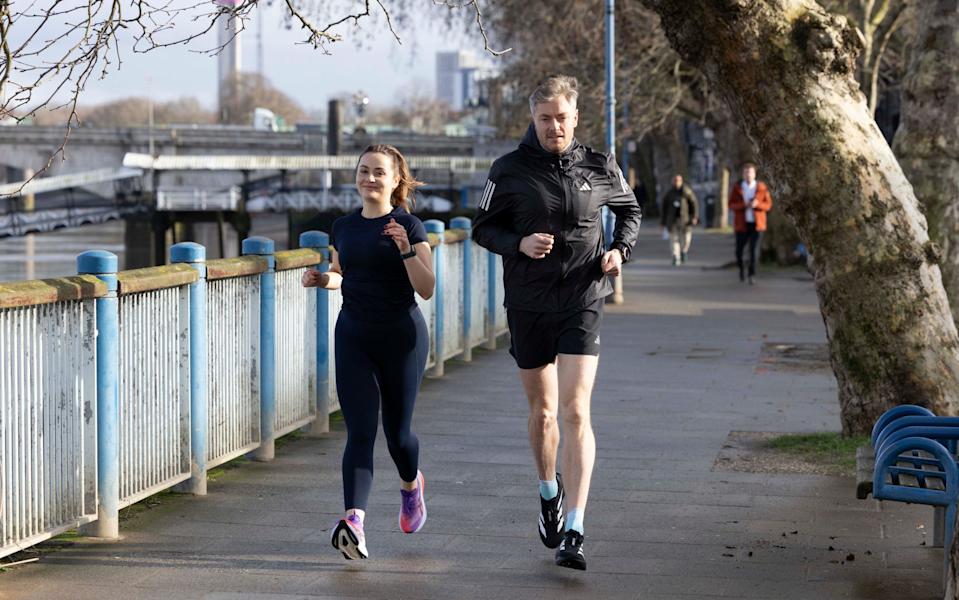
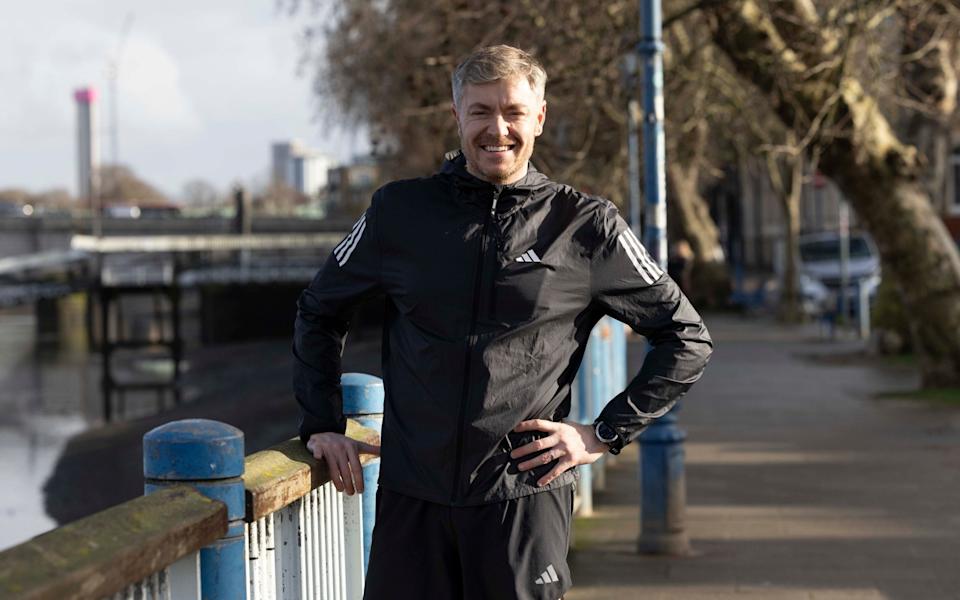
I’m lucky to be among the masses this year, taking on the 26.2 mile course for the second time. That’s providing I avoid falling in with the 12 per cent of runners who drop out before they make it to the start line, most commonly due to injury.
“Running isn’t a pain-free or injury-free sport, there are high rates of injury,” says Aidan O’Flaherty, a running physiotherapist and strength coach who has worked with Olympic runners and gained a dedicated following as @theirishphysio on Instagram.
“Runner’s knee, also known as patellofemoral pain syndrome, is the classic injury you’ll see, which is pain around the front of the knee. The hips are often impacted too, with tendon-related pain around the hip and groin being one the most reported problems,” says O’Flaherty.
It’s something I’m worried about myself, given that my parents – both formerly keen runners – have been plagued with them, including patellar tendon ruptures, meniscus tears and stress fractures.
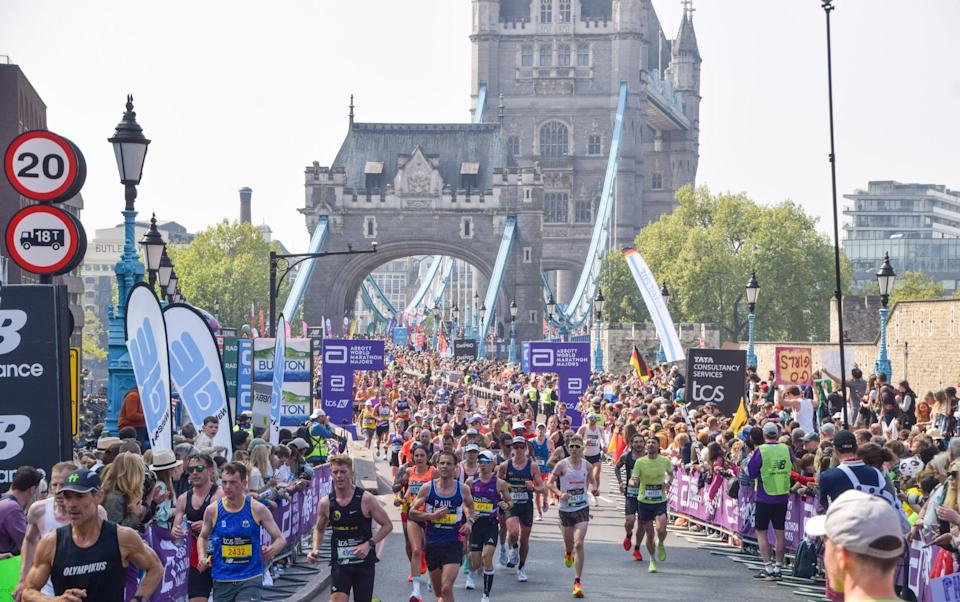
Runners pass along Tower Bridge during last year’s London Marathon – Getty
However, that doesn’t mean running is bad for the knees and hips. “It’s one of the biggest myths that I dispel in clinic,” O’Flaherty says. “Running isn’t harmful. It’s about how you manage injuries and making sure your approach is right.”
Here are his nine tips to reduce the chance of injuring those joints in the lead-up to the marathon.
Don’t do too much too soon
“We all have a capacity to tolerate a certain amount of load [the stress placed on the body from running] and when you exceed that – when you do too much, too soon – that’s often where injuries will occur,” O’Flaherty says.
“A lot of people may only be running two times a week then, all of a sudden, they’re up to four or five times because they signed up for a marathon,” he says. “Normally, after two to four weeks, your hip, knee or calf will pick up an injury because you’ve not given it time to adapt,” he says.
To combat this risk, he recommends increasing your weekly mileage and long run (the run that increases throughout marathon training, reaching up to 35km) by no more than 10 per cent per week. “Larger jumps tend to increase injury risk,” O’Flaherty notes. “That said, it’s better viewed as a rough guide rather than a strict rule.
“I also like to use ‘deload’ weeks, where after four to six weeks of gradually increasing training, overall running volume is reduced for a week. This allows the body to absorb the previous training, and can help reduce the risk of overload injuries.”
Do these three strengthening exercises twice a week
“When you’re running, you’re taking three times your body weight through each step,” O’Flaherty notes. This repetitive, cumulative stress leaves hips, knees and ankles vulnerable to injuries, inflammation, and wear and tear.
Strength training twice a week is one of the best ways to prevent this from happening, he advises. “It supports bone health, and better prepares muscles and tendons to handle the repetitive loads of running.
“Ideally, strength train on non-running days if your schedule allows. If you want to do this on a running day, separate it out by, ideally, five or six hours.”
O’Flaherty recommends performing three exercises using weights – split squats, back squats and calf raises – and doing eight to 15 repetitions of each exercise, for three to four sets. Start with 10-20 per cent of your body weight and then build that up.
You don’t need to invest in a gym membership or fancy weights, O’Flaherty notes. “Get creative, whether it’s using a rucksack and adding books to it or holding bottles of water.”
Two to three weeks ahead of the marathon, he recommends dropping down to one strength session, and reducing the number of sets and the heaviness of weights.
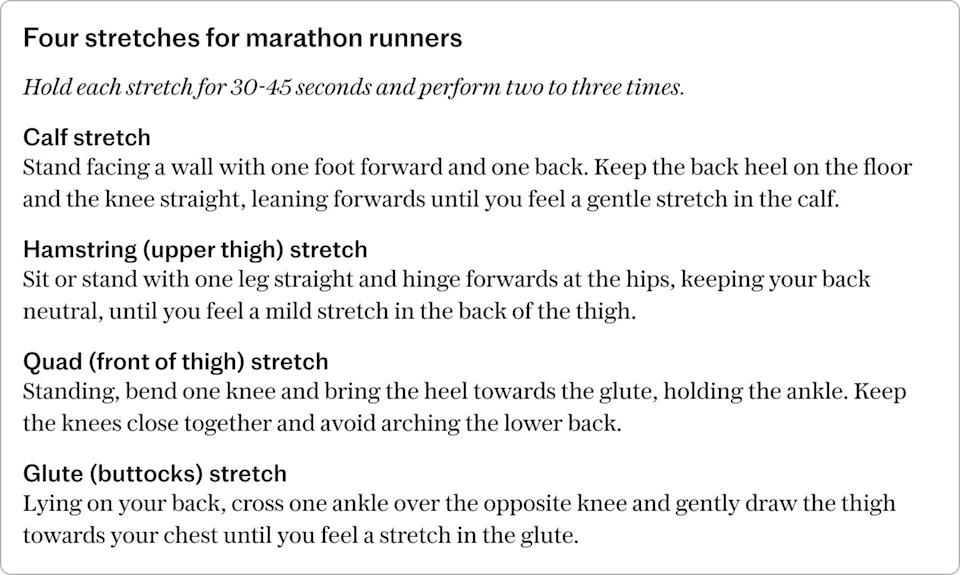
Try these four stretches – but not before your run
If you have a pre-run stretching routine, it’s time to ditch it, according to O’Flaherty. Static stretching (holding a pose) before a run can temporarily reduce strength and speed, and increase the risk of injury, he warns.
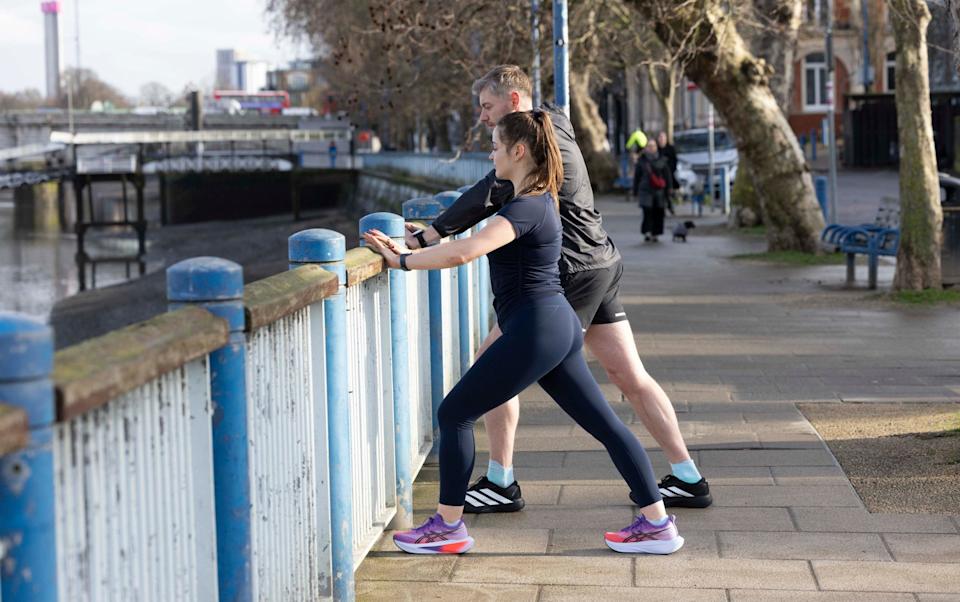
Static stretches, targeting the calves, hamstrings, quads and glutes, are beneficial after a run, says O’Flaherty – Jeff Gilbert
After a run, however, it can be helpful to do some static stretches, targeting the calves, hamstrings, quads and glutes, he notes.
“The goal is to reduce soreness and tightness,” he says. “If you feel less stiff, you move better and you’re more likely to run more efficiently, and that could reduce the risk of injury.”
It’s important not to stretch into pain, he cautions. “You should feel a little bit of tension and sustain that for 30 to 90 seconds,” O’Flaherty says. “If you stretch into what feels like a tight hamstring, you might actually make it worse because it might be a low-grade strain and stretching pulls the tissue, which actually irritates it further.”
Check your running technique
“Overstriding is probably the biggest injury risk factor,” O’Flaherty says. “This is when you’re taking strides that are too long and your foot is striking the ground too far in front of you.” Overstriding acts like a brake, making the foot absorb a higher force that runs up the leg. As a result, a bigger impact is absorbed by the body, putting pressure on the knees, shins and hips, and increasing the risk of injury.
It’s therefore important to know if you’re overstriding, and checking your cadence (the number of steps taken per minute) is a good indicator, O’Flaherty says. Running watches and phone apps can be used to measure cadence.
“If someone has a very low cadence – below 160 – they tend to have overstriding,” he says.
However, beyond rectifying overstriding, there is no “perfect running technique”, he says.
“Avoid blanket changes to your running technique because that actually increases your risk of injury. Even if you’re overstriding, if you’re an uninjured runner, it makes no sense for you to change what you’re doing.
“If you’re someone who has a history of niggles and injuries, however, it is definitely worth going to see a physio and getting an assessment to see whether you should modify how you’re running to reduce loads on certain tissues.”
Fuel properly before, during and after your run
During marathon training, your body burns more calories, so it’s important to make sure you’re getting adequate energy, O’Flaherty says. “We see a huge increase in running-related injuries when athletes are under-fuelling.”
Also known as low energy availability – when a person’s calorie intake is lower than their energy expenditure – it’s linked to both soft tissue and bone injuries, as well as slower marathon finish times.
O’Flaherty says that whilst there is no ‘perfect running technique’, overstriding can cause injuries – Jeff Gilbert
O’Flaherty recommends prioritising carbohydrates and protein. “Carbohydrates are key for energy, even on rest days,” he says. “People think that because they’re not training that day they’ll eat less. It’s probably more important on a rest day to have adequate calorie intake.”
O’Flaherty also cautions against running on an empty stomach, especially for longer sessions. “People think if they run without eating beforehand, then their body is going to become more efficient – it’s a myth,” he says. “You need to be fuelling pre-run as well as during your longer run.”
SiS, Maurten, and Precision Fuel & Hydration are three of the most common running gel brands, but sweets such as Jelly Babies and Percy Pigs are good alternatives for quick-release energy, says O’Flaherty.
Find comfortable shoes, socks and shorts
Well-fitting running shoes are key for reducing your risk of injury and preventing blisters, O’Flaherty notes.
If you’ve never suffered from an injury, he recommends sticking to the same style you have always worn. “Avoid sudden changes in shoe types – such as swapping from a heavily cushioned shoe to a very firm shoe, or from a low-drop to a high-drop shoe, which has a bigger height difference between the heel and toe of the shoe – as that will massively increase the risk of an injury,” he says.
Rotating a few different running shoes can also be helpful. “For example, a durable daily trainer for easy runs, a lighter shoe for quicker runs and then a specific race-day shoe, such as a carbon-plated shoe,” O’Flaherty suggests. “It helps vary loading patterns [the part of the leg taking the force from your run], which can keep tissue more resilient.”
Carbon-plated running shoes are highly cushioned and bouncy, which can help to improve speed and reduce fatigue. However, don’t wear them for every run, he warns. “They shift the load from below the knee to the knee, pelvis and hips,” O’Flaherty explains. “People can run for longer and quicker in these ‘super shoes’, but it increases your stride length.”
Well-fitting running shoes are key for reducing your risk of injury and preventing blisters, says O’Flaherty – Jeff Gilbert
It’s also worth investing in good-quality socks, such as those made by Versus, he says. “Avoid material that’s really heavy and cotton, opt instead for breathable, moisture-wicking fabric. If you’re sweating a lot and you’ve got a lot of friction from your foot to your sock to your shoe, it’s going to give you hot spots and blisters.”
Comfortable shorts or leggings are important as well. “If you have lots of chafing or rubbing, it’s going to impact how you’re running. Your stride might change if you’re getting discomfort.”
Sleep at least seven hours per night
“Sleep is the biggest performance enhancer,” O’Flaherty says. “Often, during marathon prep, people get up early to run before work. Sometimes, just saying no to a run and getting a bit of sleep is going to be important. We only benefit from the training that we recover from.”
There is a higher risk of soft tissue injury when people have reduced sleep, particularly when that’s consistent over a period of a couple of weeks, so it’s important to aim for seven to nine hours per night during training, he advises.
One study found that poor sleepers were nearly twice as likely to suffer an injury, possibly because their tissues did not have enough time to heal and regenerate.
“The phrase I often use is ‘sleep in to win’,” O’Flaherty says. “The Olympic marathon runners I’ve worked with get eight to nine hours most nights.”
Massage guns, compression boots and ice baths
There’s a lot of tech out there aimed at boosting recovery, but is it worth the cost?
“If you’re doing all the basics really well, then these things can be the icing on the cake and definitely have an impact,” O’Flaherty says. “But if someone is not doing 95 per cent of what we know matters – like sleeping and fuelling adequately – then adding in a massage gun is probably not going to make a difference.”
If you’re looking into what you should add to your training regime, compression boots – now available in many gyms – are one of the best options for reducing soreness and speeding up recovery, according to O’Flaherty. These cover the entire leg and deliver pulses of air to the muscles, mimicking a massage.
Ice baths, massage guns and foam rollers can similarly help with muscle aches and leave your legs feeling fresher. However, none of these things on their own have been shown to reduce injury, he notes. “It’s about reducing perceived soreness and tightness.”
Take a two-week running break after the marathon
While runners will be focused on making it to the start line, O’Flaherty also recommends having a plan for after race day, which should mainly involve taking a break from running.
“You need to allow your body to adapt to the stress it was placed under,” he says. “You placed a high load on tendons and bones, and it was a lot physically and psychologically.
“It’s normal to have a total break from running for two weeks, even the elite and professional runners will do this. Then make sure you build back up slowly both in running and strength training to reduce the risk of injury.”
Try full access to The Telegraph free today. Unlock their award-winning website and essential news app, plus useful tools and expert guides for your money, health and holidays.