
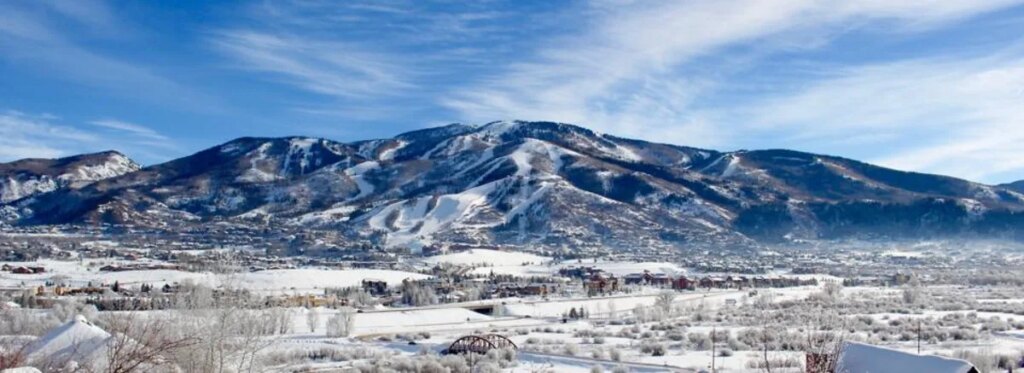


At first glance, Howelsen Hill doesn’t look like an Olympic training ground. The small, city-owned ski area rises just across the Yampa River from downtown Steamboat Springs, its 19 trails visible from the streets below.
With modest facilities and a longstanding role in local youth skiing, it’s a far cry from the famous Steamboat Resort across town, with its nearly 3,800 acres of terrain, high-speed lifts, and gondolas.
Look closer, however, and you’ll discover that these two very different mountains both contribute to the town’s extraordinary Olympic legacy.
Advertisement
Advertisement
Inside Howelsen Hill’s Olympian Hall, flags commemorate more than 100 athletes who have represented this Colorado mountain town on the world’s biggest sporting stage. Steamboat Resort plays its own part in that tradition, providing training terrain for local ski racers and hosting competitions that help prepare young athletes for the international stage.
All told, Steamboat Springs has produced more Winter Olympians than any other town in the United States, an impressive legacy for a community of roughly 13,000 people. And the tradition shows no signs of slowing down. This year, thirteen athletes with ties to the Steamboat Springs Winter Sports Club competed at the 2026 Winter Olympics in Italy, including 10 representing Team USA.
Visitors to Steamboat Springs can do more than admire the accomplishments of past champions. They can ski alongside current Olympians, explore the training grounds of future competitors, and experience the latest improvements at one of Colorado’s largest ski resorts. Beyond the lifts and luxury of modern Steamboat, one can also discover a mountain community that, despite its evolution, remains connected to its ranching roots.
The Wild Blue Gondola carries skiers from Steamboat Square to Sunshine Peak in roughly 13 minutes. It was built as part of Steamboat’s latest $200 million resort update.
Ski the New Steamboat
Over the past couple years, Steamboat Resort has undergone one of the largest transformations in its history, with more than $200 million in improvements reshaping the base area and expanding the mountain’s terrain. The centerpiece is the 3-mile Wild Blue Gondola, which carries skiers from Steamboat Square to Sunshine Peak in roughly 13 minutes, providing fast access to some of the resort’s most popular intermediate terrain.
Advertisement
Advertisement
The expansion has also opened up brand-new terrain. More than 650 acres of advanced and extreme terrain were added in Mahogany Ridge and Fish Creek Canyon, bringing Steamboat’s total skiable acreage to nearly 3,800 and making it the second-largest ski area in Colorado (second to Vail). Mahogany Ridge features glades and steep pitches, while Fish Creek Canyon offers a rugged sidecountry experience, with narrow chutes and routes that require a hike out.
For beginners, the resort’s recent improvements include Greenhorn Ranch, a 14-acre learning area located at the Wild Blue Gondola’s mid-station. Rather than confining first-time skiers and snowboarders to the base area, Steamboat brings them up to 7,500 feet where four magic carpets, a high-speed chairlift, and specially designed terrain, including gentle slopes and rollers, help newcomers develop their skills.
Greenhorn Ranch is a new mid-mountain beginner area with specially designed terrain to help newcomers develop their skills.
Despite the modernization, the resort has maintained a strong connection to the town’s Olympic history. Inside Thunderhead Lodge, an Olympian tribute showcases the athletes who have represented Steamboat on the international stage. Through the Ski With a Legend program, skiers can explore the mountain alongside a former Olympian—hear stories from the athlete’s competitive career, discover some of their favorite runs, and gain a different perspective on the town that has trained generations of competitors.
Where Olympians Are Made
To understand how Steamboat developed its Olympic resume, it’s worth returning to Howelsen Hill, where the town’s ski culture began more than a century ago.
Advertisement
Advertisement
The story starts with Carl Howelsen, a Norwegian ski jumper who arrived in the Yampa Valley in the early 1900s and helped introduce recreational skiing and ski jumping to the community.
The ski area that eventually took his name opened in 1915, and today Howelsen Hill remains one of the oldest continuously operating ski areas in the country. It is also home to the Steamboat Springs Winter Sports Club, founded in 1914, which has played a central role in developing the town’s Olympic athletes.
The club trains more than 1,200 athletes each winter across a variety of disciplines, including alpine skiing, ski jumping, and Nordic combined, among others. For many local families, participation in the club is simply part of growing up in Steamboat. Children here begin skiing at an early age, progress through organized programs and, in many cases, compete on the national and international stages.
Among the club’s most accomplished alumni are six-time Olympian Todd Lodwick, a Nordic combined skier who made his Olympic debut in 1994, and Johnny Spillane, who became the first American to win a Nordic combined world championship in 2003 before earning three silver medals at the 2010 Winter Olympics. More recently, ski jumpers Annika Belshaw and Jason Colby, both Steamboat natives who trained at Howelsen Hill, made their Olympic debuts at the 2026 Games.
Find the Old Steamboat
While Steamboat’s ski culture has deep roots, the destination itself has changed considerably in recent decades. The resort’s improvements have brought modern lifts, expanded terrain, and upscale restaurants, while luxury lodging and real-estate development continue to reshape the mountain village and surrounding valley.
Advertisement
Advertisement
But as with many ski destinations in the American West, there’s still a rugged side to Steamboat, rooted in the ranching traditions of the Yampa Valley.
Before skiing became the area’s main industry, the Yampa Valley was primarily an agricultural and ranching community. Settlers arrived in the late 19th century, establishing cattle ranches and hay farms across the valley. The arrival of the railroad in the early 20th century helped connect these operations to larger markets, and ranching became a central part of the region’s economy and identity.
Steamboat’s annual Winter Carnival showcases its western roots. Visitors can also experience horseback riding in the snow anytime during the winter at one of the nearby ranches, such as Del’s Triangle 3.
A short drive from downtown reveals open pastures, historic barns, and working ranches, picturesque beneath the surrounding mountains. Several local operations offer visitors an opportunity to experience it all firsthand.
One option is Del’s Triangle 3 Ranch, a family-owned operation near Clark, about 45 minutes north of Steamboat Springs, where visitors can explore the surrounding countryside on horseback with longtime local Rowan “Perk” Heid. His family’s roots in the Yampa Valley stretch back more than a century, and his uncle Delbert established the ranch in 1962. His father, Ray Heid, was an alternate on the 1960 U.S. Olympic ski-jumping team, which makes Perk a particularly fitting guide for a trip exploring Steamboat’s Olympic and ranching traditions. Riding with him offers an opportunity to hear about both sides of the valley’s history from someone whose family has been a part of it for generations.
Advertisement
Advertisement
Back in downtown Steamboat, the Tread of Pioneers Museum offers a closer look at the community’s early history. Housed in historic buildings, the museum explores the settlement of the Yampa Valley and the development of skiing from a practical form of winter transportation into a major recreational industry. Exhibits help connect the town’s agricultural past with the mountain destination visitors experience today.
Another example of how Steamboat’s ranching and skiing traditions intersect takes place every February, when Steamboat Springs holds its annual Winter Carnival, a celebration dating back to 1914. The festivities include ski jumping competitions at Howelsen Hill and skijoring on Lincoln Avenue. This year’s festival will be February 2-7.
Plan Your Ski Town U.S.A. Visit
To experience modern Steamboat, Moving Mountains specializes in spacious vacation rentals with a portfolio of mountain homes and condos that offer amenities such as private hot tubs and ski-in, ski-out access.
Steamboat Resort recently launched a new booking platform, Steamboat Hospitality, that allows one to search a range of properties around the resort, including hotels and condos across a wider budget range.
Advertisement
Advertisement
Steamboat offers several ways to save on walk-up ticket prices if your trip timing is flexible. The resort’s ski vacation packages include lodging and lift-ticket bundles that offer significant discounts on select dates and properties.
Families visiting in the early season can take advantage of a special offer. Children 12 and under are always able to ski and rent gear for free with an adult purchase of 5 days or more, but this season, kids can ski free from November 21 through December 15 with no adult purchase required. Although much of the mountain may not be open yet, beginners who don’t need access to the resort’s full terrain could still find plenty to enjoy.
Speaking of beginners, Steamboat allows free access to the Buckaroo Carpet, no lift ticket required, every day from noon to 4 p.m. daily—a nice way to introduce younger members of the family to the sport.
Otherwise, adult skiers can save up to 15% by purchasing lift tickets at least seven days in advance. Those planning to visit multiple resorts this winter should also consider the Ikon Pass, which includes access to Steamboat.
Advertisement
Advertisement
And, as noted, Howelsen Hill is free to ski on Sundays, making it a popular day for local families to hit the slopes. But honestly, as an out-of-towner, I’d consider leaving it to the locals. After all, while Steamboat Resort continues to grow and evolve, the next generation of American Olympians is already training on the same little ski hill where it all began. Best to let them get on with it.
This article was originally published on Forbes.com
Source link


