

Key Takeaways
Samhain is an ancient Irish festival that brings people together at autumn’s turning point for food, games, and stories.
Add Irish Samhain traditions to Halloween with shared foods, handmade costumes, lanterns, treats, and lively games.
Gather together for spooky tales, songs, and dancing as a way to connect people with Irish folklore.
For a truly spooky celebration this Halloween, look to the Irish traditions of Samhain, an ancient festival marking the beginning of the darker half of the year. October 31 is the eve of Samhain (pronounced “Sow-In”), known in Irish as Oíche Shamhna. Some Samhain traditions have been adapted into Halloween celebrations in the United States; others may be less familiar. But all are part of a social occasion that brings people together with food, games, storytelling, and yes, costumes and plenty of treats. We spoke to a folklorist and a historian to learn about the rich traditions of Samhain and how you can make them part of your Halloween celebration.
Meet Our Expert
Santina Kennedy, MA, food historian whose research and practice focus on Irish food history and food culture
Lorraine O’Dwyer, Irish folklorist and owner of Gallivanting, a tour and workshop company specializing in folklore, Celtic mythology, and nature
Related: Why Are Black and Orange the Traditional Halloween Colors?
The Menu
An easy way to bring some Samhain to your Halloween festivities is through food. We don’t have a specific Halloween menu in the U.S., beyond candy!—so serving the traditional foods is a delicious way to get a taste of Samhain. Colcannon is a must. It’s a comforting dish of mashed potatoes and cabbage or kale, traditionally served with a generous pool of butter in the center, says Santina Kennedy, a food historian whose research and practice focus on Irish food history and food culture. She adds that it’s particularly evocative of the Irish autumn as potatoes and leafy greens were key parts of the seasonal food supply and the dish is hearty, economical, and suitable for a family.
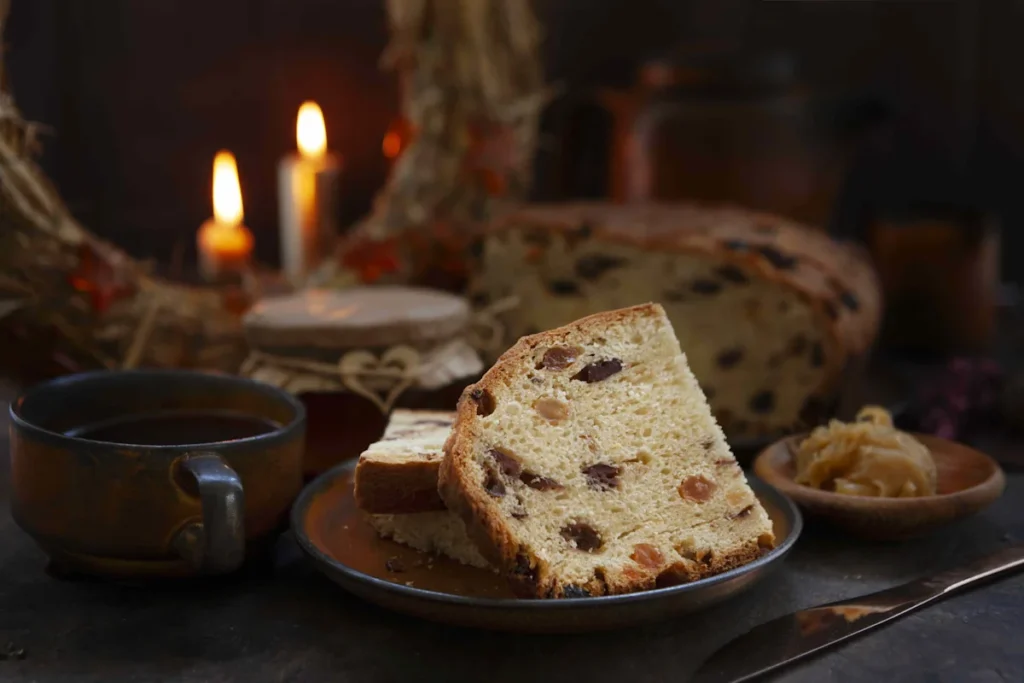
The best-known food for Samhain is barmbrack, a beloved sweet fruit bread that’s easy to make and so delicious sliced and slathered with butter. There’s a rich tradition of baking small objects, or charms, into the loaf, Kennedy explains. Each object carried a prediction about the finder’s future, making the loaf a communal game of chance. The best-known charm is the ring, which foretold marriage; historical versions of the tradition included items like a coin, suggesting wealth. Lorraine O’Dwyer, an Irish folklorist, also mentions a nutshell, meaning the finder would travel over the sea, and a small piece of cloth, which signified you would not have a good year—you’d be in rags. Charms are often wrapped in fabric before being added to the loaf to make them easier to spot and less likely to damage teeth.
Bring It Home: Serve Colcannon as part of your Halloween dinner (pre- or post-trick-or-treating!) and set out bowls of apples and nuts for snacking.
What to Wear
Members of the Beltane Fire Society take part in the Samhain Fire Festival
Credit: Jeff J Mitchell / Staff / Getty Images
Anyone seeking something different from the latest Marvel superheroes for their Halloween costume would do well to consider Irish traditions. “Dressing up is one of the defining features of Irish Halloween, for both children and adults,” says Kennedy. “Historically, disguises were often homemade and deliberately frightening. People might cover their faces with masks, rub soot on their skin or alter their voices. These disguises were associated with the belief that supernatural beings were all around on Halloween night, and that looking frightening or unrecognizable could offer protection.” Yes, says O’Dwyer, they will think you are dead too and leave you alone.
Bring It Home: Make your costumes this year, as simple or elaborate as you fancy, as ghoulish as you like.
Lighting the Way
Carved turnips hang from tree brnaches
Credit: Reed Davis
Sure you know how to carve a jack-o’-lantern, but have you ever tried carving a turnip lantern? Long before pumpkins arrived in Ireland (they’re a recent addition), people used what was widely available, the turnip, to hollow out and add a candle as a “ghost turnip” lantern for the long night. Turnips are smaller and much, much harder, so it’s not as easy to craft complex designs, but many a frightening visage has been scored into the hard flesh of this root vegetable.
Ghost turnips are tied to the Jack-o’-lantern tradition and the folklore of a character named Jack, who is said to have tricked the Devil and was ultimately accepted into neither Heaven nor Hell. Condemned to wander, he carried a light inside a hollowed-out turnip.
The lanterns were used to frighten and entertain people on Halloween night and could be carried or left in windows and around homes. They belonged to a broader set of customs involving disguises, frightening appearances, and protection from unwelcome supernatural visitors, Kennedy says.
The pumpkin became popular in the United States partly because it is larger and easier to carve. Irish emigrants carried Halloween customs with them, and the pumpkin gradually became the Jack-o’-lantern we know and love.
Bring it Home: Try carving turnips instead of pumpkins, or accept that some progress is good and stick to the pumpkin jack-o’-lantern—but make sure it has a truly scary face.
Trick-or-Treating
Traditionally, children went from house to house in disguise, singing “Any apples or nuts,” asking for apples, nuts, and other seasonal treats. Kennedy explains that these were the foods households likely had available after the harvest.
In recent years, the American tradition of trick-or-treating has largely taken over in Ireland, but O’Dwyer notes that in rural areas the older ways persist and kids will go out in costumes, but they “will absolutely have to perform a trick to get a treat! Sing a song, recite a poem!” She says there are sweets, but you can also expect lots of apples, nuts, and even a few coins, adding that plenty of time is spent at each house for games, food, and a chance to catch up with neighbors.
Bring It Home: Ask trick-or-treaters to perform a song, poem, or dance in return for candy this year. Tell them about the Irish traditions of Halloween and trick-or-treating.
Apple Games
Credit: Alexander Nicholson / Getty Images
Apples are plentiful around Halloween, and apple games are among the most enduring and recognizable Irish Halloween traditions, says Kennedy. They include apple bobbing, snap apple, and other games in which players try to catch or retrieve an apple without using their hands. The games are fun, but their historical significance goes beyond entertainment. Halloween is a time of transition, when divination powers are extra strong, says O’Dwyer. Some games were associated with identifying a future husband or wife, or who would marry next.
Bring It Home: Try one or more of these games. In apple bobbing, apples float in a basin or tub of water. Players must catch one with their teeth while keeping their hands behind their backs. In snap apple, an apple is suspended from a string, and players try to bite it as it swings, again without using their hands, Kennedy explains.
Storytelling and Music
Samhain and Halloween belong to a broader Irish tradition of gathering, storytelling, music, dancing and communal entertainment as the agricultural year draws to a close. Storytelling has a particular resonance at this time of year, explains Kennedy. “As winter approached and evenings grew darker, people gathered indoors around the hearth. Irish oral tradition contains many stories about the Otherworld, fairies, spirits, and encounters between the living and the supernatural. Halloween provides a natural setting for these tales because of its long association with the boundary between the human and supernatural worlds.” O’Dwyer points out that there are stories you may know but did not realize are Irish, like the Dullahan, the headless horseman that lives in the roots of the Yew tree. He comes out on Samhain Night to find someone to attack and take their head, so he can finally enter the land of the Dead. She particularly likes the Dearg Du, a female vampire who targets vain young men.
Bring it home: O’Dwyer suggests bringing out the whiskey later on Halloween night and letting the stories and songs follow. From ghost tales to reminiscences of friends recently passed to a good, long rambling joke, she says all contributions are welcome. Her favorite story is about what might happen to anyone who doesn’t have a story to tell!
Read the original article on Martha Stewart
Source link