

To protect your heart, your most powerful weapon might just be the humble pushup. In fact, if you can drop and knock out 40 clean reps, you may have more cardiovascular protection than guys with a higher VO2 max who lack that foundational upper-body strength.
Those were the findings of a 2019 study published in JAMA Network Open. When researchers analyzed ten years of health records from more than 1,100 middle-aged male firefighters, men who completed 40 or more pushups showed a 96 percent lower risk of cardiovascular disease events compared to those who tapped out at ten or fewer. The pushup test proved to be a stronger predictor of long-term heart health than traditional treadmill-based aerobic testing.
Before you scrap running to just chase pushup volume, remember that pressing power alone is not an impenetrable shield. Like most longevity metrics, your maximum pushup capacity serves as an indicator of your broader lifestyle. The study authors noted that core risk factors, including blood pressure, lipid panels, and smoking habits, accounted for a substantial portion of the outcome differences.
Want the latest fitness advice and workouts to tackle any adventure? Sign up for our Blueprint newsletter.
The Longevity Target Every Lifter Should Chase
Still, building up to 40 consecutive reps is a target well worth hitting, says Alex Viada, founder of Complete Human Performance and author of The Ultimate Hybrid Athlete. As Viada points out, stringing together a massive set of pushups tests far more than raw chest strength.
Advertisement
Advertisement
“Being able to do a complete pushup proves you are maintaining upper-body mass with capable shoulders and triceps,” Viada explains. “Holding that capacity across your lifespan requires muscular endurance. If someone can reliably knock out 40 or 50 continuous pushups well into middle age, they are inevitably doing a lot of other health behaviors right.”
Viada regularly helps tactical athletes and private clients expand their bodyweight output using the 15-minute daily protocol outlined below. One of his trainees pushed a baseline of 43 pushups up to 88 reps in only twelve weeks.
Whether you currently stall out at 5, 10, or 20 reps, you can build that same upper-body endurance and cross the 40-rep threshold. Here is how the progression works.
Related: I Dropped ‘Junk Volume’ and Cut My Gym Time in Half. Here’s My 45-Minute Strategy for Building Real Strength
The High-Frequency Bodyweight Protocol to Hit 40 Consecutive Reps
You can run this routine five or six days per week. Because individual sets stop well short of muscular failure, it will not compromise your existing lifting schedule, Viada says. He recommends slotting it into an open window away from your primary training session. If you lift heavy in the morning, run through these sets in the evening while unwinding, or vice versa.
Advertisement
Advertisement
Before jumping into the routine, establish your baseline by testing how many unbroken, strict reps you can complete in a single effort. That maximum number dictates your working volume for every subsequent set.
Drop and test your max now. If you plan to start the working sets immediately afterward, Viada advises stopping one or two reps shy of absolute technical failure so you avoid burning out your nervous system before the actual work begins.
Once you have your baseline number, tackle the two-part protocol below. You can run both sections back-to-back or split them across the day, knocking out the pressing sets in the morning and saving the core work for your afternoon break. Aim for five or six total exposures each week.
Part 1: EMOM at Half of Your Max
EMOM stands for every minute on the minute. During this block, you complete half of your max number of pushups at the start of every minute, resting for whatever time remains on the clock. If your baseline is 20 reps, knock out 10 pushups at the top of the minute. Finishing those 10 reps in 25 seconds gives you 35 seconds of downtime before the next interval begins.
Advertisement
Advertisement
Aim for 15 total minutes. If your rep speed drops noticeably or your form begins breaking down, cap the session at 10 or 12 rounds.
Part 2: Core Stability Circuit
Complete two to three rounds of this plank circuit, holding each position until technical fatigue.
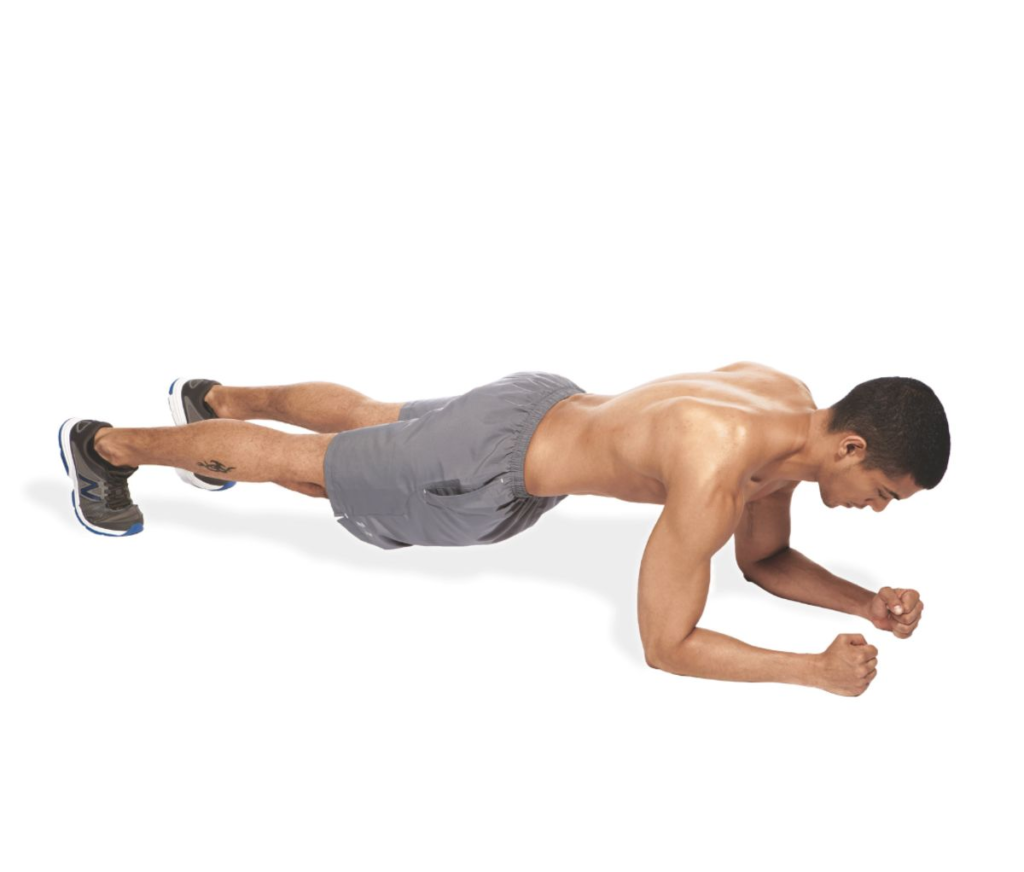
How to Do Forearm Planks
Forearm PlankBeth Bischoff
Set up on your forearms with your elbows placed directly under your shoulders.
Establish a rigid line from your crown to your heels, bracing your abs and firing your glutes.
Hold this posture until your hips drop or form breaks down.
How to Do Side Planks
Lie on your side with your supporting elbow directly beneath your shoulder and feet stacked.
Elevate your hips until your frame aligns from ear to ankle, holding until failure before switching sides.
How to Do Feet-Elevated Planks
Getty Images/Patrik Giardino
Place your toes on a sturdy bench or box, supporting your upper body either on your forearms or on your palms with arms locked out.
Lock in core tension to prevent lower back sagging.
Hold for maximum duration with zero spinal shift.
Re-Testing Your Baseline
After two consistent weeks, re-test your unbroken pushup maximum. Calculate your new half-max target from that fresh total, update your working sets, and repeat the progression.
Related: Running a Half Marathon in Your 40s? Trainers Say This 30-Minute Strength Routine Is the Key to Finishing Stronger

Advertisement
Advertisement
This story was originally published by Men’s Journal on Nov 9, 2026, where it first appeared in the Fitness section. Add Men’s Journal as a Preferred Source by clicking here.
Source link