


Bigger muscles have long been associated with strength, confidence and vitality. Visually, they create a powerful silhouette that signals athleticism and capability, which is one reason muscle building remains such a popular fitness goal. And from a health perspective, added muscle mass is linked to better metabolic health, stronger bones, improved insulin sensitivity and a lower risk of injury as we age.
When people talk about the most desirable muscles, biceps, abdominal muscles and the chest often dominate the conversation, because they’re highly visible, easy to show off and closely tied to cultural ideas of physical appeal.
But shoulder muscles deserve far more attention than they typically receive. Physical reasons include that well-developed shoulders frame your upper body, can make your waist appear smaller and give the torso a broader, more athletic look. Beyond aesthetics, strong shoulders are also essential for daily function, posture and injury prevention, making them one of the most valuable muscle groups to train.

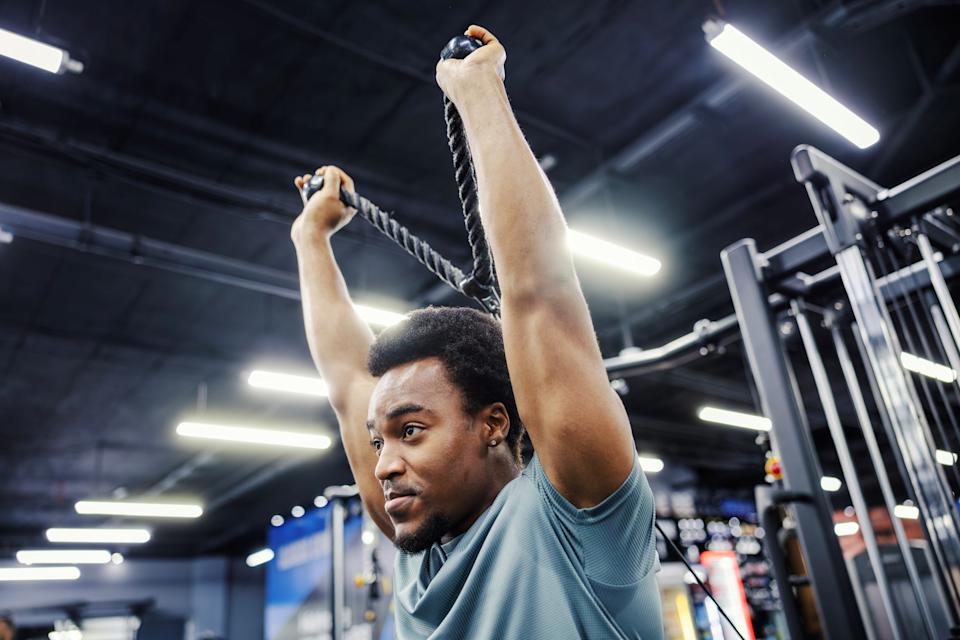
Here’s which muscles make up the shoulders, how to grow them effectively and what to realistically expect as you work toward building stronger, bigger shoulders.
What are shoulder muscles?
The shoulder is one of the most complex joints in the body, and its muscle structure reflects that complexity. The primary shoulder muscle is the deltoid − a large, triangular muscle that caps the shoulder and gives it its rounded shape.
“The larger your deltoids are, the more ‘width’ you will appear to have,” says Jeremy Loenneke, PhD, associate professor of exercise science at the University of Mississippi.
Sean Sewell, a certified personal trainer and founder of Colorado Personal Fitness in Denver, explains that the deltoid has three distinct heads, each with a unique role:
-
Anterior (front) deltoid: Located at the front of the shoulder, this head is heavily involved in pushing movements, lifting objects in front of you, and raising the arm forward. You use this muscle whenever you lift groceries from your car trunk, push a heavy door open or place a suitcase into an overhead bin at the airport.
-
Lateral (middle) deltoid: Running along the outer edge of the shoulder, this portion is largely responsible for shoulder width and helping to lift your arms out to your side. You use this muscle whenever you carry grocery bags away from your sides, raise your arms to put on a jacket or lift a child up onto your hip.
-
Posterior (rear) deltoid: Found on the back of the shoulder, this head plays a key role in pulling movements and helping to stabilize the shoulder joint. You use this muscle whenever you pull open a big drawer, start a lawnmower or reach backward to fasten a seatbelt.
Supporting the deltoids is the rotator cuff − a group of four smaller muscles comprised of the supraspinatus, infraspinatus, teres minor and subscapularis. “These muscles help stabilize the shoulder and allow for smooth rotation and overhead movement,” Sewell says.
How to get bigger shoulders?
Building bigger shoulders requires targeted resistance training that challenges all three heads of the deltoid while also supporting the rotator cuff.
One of the most foundational shoulder-building exercises is overhead pressing. Using kettlebells, barbells or dumbbells, overhead presses involve driving weight from shoulder height to over your head while keeping your core braced and your spine neutral. This movement heavily recruits the anterior and lateral deltoids and allows for progressive overload, which Sewell notes is essential for muscle growth and building strong, well-developed shoulders.
No gym membership? Try these simple workouts you can do at home
To emphasize shoulder width, lateral raises are another highly effective exercise. Sewell says this can be done using dumbbells, cables or resistance bands. It also involves lifting the arms out to the sides with a slight bend in the elbows until they reach shoulder height.
Rear deltoids often lag behind but are also critical for balanced shoulder development. Reverse fly exercises − performed with dumbbells or cables − require hinging at the hips or sitting upright while pulling the arms back and outward. Face pulls, which involve pulling a rope attachment toward the face with the elbows flared, also strongly activate the rear deltoids while reinforcing shoulder stability.
Happy New Year! A beginner’s guide to exercising at home, according to fitness experts
Upright rows can also contribute to shoulder development, Loenneke says. The movement is performed with dumbbells or a barbell, starting with the arms extended in front of the body, palms facing down. The weight is then pulled upward toward the chin and then slowly lowered back to the starting position.
Shrugs, while often associated with the trapezius muscles, can also indirectly support shoulder development by strengthening the muscles that stabilize the shoulder girdle.
How often should shoulder muscles be worked?
No matter which exercise you favor, many people train their shoulders about twice per week; but, Sewell notes that he often programs shoulder training three times per week.
Loenneke agrees that two-to-three shoulder-focused sessions per week are usually sufficient but notes that “volume is only important for growth to a point.” He explains that one to four sets of exercise are typically enough, because once the stimulus for growth is reached, doing more may simply delay recovery without producing additional gains. “This means three well-executed sets may be better than one − but six sets may not be meaningfully better than three,” he says.
When marking progress, it’s important to note that muscle growth begins when muscle fibers are stressed and repaired but visible increases in size take time. Early strength gains often come from improved neuromuscular coordination, while noticeable muscle growth usually appears after several weeks of consistent training, with more significant changes developing over two to three months.
More: Functional strength training provides many health benefits. But you need to be careful.
And preparation and recovery are just as important as training itself. “It is key to warm up effectively to perform any exercise, and that is especially true with the shoulders,” Sewell says. Two warm-up exercises he recommends include controlled arm rotations − standing with arms extended and rotating one arm up while the other rotates down − and wall slides, where you face a wall and slide your hands upward overhead. “Both exercises help prepare the shoulder joint for safe, effective training,” he says.
It’s also important to note that, because shoulder muscles are involved in many upper-body exercises, overtraining can sneak up quickly. “Injuries can often occur from doing movements incorrectly, so it’s important to learn proper form,” Loenneke says. Adequate sleep, sufficient protein intake, rest days between intense sessions and avoiding painful ranges of motion are all also essential for continued progress.
“When first starting out, make sure you stay within your limits,” Loenneke advises. This means beginning with lighter weights to master proper form “and, once the you feel confident you can do the movement, start progressing the load.”
This article originally appeared on USA TODAY: How to get bigger shoulders