

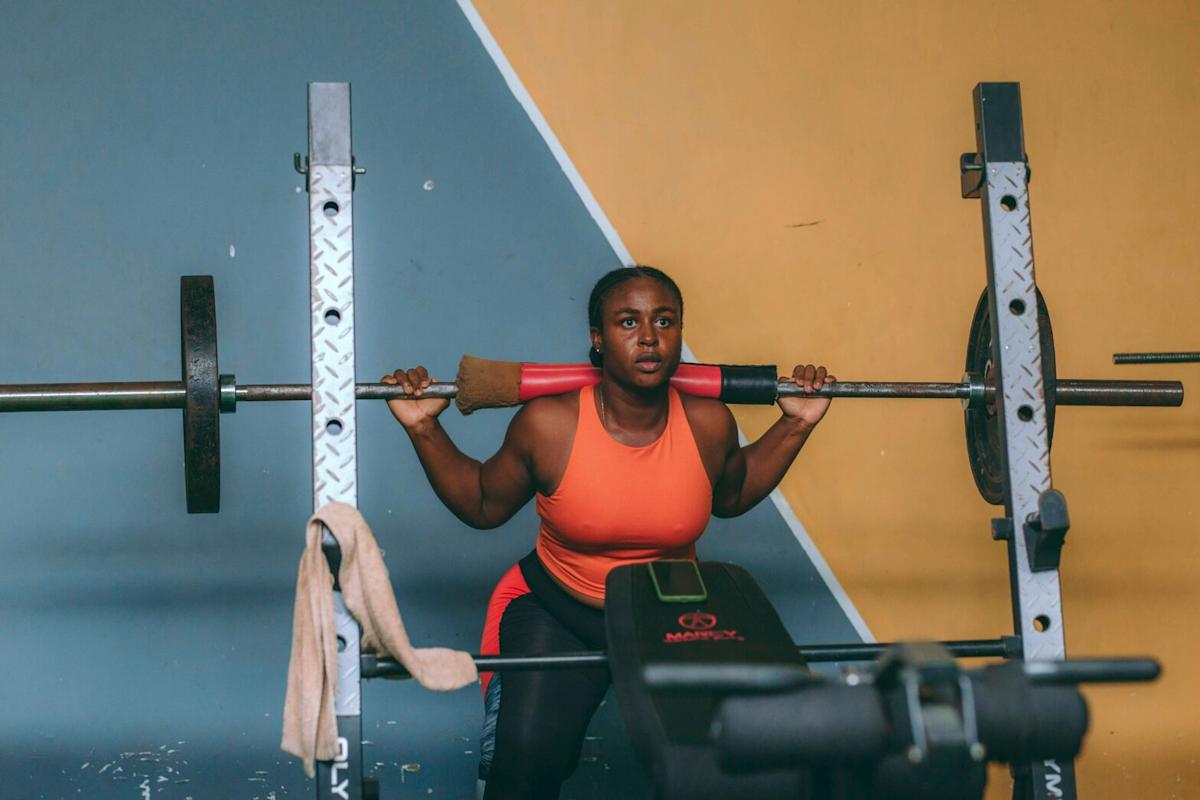
For decades, mainstream fitness messaging aimed at women has revolved around shrinking. The goal has always been to burn calories, flatten your stomach, and slim your thighs. The prescription has often been even narrower for Black women, with little acknowledgment of strength training as a legitimate or empowering health tool.
That narrative is slowly shifting, however. More Black women are entering weight rooms, lifting heavy, and reframing fitness not as punishment or aesthetic management, but as a pathway to longevity, autonomy, and self-trust.
Research increasingly supports this shift. According to the ACSM and the CDC, resistance training is essential for maintaining muscle mass, protecting bone density, improving insulin sensitivity, and reducing injury risk. Yet strength training remains underutilized among women overall. The risks are even higher for Black women due to disproportionate rates of conditions such as Type 2 diabetes, cardiovascular disease, and mobility-limiting injuries later in life.
“While cardio is beneficial for heart health, strength training is foundational for long-term resilience and quality of life,” says Monique Battiste, a personal trainer at Momentum Fitness. “It supports bone density, lean muscle mass, mobility, and longevity—areas that are often under-discussed when it comes to Black women’s health.”
Strength Training and Long-Term Health
Multiple large-scale studies back this up. A 2022 study published in JAMA Network Open found that adults who engaged in regular strength training had a significantly lower risk of all-cause mortality, even when accounting for aerobic exercise. Resistance training has also been shown to improve glucose regulation and insulin sensitivity, which is particularly relevant given that Black women are nearly twice as likely as white women to be diagnosed with Type 2 diabetes, according to the CDC.
Bone health is another key factor. While osteoporosis is often framed as a concern primarily for white women, research published in the Journal of Bone and Mineral Research shows that Black women are still at risk for bone loss with age and may experience worse outcomes after fractures. Weight-bearing and resistance exercises remain one of the most effective non-pharmaceutical interventions for preserving bone density.
“Strength training is one of the best tools we have for preventing muscle loss and maintaining independence as we age,” Battiste explains. “It’s not about shrinking yourself—it’s about sustainability.”
Unlearning the Myths Around Heavy Lifting
Despite the evidence, misconceptions persist. One of the most common is the fear that lifting heavy weights will make women “bulky” or unfeminine. Physiologically, this concern is largely unfounded. Due to lower levels of testosterone, women generally do not build muscle mass at the same rate or scale as men without highly specific training, nutrition, and often years of focused effort.
Phoebe Gavin, who began lifting seriously after years of cardio-focused fitness shaped by military culture, recalls how transformative it was to shift her mindset.
“The biggest misconception I still see is that heavy lifting makes women bulky or is only for people who want to compete,” she says. “When I started focusing on what my body could do instead of how it looked, everything changed.
Beyond physical health, strength training offers psychological benefits that are harder to quantify but no less powerful. Resistance training has been linked to reductions in anxiety and depressive symptoms. For many Black women, the gym becomes one of the few spaces where progress is measurable, earned, and indisputable.
“There’s something special about objectively knowing that I’m really strong,” Gavin says. “No one can take that away from me.”
Battiste sees this shift regularly in her clients.
“Strength training teaches patience and self-trust,” she explains. “In a culture that promotes six-week transformations, lifting reminds women that progress takes time—and that process is something to respect.”
Barriers in Fitness Spaces and What Needs to Change
Still, access and inclusion remain major challenges. Lack of representation, culturally competent coaching, and individualized instruction can discourage long-term participation among women of color.
Gavin points to biomechanics and body diversity as an often-overlooked issue.
“Good training is individualized training,” she says. “Too often, Black women are treated like white women or small men, instead of trainers adapting movements to our bodies.”
Battiste agrees, saying that shaming and misinformation, particularly online, create unnecessary barriers.
“Fitness should be educational and empowering, not punitive,” she says.
Cultural narratives around the “strong Black woman” stereotype complicate these dynamics further. Strength is often expected of Black women, but rarely framed as something they get to claim for themselves.
“Weight training helped me redefine strength as something that’s for me,” Gavin says, highlighting that it is not something demanded, projected, or taken for granted.
That reframing may be the most radical benefit of all. When lifting becomes about autonomy, health, and self-preservation rather than aesthetics or discipline, it opens the door for more Black women to engage with fitness on their own terms.
The post How Black Women Are Redefining Strength Training appeared first on Blavity.