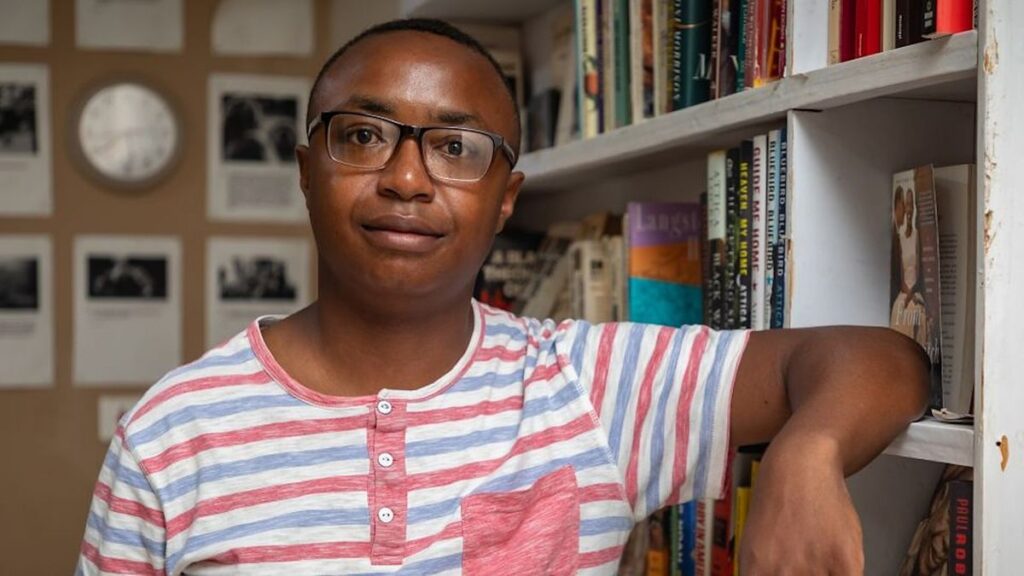
The Zimbabwean author Simbarashe Kundizeza won the Caine Prize for African Writing on October 6 for his short story “The Blue Fighter,” a tale about a father in suburban Harare who has a financially ruinous obsession with exotic fish. On October 11, an article published in The Atlantic by the journalist Vauhini Vara accused Kundizeza of using AI to write the story, claiming that the AI-detection software Pangram flagged “almost the entire story as AI-generated.”
The allegation against Kundizeza was the latest in a specific category of literary scandals that have emerged over the last year, in which people scan authors’ works with tools like Pangram and post the results like bounties on social media. The most prominent accusations of AI writing have been made against nonwhite writers.
“Maybe one or two is a coincidence, but there seems to be a bit of a concerning pattern,” Kundizeza said. “People are speculating as to reasons why that could be, whether it could be an inbuilt bias in the detection tools or something a bit more structural around how writing sounds in different areas of the world.”
Kundizeza was cleared of using AI by the Caine Prize committee on November 12. The committee said the review was comprehensive and included an examination of draft metadata and Kundizeza’s email correspondence during the time he was writing the story. Pangram and other AI detectors weren’t used during the review process.
In an interview, the author spoke about his experience, noting that it isn’t typical to think about defending or explaining every line in one’s work: “Sometimes you just write in the moment, so then to have to retrospectively explain why you included a certain phrase is frustrating,” Kundizeza said. “It’s almost an impossible argument to win.”
This conversation has been edited and condensed for clarity.
How did it feel to have your work dissected in public by people who weren’t familiar with your work or literature generally?
It feels really weird and concerning. There’s almost this hopelessness that comes with it, because how do you explain to someone who has maybe even passing interest in writing and in literature that these nuances exist in writing? How do you explain that the tech maybe got it wrong?
For some people, I think there’s a strong belief that the technology is infallible. There’s a rush to hold up certain detection scores. But for people who are not really into literature, who are not into writing, it’s a difficult conversation to have. You’re basically arguing with someone who’s coming from a viewpoint of technology and you’re trying to have a literary argument and they collide. That’s been the most frustrating aspect.

The Caine Prize has been awarding African authors a cash prize since 2000. – Aaron Ufumeli/AP/File
You said that it feels “impossible” to disprove these allegations once someone has made up their mind. Is that a liberating or a frustrating aspect of the whole ordeal?
It was frustrating in the broader context, but liberating when I was going through the process with the team from the Caine Prize because at least you’re having a conversation with someone who’s got a background in literature who understands these things. Things aren’t as difficult to explain.
But again, when someone has made up their mind — it feels a bit unfair as well to have the burden of proof put on you as the person who’s accused of doing something improper rather than the person who’s making the allegations. You’re the one who suddenly who has to do all of that work.
The barrier to entry for allegations has been lowered quite a lot.
They’ve lowered the bar to such an extent that all it takes is just one scan, and then everything else is called into question.
We’ve had nearly a dozen major AI literary scandals, and all of the writers in question have been non-white. I’m curious if you’ve thought about that dynamic at all.
I haven’t really been following each and every incident, but eventually you start to question the basis and the motivation of putting certain writers’ work through a scan first. So, what is motivating that? Is it bias? Is it maybe something more?
I think we’ve always had a situation where certain voices and certain writers have always had to work harder to be appreciated and to have their work respected. So this is just another form of gatekeeping and a continuation of the marginalization of certain voices in literature
Did you find yourself wondering whether you wanted to continue writing if this is going to be the environment you were operating in?
I’m not really sure I ever considered not writing again. Maybe I was a bit discouraged in terms of the prize and what would happen with that. But the motivation to write has never been about winning a certain prize. It’s just something that I’ve always wanted to do.
How did it feel to have to share your drafts and share your work? As a writer I can imagine that felt slightly violating.
I think the thing that put me at ease was the Caine Prize explaining what the process was going to be from the outset. They were clear they were not just going to use Pangram or other AI detection software as definitive of anything.
It was quite easy for me to cooperate and to have these discussions with them and share the drafts of the story because I agreed with the approach they were taking. It really seemed like the only way that I could prove that I’d written this story.
I wasn’t the only person they spoke to. They included the editor of the journal that published the story first, the Shallow Tales Review, and the poet whose poem I wrote the story off of. We went through the genesis of the story, the inspiration for writing the story, what made me write the story. Some of these things happened a year ago so I didn’t remember every single detail, but I was able to broadly paint a picture of the development of the story.
I think the draft history did most of the heavy lifting where you can trace this development of the story and how it came to be where it was in the end. When I was writing the story, I shared early drafts with the poet to get her feedback as well as getting her approval for that story. Once you send something electronically, those timestamps are included and the prize committee were able to pull metadata from those files and the draft that I submitted to the journal at the end of the process.
I’m curious if Vauhini Vara from The Atlantic reached out to you when she was writing this piece, or if you reached out to her.
It was a sort of roundabout way. She reached out to my agent and the agency that represents me, as well as the Caine Prize team and the poet who I mentioned. She reached out to all these people, and then she requested an interview through my agent.
But that first communication was on a Friday and then the story was published on a Sunday morning. It wasn’t possible for me to meet with her in that timeline. I didn’t really understand the rush, and she then did reach out after the story had been published to say she was still interested in having a chat. But you know, I didn’t really see a point in having the conversation after the fact.
Were you surprised that a large American publication was writing about your work in that way?
Yes, and when you look at you know the broader picture as well — they’ve never covered the Caine Prize before, so it did feel strange to have that interest now when there’s this attachment to this potential controversy. It was quite a strange moment.
We tried to get a response from The Atlantic asking what the basis for writing the story was, and I don’t know that they’ve given us a response. So we’re left having to speculate about why this specific story was of interest to such a prominent American journal.
I’m curious if you ever talked to anyone from Pangram, or if you had any desire to talk to have a larger dialogue about AI detection.
Interest in speaking to them? No.
At the end of the day, I’m just a writer. I would really love to focus on writing than the wider issues around AI and AI detection. I think I’d leave to people who know more about that stuff.
But I think there’s been a really big push from Pangram and other AI detection makers to say that the technology is infallible. It has this high error threshold, but I think it needs to be taken with a grain of salt.
Were you familiar with the AI writing tics before this whole conversation started?
Not really, which was one of the strangest things for me when I was encountering the reaction to this online. You’d have people saying “This is classic AI” and “This definitely sounds like AI.” I’m not really sure how people get to the point where they can confidently say they recognize AI writing.
It does leave you with questions about your own writing, of course. Criticism of the story and the way it was written is fair game. But I put it this way: If there’s no Pangram scan, there’s really no story here. I think you’re starting from a point where the scan is saying one thing you start looking for things to confirm the scan.
Did you find that ironic?
It’s ridiculous that now go around and say em dashes are AI writing, that the “not X, but Y” is AI writing. We’re now in a weird situation where we’re retrospectively punishing writers for using certain things in writing.
Do you think artificial intelligence has any role in literary life?
I think it might not be the role that certain people are envisioning for it right now. I don’t think we’re at that stage yet where the tools can definitively say that this piece of writing has been written by AI.
Can it be an assistive tool in writing? I think it can. I think the issue of AI in writing is not like a binary issue. I think there’s a spectrum, and people can use AI in different ways. But I think we just need a consensus on what constitutes fair use of AI in writing and what’s acceptable and what is not before we know we just sweep everyone into the same bracket. For instance, does using Grammarly to correct your grammar constitute AI usage?
I think we need to come up with a fixed position rather than this situation where you retrospectively go back and say, okay, so now you know you can no longer do this, you can no longer do that.
Did you use any of those tools when you were working on the story?
I think I used spellcheck in Word, like native function in the program. I don’t like some of the suggestions from other programs. Something like Grammarly lights up a document like a Christmas tree. I find the changes suggested by these programs change the meaning of what I’m trying to say too much for my liking.
For more CNN news and newsletters create an account at CNN.com