

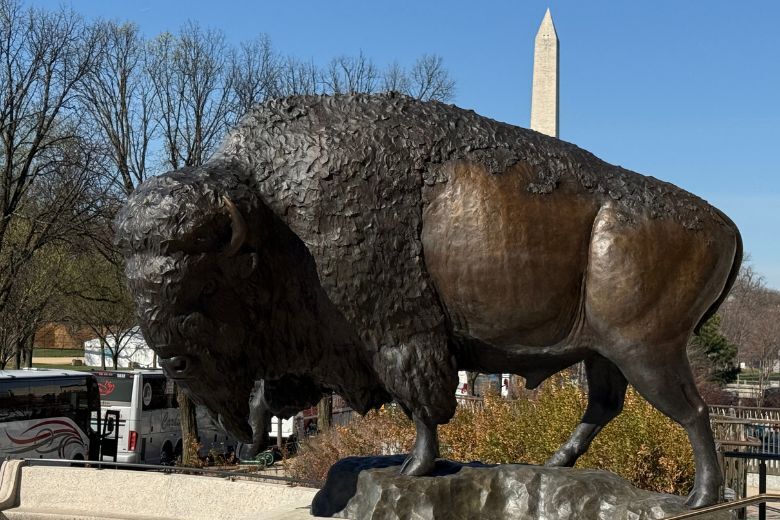
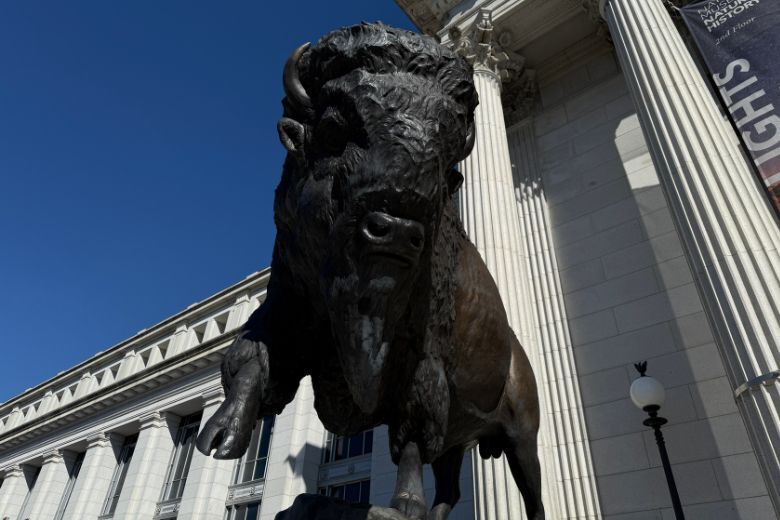
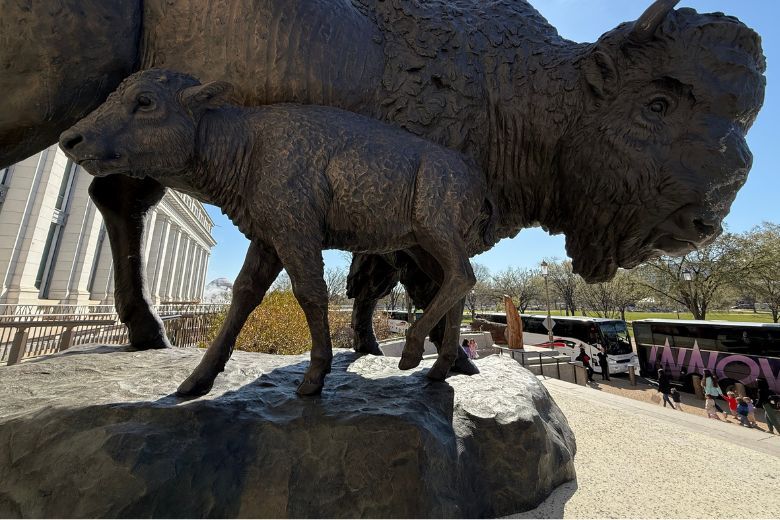
Each statue, one depicting a bull bison, the other, a cow and calf, weighs about 2,500 pounds.
This page contains a video which is being blocked by your ad blocker.
In order to view the video you must disable your ad blocker.
National Museum of Natural History adds new bison statues outside entrance
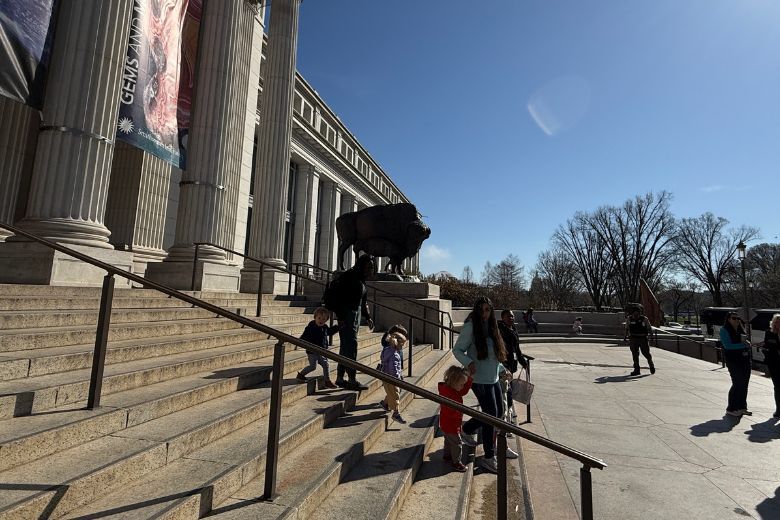
Cranes lifted two giant American bison statues into place on either side of the south entrance of the Smithsonian Museum of Natural History on Thursday night. Each statue, one depicting a bull bison, the other, a cow and her calf, weighs about 2,500 pounds.
The burly bronze bison busts are a gift to commemorate the nation’s 250th anniversary and are being displayed ahead of major bison exhibits set to debut later this year.
“These sculptures refer to animals the Smithsonian collected in 1886 in Montana, just as the bison were about to go extinct,” the museum’s Sant Director Kirk Johnson said. “They were just slaughtered across the nation as we expanded. And they got as low as less than a thousand animals in the entire continent.”
The statues were placed after a weeklong trek that started at a foundry in Colorado, where artist Gary Staab created them over the course of the last year.
Named the national mammal in 2016, the bison will be a major focus of the Smithsonian this year. An exhibit called “Bison: Standing Strong” will highlight the species from the point it nearly went extinct in the late 1800s to its resurgence through significant conservation efforts led, in part, by the Smithsonian Institution.
“As far as I’m concerned, they are a symbol of the strength of our country,” Naoma Tate, who serves on the Smithsonian National Board, said of bison.
Tate, a renowned Western art collector and philanthropist from Cody, Wyoming, and her family gifted the bison to the Smithsonian.
“We see these magnificent animals all the time,” she said. “There are about 5,000 there.”
(WTOP/Alan Etter)
WTOP/Alan Etter
(WTOP/Alan Etter)
WTOP/Alan Etter
(WTOP/Alan Etter)
WTOP/Alan Etter
(WTOP/Alan Etter)
WTOP/Alan Etter
The animals depicted in the statues represent actual bison that the Smithsonian preserved as the population began to decrease in the U.S.
“The little calf next to the cow here was on the (National) Mall in 1886 as a live animal,” Johnson said. “It was brought back as an orphaned calf. That animal’s name is ‘Sandy,’ the little baby bison.”
“Sandy” became the face of the movement to protect the American bison through conservation efforts.
The species has recovered from the brink of extinction and now exists in all 50 states with a population of approximately 500,000 animals. It is currently listed as “near threatened” by the International Union for Conservation of Nature.
Get breaking news and daily headlines delivered to your email inbox by signing up here.
© 2026 WTOP. All Rights Reserved. This website is not intended for users located within the European Economic Area.