

When you buy through links on our articles, Future and its syndication partners may earn a commission.
Credit: Shutterstock
The overhead press is not a simple exercise, even if it technically is just lifting a weight from your shoulders. It takes a little know-how to prevent developing shoulder problems over time with this exercise, as your shoulders are made up of complex joints and muscles that need looking after.
I always say to clients: look after your shoulders now, and they’ll look after you later, especially as these muscles are partly responsible for posture. If you’re new to the shoulder press or it doesn’t feel comfortable for you, there’s one exercise I would add to your mobility routine while warming up to help look after your shoulders — the pike push-up.
This bodyweight compound exercise increases strength and stability using a vertical pressing motion, and will help you with your overhead movement patterns, especially if you want to progress to exercises like the overhead press, handstands, or handstand push-ups. Here’s what you need to know (and do).
What is the pike push-up?
Credit: Shutterstock
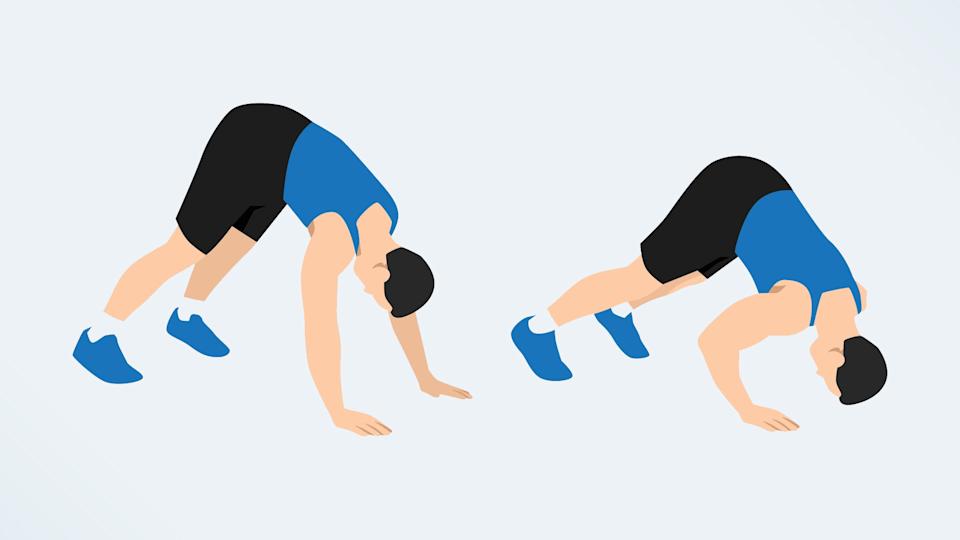
Pike push-ups vertically load the body, which means you’ll start in a position similar to a downward-facing dog, then tap the crown of your head down to the ground just in front of your hands and push upward again. Like the overhead press, it works the shoulders, pectorals, triceps and core muscles, but also tests hamstring flexibility.
Over time, using your bodyweight to perfect this exercise will help you build mobility, shoulder stability, balance and strength, making your overhead press feel more comfortable.
How to do a pike push-up
Here’s how to do a pike push-up:
-
Start in a downward-facing dog, then walk your feet and hands slightly closer together and send your butt toward the ceiling. If you have tight hamstrings, softly bend your knees.
-
Before you begin, brace your core muscles and shift the weight forward into your shoulders.
-
Lift onto the balls of your feet or tiptoes.
-
Wrap your elbows closely toward your ribs.
-
Lower the crown of your head to the floor just in front of your hands, creating a tripod position while bending your elbows.
-
Pause, then press upward and backward. Your hips should stay high throughout.
Aim for 6-8 reps to begin. I’d try 3 sets, but you can aim for more or less depending on how you’re using the exercise in your program.
To make the exercise harder, try elevating both feet onto a box or bench. You could also hold a weight in each hand, which takes pressure off the wrists but also gives your head further to travel, increasing range of motion and making the exercise more challenging. The toughest pike push-up variation I have seen involves placing your feet on a Swiss ball — the instability tests your balance and stabilizing muscles to prevent you from falling.
On the flipside, bend your knees more to make the exercise feel easier, or place a block or pad slightly in front of your hands to reduce how far your head needs to travel.
Bottom line
The overhead press is one of the “big lifts” and a brilliant upper-body exercise to include in your regimen if you want to increase strength, power and muscle mass. It’s also functional, which means it closely resembles movements you’d do naturally.
To perform an overhead press with proper form, shoulder mechanics are important, and you will need to work on shoulder mobility to ensure a full range of motion. What does that mean? During the press, think about creating a shelf for the weight to sit on with your arms and shoulders; pull your shoulder blades back and down, setting them properly in position, which also helps engage the lats.
Next, slightly push your head through your arms at the top of the press as you extend your elbows, keeping both arms close to your ears. Imagine placing the bar on a shelf slightly behind your body. This increases stability, but you’ll also need to think about your posture (no arching the lower back) and core engagement to create a strong torso to lift from.
With all of that in mind, adding pike push-ups to your routine can help you learn the correct movement using your bodyweight. As a trainer, I want all of my clients to work with their bodyweight first before adding external loads like dumbbells or barbells. Being able to push, pull, squat and generally move with your own weight is paramount to overall longevity, helping you to stay mobile, flexible and strong when you do hit the weights room.

Follow Tom’s Guide on Google News and add us as a preferred source to get our up-to-date news, analysis, and reviews in your feeds.