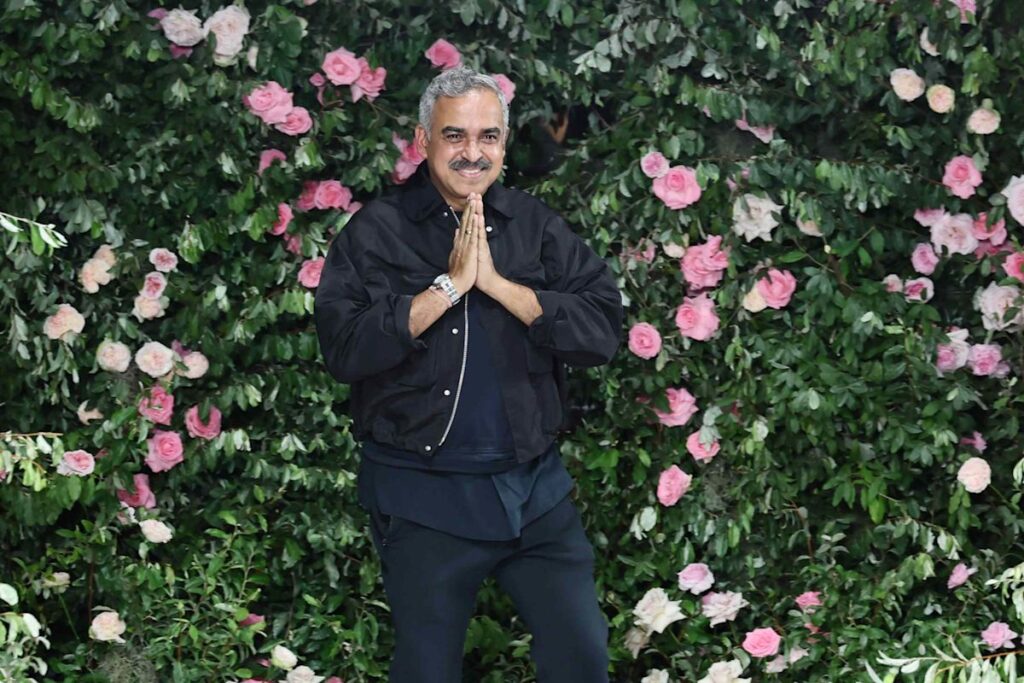


Designer Bibhu Mohapatra has built a career that spans continents, with his celebrated fashion house firmly on the international stage, and clients including Michelle Obama, Priyanka Chopra Jonas, and Glenn Close. But before all of that, there was Rourkela, Odisha—the industrial city where he grew up and where his story began.
Mohapatra was about 10 years old when his mother taught him to sew after noticing his fascination with his grandmother’s sewing machine. He practiced on old saris and bedsheets, turning scraps of everyday life into clothes for his sister. His father nurtured another side of that same curiosity. Weekends meant taking apart his motorcycle and putting it back together, an exercise in mechanics and problem-solving that Mohapatra now describes as part of the making of his “technical mind.”
When he was 13 years old, his mother gave him the ultimate vote of confidence: cash and the opportunity to design his sister (his very first model, he would later realize) an outfit for a wedding. He made a yellow chiffon skirt paired with a cotton black-and-gold jacquard top. “I remember being at the venue when my sister walked in—the big doors opened, the breeze was coming through, and she walked in with such confidence. Afterward, she told me, ‘I never felt like this.’ Between my mom acknowledging that I was good enough to make something and my sister expressing how she felt, I thought, ‘Okay, I have something—I can make other people feel that way.'”
Advertisement
Advertisement
But growing up in Rourkela in the 1990s, Mohapatra saw a city shaped more by engineering and medicine than by the creative industries. India had few avenues into fashion education, and becoming a designer was not a traditional professional path. So he studied economics, in part because it offered a more practical route forward.
After completing his bachelor’s degree, Mohapatra moved to Utah for a master’s degree in economics. When he checked his suitcases in Kolkata before flying to the United States, he thought he had left them behind at the counter. “I thought I was supposed to bring them onto the plane with me,” he said. A flight attendant pointed out the luggage being loaded onto the aircraft, but he still didn’t believe it. “Those were the longest 24 hours. When I finally got to JFK and found my suitcases, I ran and hugged them.”
Still, the impulse to create things persisted, and he eventually enrolled in the Fashion Institute of Technology, in New York City, The boy who learned to sew from his mother and dismantle machines with his father would eventually find his way into the rarefied world of fashion. When asked when he felt he had “made it,” he doesn’t cite a fashion milestone, celebrity moment, or accolade, but says that it was when he got his U.S. visa. “You could invest all that money and time preparing, but if you didn’t get a visa, you couldn’t go,” he said.
What followed was a long way from the so-called pragmatic life he had once imagined for himself. One of his admissions exercises for FIT asked him to design something for the first lady at the time, Hillary Clinton. Years later, the exercise would acquire an almost uncanny resonance: in January 2015, then first lady Michelle Obama arrived in Delhi wearing one of Mohapatra’s designs—a moment he’s described as a turning point in his career and a realization of his American dream.
First Lady Michelle Obama wears Bibhu Mohapatra during a visit to India in January, 2015.
Credit: Saul Loeb/AFP via Getty Images
Now, three decades after that first flight, Mohapatra has traveled the world for his craft. “Travel is a big part of my process, and it helps me reset my mind and gives me life,” he said. He points to Cape Town, Marrakech, Yalıkavak on the Turkish coast, western Odisha, southern Kerala, and China as sources of inspiration—and says there is still much of India, Africa, Japan, and Brazil he hopes to explore.
Advertisement
Advertisement
For Mohapatra, traveling isn’t just about finding new visual references, but about understanding the people and cultures behind them. He wants to spend enough time in a place to see its traditions from the inside. “It’s a big part of traveling and culturally understanding people, rather than just going into a place and trying to get inspired by their techniques,” he says. “No, it’s really about living with them, understanding how they eat and what their life is like, and then observing it deeply enough that I can do justice to a craft influenced by [them]. It’s always about the people, the food, and the craft.”
Through seeing the world, he’s acquired a new lens through which to see Odisha. His husband, artist Bobby Beard, has helped him look at the state with fresh eyes, pointing out things that Mohapatra himself missed simply because they were so familiar in his everyday life. His late brother, who he lost during the pandemic, encouraged him to explore more of the state as well, including places like Satkosia, a wildlife sanctuary and tiger reserve, that he might otherwise never have visited.
His brother also introduced him to one of his most treasured spots: a secluded peninsula near Chandrabhaga Beach, where a river meets the Bay of Bengal. “It is a private spot, and the owner kindly allowed us to pitch our tent and have a picnic there,” he said. “I remember the sky, the river, the sea, and the sand all meeting in one place, with almost nothing built to interrupt them. It was grand and simple at the same time, and I have never forgotten it.”
For Mohapatra, returning to Odisha is about more than nostalgia. It is about looking again at landscapes that once seemed ordinary, at traditions that existed long before he had a name in fashion, and at the people and places that shaped him before he ever imagined leaving. Odisha is home to countless handloom traditions and artisanal practices—Sambalpuri ikat (bandha), Bomkai weaving, Kotpad textiles, Khandua silk, Dhalapathar weaving, Pipili appliqué, and silver filigree (tarakasi), to name a few—and while Mohapatra draws inspiration from them, he is wary of the all-too-familiar practice of taking a traditional craft, putting a designer’s name on it, and claiming it as something new.
Advertisement
Advertisement
For him, supporting local craftsmanship means the people who make the textiles need to benefit financially and be recognized for what they create. In past projects, he has been mindful of making sure weavers get credit. “The root is not me. I’m just someone who sketches, gives them the design. But the due credit is to the people. That’s why I’m a very big proponent of weavers weaving their name into the fabric.”
An ikat saree designed by Bibhu Mohapatra for Ikatan.
Credit: Ikatan
Below, Mohapatra shares some of his favorite places and discoveries from Odisha. “I think Odisha has everything,” Mohapatra added. “It has mountains and the sea, and while we don’t quite have a desert, western Odisha is pretty arid and has its own beauty. There are textiles, crafts, food, and architecture unlike anywhere else—and we’re talking about centuries-old traditions. So much has remained unchanged, and there’s still so much to discover.”
What’s the first thing you do when you return home?
See my family very fast, and then go and eat.
What’s your favorite place in Odisha?
Satkosia. The tiger reserve, ecotourism facilities, crocodile rehabilitation center, and boat rides in the river are all massive draws for me. I had the most restful stay here. Plus, it was the favorite place of my beloved late brother, Bijaya Ram, to visit with family and friends. He’s the one who took me to Satkosia. I will never forget that trip.
Advertisement
Advertisement
There’s also the Konark Sun Temple. I first visited it when I was six, and the memory has stayed with me ever since. My late mother took me there, so it holds something deeply personal for me. Whenever I can, I go back. Each time, I’m humbled by the greatness of what my people, the Odia people, created. The temple is a poetry in stone, and its artistry and architectural ingenuity takes my breath away.
Is there a standout hotel you recommend?
The Belgadia Palace in Baripada. These two sisters took their ancestral home and created a beautiful small hotel, and they tell the stories of their family.
For visitors doing Odisha’s classic circuit, what should they prioritize in Bhubaneswar, Puri, and Cuttack?
In Bhubaneswar, explore the temples and the Old Town. In Puri, visit the Jagannath Temple, Swargadwar, the eco retreats, the old bazaars, and take a trip to the craft village of Raghurajpur to visit the artists residences. In Cuttack, I’d recommend travelers go to the Barbati Fort, the Subhas Bose Museum, and shop Cuttack’s finest craft, silver tarakasi jewelry.
What’s your favorite beach in Odisha?
I loved Puri Beach growing up, but there are also great beaches farther south in the Chandrabhaga area.
What’s a scenic drive you’d recommend?
The mountain drives in the Koraput district. You’re in the woods and then all of a sudden you see these cliffs and beautiful views.
What should a first-time visitor eat to understand Odia food?
My favorites are pitha (traditional cakes, crepes, and dumplings), rasabali (a soft paneer-based dessert), ilishi (a herring-like fish also known as hilsa), prawns, and ilishi shukua (dried fish). First-time visitors should dahi vada aloo dum (lentil dumplings in yogurt with spicy potato curry) for street food, but Odia home cooking is the heart of our cuisine, and no restaurant quite matches it. Palanga saga (spinach stir fry) is a go-to. If you’re on the coast, order the steamed fish, which is fresh and delicately spiced. And have pakhala bhata, fermented rice served cool with an array of condiments. My personal favorite is sukhua curry, made with sun-dried fish. It is bold and deeply flavorful, and it tastes like home to me.
What festival would you travel to Odisha specifically to experience?
Raja (a three-day holiday celebrating womanhood, fertility, and menstruation) or Durga Puja (an annual Hindu festival that celebrates goddess Durga)
What do you wish more travelers understood about rural Odisha?
Being from Rourkela, I grew up in close proximity to tribal communities, and their world is incredible. Craft is woven into the way they live, such as with their beautiful tribal jewelry. Even the way they grow vegetables is completely unique.
What’s one souvenir you think everyone should seek out?
Talapatra (palm-leaf art) and pattachitra (traditional painting on a cloth canvas). The technique of pattachitra is its own whole story: they prepare the canvas with layers and layers of natural materials, so that it lasts for centuries.
How can travelers support Odisha’s craftspeople more meaningfully?
Go to the source and go to the weavers. Give them a premium if you can. Part of what you’re getting is the story behind the craft—the human story.
What advice would you give someone planning their first trip to Odisha?
Read about Odisha as much as you can. For example, Bhubaneswar is a vibrant city, but it isn’t going to give you the big-city experience of Mumbai or Delhi—and that’s part of what makes it special. Do your research, know what you’re looking for, and build your trip around that.
Advertisement
Advertisement
Read the original article on Travel & Leisure
Source link