


Dumbbells are great, but weight plates open up a whole new level of strength training. The best weight plates align with your budget and lifting style — cast iron for durability and affordability, rubber for powerlifters who need to drop loaded bars from a height. Whatever your approach, a solid set of plates can turn a basic home setup into a legit lifting space.
Certified personal trainer Cassandra Padula Burke agrees, saying, “[Weight plates] can be used on a barbell but can also be used independently for exercises like overhead triceps extensions, Russian twists and shoulder presses.” She also highlights that weight plates are perfect for strength building, allowing you to add heavier plates as you get stronger. “Weight plates allow you to progressively load muscles to improve strength and build muscle,” she says. Plus, they’re space-efficient. “They are easy to store and don’t take up as much space as an equivalent variety of dumbbells would,” she adds.
Ready to create a gym-quality lifting experience at home? You’ll need three key pieces of equipment: a sturdy weight bench, a good-quality barbell and a set of weight plates. We did the heavy lifting for you here. Over six months, we rigorously tested six sets of weight plates, including rubber, cast iron and Olympic options. We also gathered expert insights from professional personal trainers and powerlifters and drew from our own experiences as lifters to inform our recommendations.
Best overall weight plates
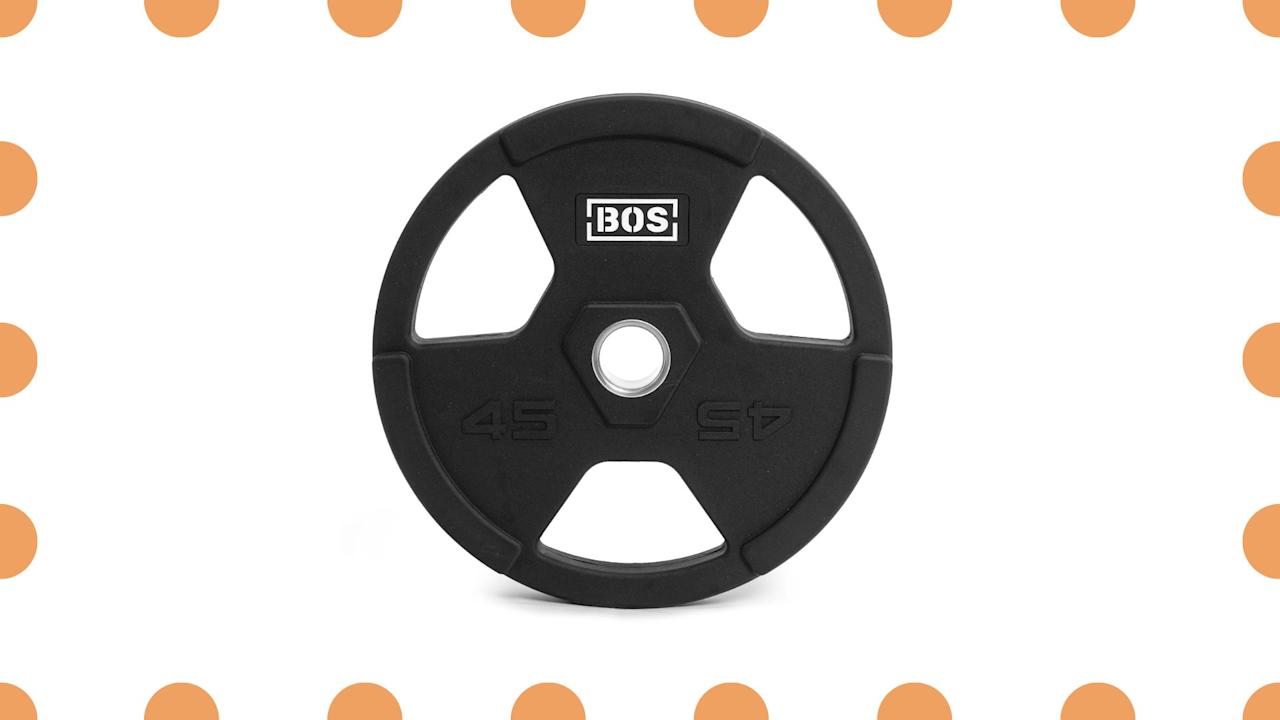
Bells of Steel
Material: Cast iron plate, virgin rubber coating, stainless steel insert | Coating: Rubber | Included weights: Purchase individually or as a set; options range from 2.5-45 lbs. | Type: Light commercial easy-grip plates | Grip handles: Yes | Standout features: Stainless steel insert makes it easy to glide them on and off barbells; virgin rubber coating helps protect floors; handles make them easy to grab and load
If you’re not training for a specific sport like powerlifting or weightlifting, the best all-around plate weights are grippable, rubber-coated plates. The cast-iron interior often makes them more affordable than other options while the rubber coating is easy on the hands and helps protect your floors and barbells. Plus, built-in handles make the plates easier to load and unload from a barbell, adding versatility to your routine. After all, it’s much easier to use a plate weight for overhead triceps extensions or ab work if you can grip the handles rather than trying to white-knuckle a handleless variety.
The Bells of Steel Rubber Coated Iron Weight Plates check all of these boxes in spades. Upon opening, they didn’t smell overly “rubbery,” thanks to the 100% virgin rubber coating, and they weren’t excessively greasy feeling either. We could put them to use immediately without feeling like we’d need to hose them down first or let them off-gas outside before bringing them into the house.
We also appreciate the stainless steel insert at the 2-inch bar hole. This makes them easier to slide on and off the barbell, making for a positive all-around lifting experience.
You can purchase these plates as individual pairs — weight options range from 2.5 to 45 pounds — or you can choose a set of 245 pounds, 335 pounds or 425 pounds. We tested the 245-pound set, which includes a pair of each of the standard weight increments (2.5, 5, 10, 25, 35, and 45 pounds). The heavier sets include additional pairs of 45-pound weights. Affordability improves based on the weight amount purchased. For instance, a single pair of 2.5-pound weights costs $28, which breaks down to $5.60 per pound — definitely on the more expensive side. But the 245-pound set costs $681, or $2.70 per pound — a much more cost-effective option and very much in-range with industry norms.
These plates also feature a 2% tolerance rate, which means they’re guaranteed to be within 2% of the advertised rate. While 2% is higher than you’d want for competition purposes (which typically have a rate between 0.5 and 1%), it’s better than many economy or home gym options (which may fall between 3-5%), making them an overall high-quality choice.
- Easy-to-grip handles offer workout versatility
- Stainless steel insert makes them easy to load and unload from barbells
- Virgin rubber coating helps protect floors
- 2% tolerance rating is good for a home-gym weight plate
- Tolerance rating may not be ideal if you’re training for specific sports
- Design isn’t intended to be dropped from a height — not ideal if you’re training for powerlifting or weightlifting sports
More weight plates we like in 2026
_1484.jpg)
Ethos
Material: Vulcanized rubber | Coating: Rubber | Included weights: 205-pound total weight including barbell, collars and three pairs of plate weights in 10, 25 and 45 lbs. | Type: Olympic bumper | Grip handles: No | Standout features: Set includes a barbell and lock jaw collars
The Ethos 205 lb. Olympic Rubber Bumper Plate Set is our top pick for the best bumper plate set due to its exceptional durability and versatility. Designed to withstand heavy, repeated use, these plates excelled during months of testing in a commercial gym environment, enduring up to six classes per day without any visible wear and tear. Their resilience makes them a reliable choice for intense training sessions, from traditional lifts to powerlifting and CrossFit-style movements.
The Ethos bumper plates are built for rigorous, daily use. One professional powerlifter who helped put them to the test described them as “made to be dropped,” underscoring their suitability for high-impact exercises. Their rubber construction effectively absorbs impact, making them ideal for movements like deadlifts, cleans and snatches.
However, as is common with rubber plates, they aren’t as easy to grip as other types of plates due to their smaller lip at the edges. Loading heavy plates onto a high bar can be slightly challenging, but our testers noted that the narrower profile is advantageous for stacking multiple plates on a barbell.
When the plates arrived, they initially felt slightly slippery — a residue likely from the manufacturing process — but this wore off after a few weeks. Despite this minor quirk, the Ethos plates proved to be well-made and reliable.
Another bonus? The price reflects the full weightlifting set, including six plates, two collars and a barbell. Currently on sale for about $480, the per-pound price is a highly-affordable $2.34, making it a good choice if you want a high-quality set of weights at a home gym-friendly price. That said, if you already own a barbell or are looking to add just a couple of plates to your home gym, Ethos Bumper Plates can also be purchased individually at Dick’s Sporting Goods. Unfortunately, lower-range weights of 2.5 or 5 pounds aren’t available.
- Fully rubber plates
- Barbell and collars included
- Plates can be purchased individually
- Per-pound price is very affordable
- Initial slippery residue
- Harder to grip
- When plates are purchased individually, no option to purchase lower weight increments of 2.5 or 5 pounds
_3768.jpg)
Centr
Material: Rubber | Coating: Rubber | Included weights: Set includes barbell and collars as well as plate weight pairs in increments of 2.5, 5, 10, 25, 35 and 45 lbs. | Type: Olympic | Grip handles: Yes | Standout features: Tri-grip textured design, barbell and collars included
The versatility and usability of the tri-grip textured plate design made the Centr 300 Lb Olympic Set a no-brainer as our top pick if you want to purchase a full set of plates (and a barbell and collars) in one fell swoop. Our tester, who dabbles in professional powerlifting outside of his career as a professional mover — chose this set for his personal home gym, praising its grip and sleek, streamlined design.
“The weight plates have a nice grip feature and seem much smaller and more compact than typical plates,” he says. Additionally, as someone who trains with heavy resistance and powerlifting moves, he appreciated the fact that these plates are rubber, which he explains offers better protection against wear and tear from frequent use.
Reviews on the Centr website echo our findings, with shoppers noting that these weights are easy to pick up and offer a versatile range of weights (from 2.5 to 45 pounds) to accommodate different fitness levels. As with the Ethos set, the biggest consideration is these weights are sold with a barbell, which may deter those who aren’t looking to add a second (or even a third) bar to their setup. It’s also worth noting that at $800 for the set, the per-pound price comes out to $2.67. That’s still very much within the industry norm (and about 10 cents cheaper than the Bells of Steel set), but a bit pricier than the Ethos set.
- Comfortable grip design
- Easy to load
- Versatile use off bar
- Includes barbell and collars
- Only sold as a set (can’t purchase plates individually)
_4660.jpg)
Nike Strength
Material: Blend of vulcanized rubber and recycled Nike footwear | Coating: Rubber | Available weights: 10, 15, 25, 35 and 45 lbs. | Type: Bumper | Grip handles: No | Standout features: Each batch is color-unique
Along with the Nike Coated Premium Barbell, I’m partial to the Nike Grind Bumper Plates because they’re such a fun and colorful addition to a home gym. They combine practicality, durability and a touch of personality, making them our top pick for best bumper plates.
These plates stand out for their vibrant, colorful design, crafted from at least 30% recycled Nike Grind material — sourced from Nike footwear — which means every set is one-of-a-kind. On the days that I am just not feeling my workout, there’s something about that bright orange bar and my colorful confetti bumper plates that helps keep me motivated.
From a performance standpoint, these plates excel as training tools. Drop-tested for durability, they’re suitable for everything from traditional weightlifting to CrossFit and Olympic-style lifts. However, Nike advises against dropping the 10- and 15-pound plates alone — they should be paired with heavier plates like the 25-, 35- or 45-pound options for safe use.
The plates’ textured, bumpy surface boosts grip compared to smoother rubber plates like the Ethos. This texture, reminiscent of recycled playground material, makes the plates easy to handle during lifts. During testing, the plates held up exceptionally well with no visible wear or tear. The textured material raises minor concerns about potential flaking over time, but we haven’t seen any issues so far.
Nike does include a disclaimer: Prolonged exposure to UV rays, sunlight or heat may cause the plates to develop yellow discoloration. While this doesn’t affect their performance, it’s worth noting if your workout space has multiple windows or tends to get toasty.
It’s worth noting that the bumper plates are only available in 10-45-pound increments (and the 10-pound plates are currently sold out). However, lighter, “change plates” are available including 1.25, 2.5, 5 and 10 pound options.
The plates are only available to purchase in pairs, rather than as a full set, but pricing per pound is affordable, ranging from $1.39 to $2.30, dropping in price as the weight of the plates increases.
- Versatile bumper plates
- Unique, colorful design
- Comfortable grip and loading
- Price per pound is good
- Discoloration can occur
- Only available for purchase as individual pairs of plates, not a full set
Types of plate weights
Thanks to their versatility, weight plates can be used on their own for functional training or paired with a barbell for compound lifts. Whether made from iron, steel or rubber, each type serves a purpose — from powerlifting to CrossFit. Here’s a breakdown of the primary options:
-
Standard weight plates: Designed for a standard barbell with a 1-inch diameter, these plates are best suited for casual or beginner lifters.
-
Olympic plates: These plates fit Olympic barbells with a 2-inch diameter. They can be made from steel, iron or rubber and are known for their high weight accuracy, making them a staple for serious strength training.
-
Change plates: Often lighter and available in smaller weight increments, like 2.5 and 5 pounds, change plates are perfect for beginners or those refining their technique and form. Because of their low weight, they help lifters gradually increase strength while focusing on proper movement patterns.
-
Bumper plates: Thicker and more shock-absorbent than traditional plates, bumper plates are designed for exercises like deadlifts and those performed during CrossFit workouts where weights are frequently dropped from thigh height. These plates are made from all rubber or with a rubber coating over a steel or iron core, offering durability and safety.
-
Competition and powerlifting plates: These plates are engineered for maximum weight accuracy and precision. They’re typically reserved for high-level strength competitions.
Factors to consider when purchasing weight plates
The best weight plates for your home gym depend on your goals, space and how you like to train — whether you’re chasing PRs (personal records) or you’re just trying to challenge yourself on leg day. Here’s what our experts say you should keep in mind when picking your plates:
Durability
According to Burke, durability is an important factor, though it may be outweighed (no pun intended) by other considerations, like your workout space and budget. Still, when possible, opt for weight plates designed to withstand regular use. Cast iron and steel plates, for example, are incredibly durable and have been trusted since the 19th century, but they can be noisy and may damage floors or walls if dropped.
Rubber-coated plates are quieter and less likely to cause damage, making them a good choice for apartments or shared living spaces. Burke explains that rubber plates remain highly durable because they often feature an internal iron or steel core for added strength.
Construction and calibration
High-quality construction and accurate calibration are key. “Weight plates should be accurate within 1% to 2% of the specified weight,” Burke notes. This accuracy ensures consistent training and prevents imbalances — for instance, poorly calibrated weights can cause problems when loaded onto a barbell, leading to discrepancies in load between the two sides. Many manufacturers list their plates’ weight calibration online, but you can also contact the company before purchasing to double-check.
For serious lifters or those aiming for precise progression, Raymond Agostino, physical therapist and sports performance coach, recommends competition-grade plates with a weight accuracy to within 0.5%. However, he adds that standard weight tolerance is adequate for most home gym setups.
Burke also points out that poor construction and damage to the plate, such as chipping or cracking, can affect the accuracy of the weight. “Damage to the rubber coating of the plate can expose the iron underneath, making it vulnerable to corrosion, which may cause weight loss,” she says. This brings us to the next consideration: material and coating.
Material
Weight plates are typically made from cast iron, steel or rubber, with some rubber plates featuring a metal core. As Agostino points out, each material has its pros and cons. “Cast iron plates are cost-effective and compact, steel plates are durable [and] rubber-coated plates are quieter and protect floors,” he says.
Training and strength goals
If you’re new to weight training, dumbbells may seem like a more approachable and versatile option. But trust us: weight plates are just as versatile. Noelle McKenzie, a certified physical trainer and correctional exercise specialist, explains that weight plates can double as dumbbells for exercises like chest flies, curls and raises, while also offering added functionality. Beyond their traditional use with a barbell for heavier lifts, weight plates can be used creatively for bodyweight exercises, like planks or wall sits, introducing variety and challenge to your workouts. Ultimately, how you plan to use the plates will determine which plates to buy and how heavy your weights need to be.
Available space
McKenzie emphasizes that weight plates are more space-efficient than dumbbells or kettlebells, as they can be stored on a plate tree or mounted on a wall.
Application
Umo Callins, a certified physical trainer and board-certified sports dietitian, recommends choosing a weight plate based on your budget, the floor it will be used on and how the weights will be used.
“If you plan on squatting, deadlifting and doing Olympic lifts, bumper plates work best because if you drop the bar, the plates will have some level of bounce,” she says. “Plus, as long as your bar has a high whip grade, they will not bend your bar over time.”
Overall, bumper plates are Callins’s go-to recommendation. “Bumper plates are easier on your flooring, not loud when dropped and allow you to do more varieties of barbell training,” she notes.
Budget
While top-tier Olympic weight plates aren’t necessary for most home gyms, going too cheap may sacrifice durability and end up costing more over time. Ideally, opt for a high-quality, durable set from a reputable manufacturer. Depending on the brand, some plates are covered under warranty, providing additional peace of mind.
How we chose
To determine the best weight plates for every fitness level, two professional personal trainers, several powerlifters and a diverse group of casual gym-goers of varying ages and abilities rigorously tested five weight sets, providing a well-rounded perspective on each plate’s performance. The plates were used regularly over six months to assess their durability and reliability with repeated use in home and commercial gym environments. Each set was evaluated based on its materials, durability, performance and overall value.
Our final list was determined using a combination of tester feedback, expert insights from personal trainers and our own lifting experience.
Other products we tested
-
Sole SW106 Olympic Weight Plates: This 245-pound set of rubber-coated Olympic weights was previously our top overall pick for best weights. Reasonably priced at $600 and with wide, easy-to-grip handles that are easy to rack and unrack, there’s a lot to love about this set. Unfortunately, it’s now out of stock, and the website doesn’t indicate whether they’ll be available for purchase again.
-
Flybird Cast Iron Olympic Plate Weights: Previously named our top cast iron choice due to a wide and easy-to-grip lip and a baked enamel finish to help prevent rust and corrosion, these plate weights have since been discontinued.
FAQs
What type of weight plates do I need for my barbell?
Most weight plates are designed to fit either a standard barbell with a 1-inch diameter or an Olympic barbell with a 2-inch diameter. If you’re unsure, check the manufacturer’s specifications to confirm compatibility. For added assurance, consider purchasing a coordinated set of plates and barbells to guarantee a perfect fit.
What’s the difference between cast iron, steel and rubber-coated plates?
Cast iron and steel plates are highly durable and built to last, but they’re not intended to be dropped during workouts. In contrast, rubber-coated plates are designed for high-impact movements like deadlifts and snatches, safely absorbing the force when dropped on the ground. This makes them ideal for more dynamic training styles.
How accurate should my weight plates be?
Most weight plates should be accurate within their reported 1% to 2% range. Some manufacturers also list the weight plate calibration for accuracy. On our list, for instance, Ethos reports that its weight plates are calibrated to +0.1% to -0.05% of 20 kg.
How do I care for and maintain my weight plates?
Metal plates can be wiped down with a cloth, dried and occasionally treated with WD-40 to prevent rusting. Rubber plates can be cleaned using mild dish soap and water, then towel-dried. To prolong the life of all weight plates, avoid exposing them to excess moisture or humidity and store them off the floor whenever possible.
What safety precautions should I take when using weight plates?
Always use reliable equipment and regularly inspect weight plates for signs of damage, such as cracks or chips. When lifting a barbell, prioritize safety by using equipment like clips or collars, racks and safety arms and enlist a spotter whenever possible. It’s also important to take care when storing weights. Improperly stacked plates can pose a falling hazard or result in pinched fingers. To minimize risks, use a plate tree or designated storage system.
Meet our experts
-
Raymond Agostino, DPT, sports performance coach and owner of Agostino Athletics in Fort Myers, Fla.
-
Cassandra Padula Burke, MFS, RDN, CPT, owner of Catalyst Performance Lab in Finksburg, Md.
-
Umo Callins, MS, RD, LD, CSSD, CPT, a sports dietitian and fitness coach based in Oklahoma City, Okla.
-
Noelle McKenzie, CPT, correctional exercise specialist and co-founder of Leading Edge Personal Trainers in New York,
-
Tim Strunk, CPT, former head trainer at Eighty Twenty Club in Lapeer, Mich.
Update, Jan. 12, 2026: We checked all product prices and availability. Our No. 1 pick remains unchanged.
Our health content is for informational purposes only and is not intended as professional medical advice. Consult a medical professional on questions about your health.