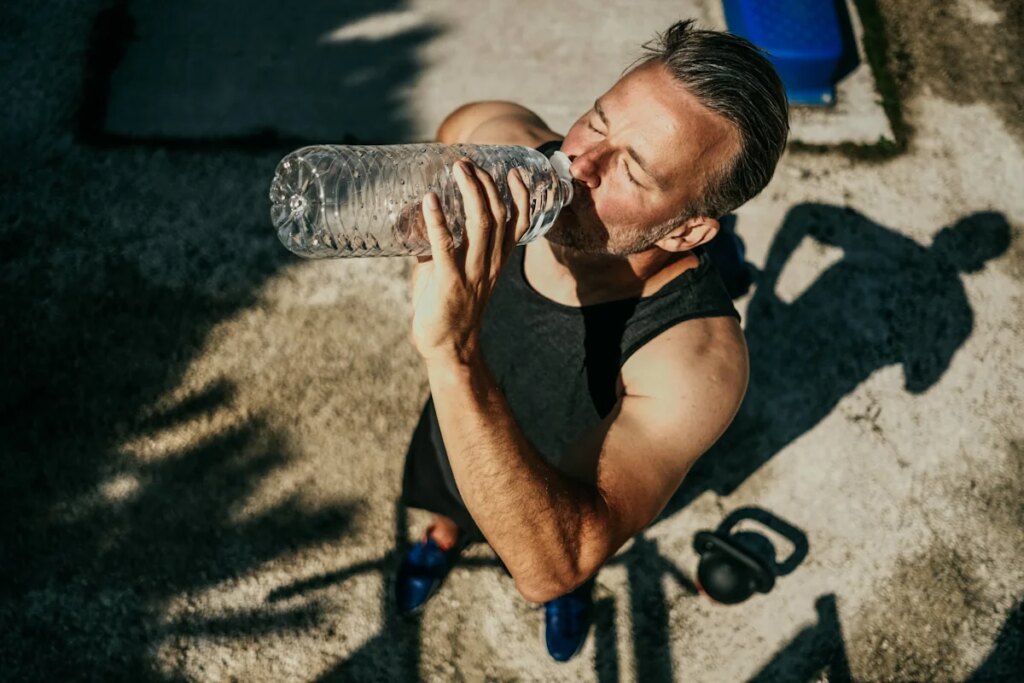
You cannot build two pounds of muscle between breakfast and lunch. A body-composition scan can still make it look like you did.
A new randomized trial found that drinking one liter of water before a dual-energy X-ray absorptiometry scan—usually called DXA or DEXA—increased the machine’s whole-body lean-soft-tissue estimate by roughly 1.7 to 2.2 pounds. The effect persisted through the final scan 90 minutes later.
The water did not become muscle. The machine classified most of the added mass as lean tissue in the trunk.
What the Study Found
For the study published in Clinical Nutrition ESPEN, researchers assigned 46 adults—26 men and 20 women—to drink no water, 250 milliliters, 500 milliliters, or 1,000 milliliters after an eight-hour food-and-fluid fast.
Advertisement
Advertisement
Each participant received a baseline DEXA scan and additional scans immediately after drinking and 30, 60, and 90 minutes later.
One liter of water produced the clearest result. Whole-body lean-soft-tissue estimates remained roughly 0.76 to 1.01 kilograms above baseline across the post-drink measurements. At 500 milliliters, whole-body lean soft tissue was 0.627 kilograms above baseline at 90 minutes. At 250 milliliters, it was 0.442 kilograms above baseline at 30 minutes, but the smaller-dose effects were not consistent across all post-drink scans.
Between 53 and 99 percent of the apparent lean-tissue change came from the trunk. Appendicular lean soft tissue—the estimate from the arms and legs—did not change significantly.
Why Water Can Register as Lean Mass
DEXA does not directly count muscle fibers. It uses low-dose X-rays to separate the body into bone mineral, fat mass, and lean soft tissue. Water sitting in the digestive tract is neither bone nor fat, so the algorithm can assign much of it to the lean category.
Advertisement
Advertisement
That distinction matters because “lean mass” includes far more than contractile muscle. It also includes organs, connective tissue, body water, and glycogen-associated water.
This is not the first experiment to expose the problem. In an earlier study of 100 adults, 500 milliliters of water increased the average DEXA lean-mass estimate by about 525 grams and reduced estimated body-fat percentage by 0.16 percentage points. In another experiment, 12 active men lost 1.69 kilograms of DEXA-measured lean tissue after exercise and heat-induced dehydration; after 48 hours of rehydration and carbohydrate loading, the reading rose 2.36 kilograms—changes that did not represent comparable muscle loss and gain.
What This Means for Tracking Muscle Gain
A DEXA scan can still be useful. The mistake is treating every decimal point as a biological fact.
If you want to compare two scans, make the conditions as similar as possible:
Advertisement
Advertisement
-
Use the same facility and machine when possible.
-
Schedule each scan at approximately the same time of day.
-
Follow the facility’s instructions on food, fluid, exercise, and clothing.
-
Arrive with a similarly empty bladder.
-
Avoid placing one scan after a hard workout or carbohydrate-loading day and the other after fasting or dehydration.
The International Society for Clinical Densitometry likewise emphasizes consistent preparation, including fasting state, time of day, physical activity, clothing, positioning, and bladder status.
The new study’s authors recommend consuming less than 500 milliliters during the 90 minutes before a standardized whole-body DEXA assessment. That is a testing protocol, not advice to deliberately dehydrate yourself. Follow the instructions from the clinic performing your scan, especially when the test has been ordered for a medical reason.
What the Study Cannot Tell Us
This was a small, short experiment in 46 adults. It measured the 90 minutes after water intake, not normal day-to-day changes across a training program. Different scanners, software, meals, hydration states, and populations may produce different errors.
Advertisement
Advertisement
It also does not show that DEXA is useless. The arm-and-leg estimate remained comparatively stable, and standardized scans can still help monitor trends. The lesson is that preparation affects the number—and one scan cannot prove exactly how much muscle you gained.
The Bottom Line
Drinking one liter of water before a DEXA scan can add as much as roughly 2.2 pounds to the machine’s whole-body lean-mass estimate. Most—and in some measurements almost all—of that apparent change came from the trunk, not new muscle in your arms or legs.
Do not chase the most flattering scan. Chase repeatable conditions. A trend measured the same way each time is more useful than a precise-looking number collected under completely different circumstances.
This article is for informational and educational purposes only and is not medical advice. Follow the preparation instructions provided by the clinician or facility performing your scan. Men’s Fitness did not participate in the research, and no clinic, scanner manufacturer, supplement company, or other commercial entity paid for or influenced this coverage.
Advertisement
Advertisement
This story was originally published by Men’s Fitness on Oct 21, 2026, where it first appeared in the Training section. Add Men’s Fitness as a Preferred Source by clicking here.