


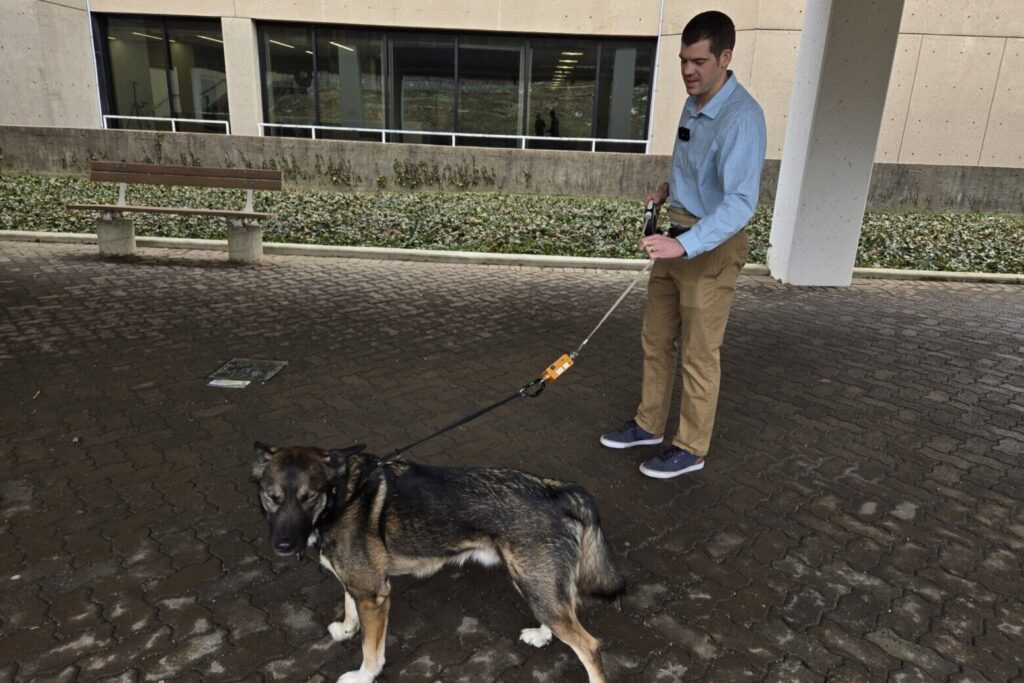
UDC professor Alex Peebles designed a study and a system for measuring the forces exerted on volunteers walking their dogs.
Alex Peebles describes 4-year-old Guinness as a very strong and energetic dog, “but not the best trained on leash.”
Peebles said he noticed when he his dog pulled on the leash while they were walking, “it was aggravating some back pain that I had been dealing with.”
His mother also hurt her knee while walking her dog, and that led Peebles, an assistant professor of mechanical engineering at the University of the District of Columbia, down a new research path.
“We wanted to characterize how much force dogs typically pull with, and we wanted to know what effect that pulling behavior had on human walking balance, as most of the injuries that result from dog walking were fall-related,” he said.
Peebles and three of his students at the UDC School of Engineering and Applied Science designed the study and a system for measuring the forces exerted on volunteers walking their dogs.
Existing research on dog-walking injuries doesn’t dig into their causes, so the UDC study is the first of its kind.
“We found that a lot of participants had very small or negligible amount of pulling force,” Peebles said, and many people walk their dogs without issue. “But you do see a large number of people whose dog is pulling them.”
A quarter of the participants were pulled by forces of 45 pounds or greater, and the largest force recorded was 92.5 pounds.
“Which is a considerable amount of force, considering the fact that it’s happening while you’re walking,” Peebles said. “That will pull your body forward into potentially dangerous positions.”
The findings, published in the “Annals of Biomedical Engineering,” are based on data collected by 20 dog owners.
Peebles said he wants to expand on the initial study with more research in the real world and in the simulation lab.
“We really want to collect a lot more data to understand the impact of the dog size, the dog’s breed, the size and age of the human, the effect of different types of equipment, like different leashes and harnesses,” Peebles said.
From there, he said he foresees developing guidelines for safer dog-walking behavior.
“If we look at a lot of other activities that we do that are known to cause injury, for example occupational lifting, there’s safety guidelines out there that say, ‘How much force or how much weight is it safe to ask an employee to lift?’ There’s nothing like that that exists for dog walking,” Peebles said.
Get breaking news and daily headlines delivered to your email inbox by signing up here.
© 2026 WTOP. All Rights Reserved. This website is not intended for users located within the European Economic Area.