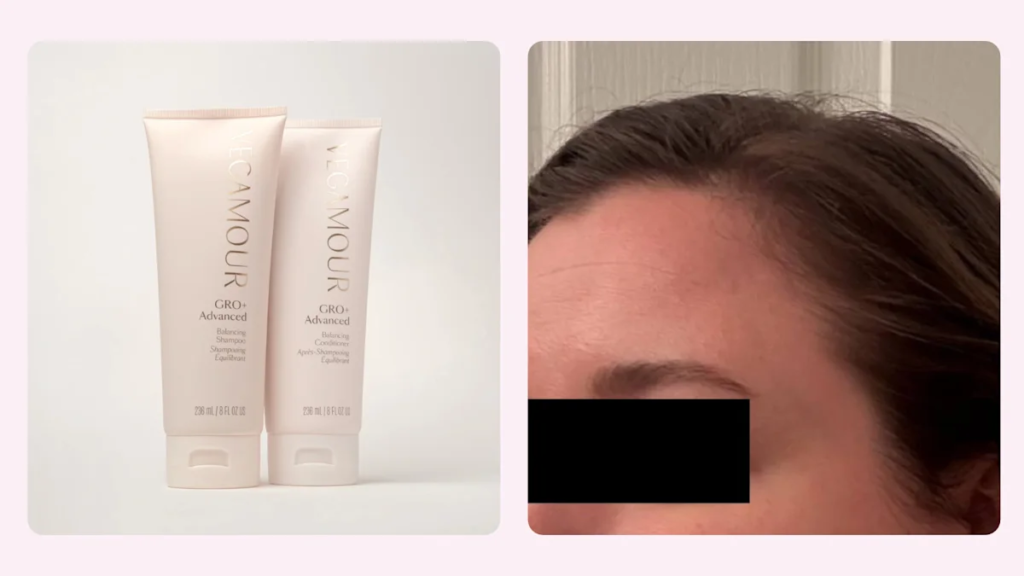


A hair growth shampoo requires the bare minimum of commitment — it’s a simple swap for something you already have in your shower. That’s the pitch behind Vegamour GRO+ Advanced Balancing Shampoo and Conditioner, the brand’s line claims to deliver “up to a 95% reduction in shedding,” and at $94 a set, it’s a pitch with a serious price tag.
Our tester, in her 20s, didn’t need convincing. While she had never tried a hair loss treatment of any kind before, she’d spent at least a year building her mornings around hiding what was happening at her hairline. “Whenever I wear my hair up, you can see bald spots around my forehead area,” she said before she started. “I dislike it!”
Four months later, it’s safe to say our tester liked what she saw. “This product has done exactly what I hoped for,” she said, and her survey results — and her before and after photos — back her up. She rated her overall results a perfect 5 out of 5. Her shedding dropped and hair density went from a dismal 1 out of 5 to a 3, which she “really noticed” when she went back to look at her starting pictures. The conditioner, though? “It’s just OK,” and she blames it for causing greasy locks.
Advertisement
Advertisement
Here’s what we learned.
Vegamour
A solid win, but from only half the kit: The shampoo delivered less shedding while visibly filling in patches at her hairline, while the conditioner seemed to work against her.
Price: $94 for the set, or $52 for the shampoo alone
Best for: Early thinning at the hairline, for someone who’d rather swap a step than add one
Timeline to notice changes: Around 2 months for our tester
Would she buy it again? Yes — the shampoo, not the conditioner
- Perfect overall score
- Baby hairs and filled-in patches by month 2
- Noticeably less shedding
- No irritation on our tester’s sensitive skin
- Pricey, even for a 2-piece set
- Conditioner left hair “rough” and greasy
- Not a hair-growth formula
📍 The baseline: where our tester started
Shocking as it may seem, hair loss can, in fact, affect you well before perimenopause, as our 20-something tester knows full well. She’d been dealing with hair thinning for at least a year, with a visible scalp and a dwindling ponytail topping her list of hair woes. “I lose so much hair when I shower, brush, put it up in a ponytail — or really anything,” she said. Her hair had gotten thin enough that it was breaking easily too.
The spots on her temples and the front of her hairline bothered her the most since they’re the hardest to hide. She avoided buns. When she did attempt a ponytail, it was only with the help of “a lot of dry shampoo” to offer a temporary volume boost. Curling didn’t help. “My hair is so thin that it just drops. It was very difficult to think about styling it every single day. “
Before testing, she gave her hair density a 1 out of 5, the lowest score possible, with shedding coming in at a 2 out of 5.
🧴 The routine: what it’s actually like to use
Sticking to a new hair-wash routine proved easy for our tester. She rated ease of use and her own consistency a perfect 5. “A handful of times while traveling, I used a different product, but 99% of the time I have been using the same products,” she said.
Advertisement
Advertisement
Vegamour’s instructions ask users to work a quarter-sized amount of the shampoo from the scalp to the ends, leave it on for a full minute before rinsing. “I followed the directions and made sure to really massage my scalp for several minutes with the shampoo,” she said, “and I think that’s what has caused a drastic improvement in the amount of new growth.”
The directions also call for massaging the same amount of conditioner from roots to tips, then leave it for 2 minutes before rinsing. That part of the instructions is worth a pause.
“Traditionally, most conditioners should be applied from the mid-lengths to the ends,” says Kelly Dobos, a cosmetic chemist and adjunct professor of cosmetic science at the University of Cincinnati. “Applying a rich conditioner directly to the scalp can weigh down fine hair and may leave it greasy sooner.”
While Dobos notes that a roots-to-ends application can make sense for a lightweight conditioner built around scalp health, Vegamour GRO+ Advanced Balancing Conditioner is not lightweight. It contains rich emollients like shea butter and coconut oil that make hair feel smooth — and heavy at the roots.
🕐 The midpoint check-in: any early changes?
Six weeks into testing, our Vegamour tester filled out her second survey. While it’s still early for true hair growth results — the follicle cycle is slow — a midpoint check-in is great for gauging whether a product is tolerable and whether there’s an early flicker worth watching.
Advertisement
Advertisement
For our tester, there was. Shedding was the first thing to move — and at the same time, her hair started getting “oily faster than before.”
At the halfway mark, here’s where she landed:
Shedding vs. baseline | Noticeably less — “A lot less hair coming out in the shower than before” |
Overall change noticed so far | Clear improvement — less shedding, new growth, stronger-feeling hair |
Flagged problem areas | Hairline, ponytail and scalp visibility slightly better; crown, part and overall thinning unchanged |
Confidence the product is working | 3/5 — not yet convinced |
Confidence is how sure she is that the product caused the change.
At this point, growth at her crown and part was unchanged, as was overall thinning. But she noted that hairline, ponytail thickness and scalp visibility had all moved to “slightly better.”
🪞 The results: what happened after 4 months?
Her numbers moved in both of the directions that matter. We ask testers to rate each category on a 1-to-5 scale, where 5 is always the best result — so a higher shedding score means less hair lost, not more. When testing wrapped, here’s where she landed:
Category | Result |
|---|---|
Density and thickness | 1/5 → 3/5 — filled-in patches at her hairline |
Shedding severity | 2/5 → 4/5 — substantially less |
Most notable change | Less shedding, new growth (baby hairs) |
First noticed | Around 2 months |
Confidence it caused results | 5/5 |
“My hair before was very thin and sparse, so I always hated having it pulled back,” she said. “But now I feel a big difference in the bald patches that I have framing my face.” While she can still see some of her scalp, she says she’s “had a dramatic improvement.”
Advertisement
Advertisement
What convinced her, however, wasn’t the mirror — it was her before-and-after photos. “I really noticed a difference when I went back to look at my starting pictures,” she said. This is an argument for taking a before shot of your own part before you start anything, because slow change is nearly impossible to see day to day.
Before and after: 4 months of Vegamour GRO+ Advanced Balancing Shampoo and Conditioner Kit
“It’s done exactly what I hoped for — promote new growth and thicken the hair I already have.”
Baby hairs — the result our tester was most excited about — are a hopeful sign, but not yet something to fully bank on. They “may represent true new growth, but they can also simply be short, broken hairs,” says Dr. Sejal Shah, a board-certified dermatologist at SmarterSkin Dermatology in New York City.
Less shedding may be the early result that matters most. “One of the earliest and most meaningful signs that a treatment may be working is reduced shedding,” Shah says.
Her scores cover both products. Her enthusiasm doesn’t.
Advertisement
Advertisement
“I think the shampoo is the heavy lifter. The conditioner was just OK,” noted our tester. “The ends of my hair are not as healthy and soft as they have been when using other conditioners, and I think the conditioner is what caused my hair to become greasy faster.”
🎯 The target audience: who’s this actually for?
At Sephora, this set is billed as a treatment for those dealing with “severe signs of thinning,” but Vegamour’s own site is more modest — and accurate. There, the kit is for “anyone seeing signs of shedding or wanting to support a hydrated, balanced scalp.”
“A healthy scalp provides the environment follicles need to function optimally, while problems such as excess oil, dandruff, inflammation or other scalp disorders can contribute to increased shedding and poorer hair quality,” says Shah.
But there’s a wall. “Improving scalp health alone will not reverse underlying hair loss conditions such as androgenetic alopecia, alopecia areata or scarring forms of alopecia,” she says. “While maintaining a healthy scalp creates favorable conditions for healthy hair, it is not a replacement for treatments that address the underlying biological causes of hair loss.”
🧬 The science: what’s actually in GRO+ Advanced?
Finding out what’s actually in this kit is harder than it should be. While we found no issues with the conditioner’s label, the shampoo ingredients on Vegamour’s website match the 28-ingredient list for its GRO+ Advanced Hair Serum (see our full review). Not one is a cleanser, a preservative or a fragrance. Sephora, Kohl’s and Amazon, meanwhile, list a different, 42-ingredient formula. Vegamour did not respond to questions about the discrepancy.
Advertisement
Advertisement
Your best bet? Go by the bottle. The ingredient list on the package is the one that must legally match what’s inside, Dobos says. For the shampoo, the breakdown below uses the 42-ingredient version.
Across the two products, Vegamour highlights four ingredients:
GROActive+ Complex: Vegamour’s marketing term for encapsulated rhubarb and Japanese beautyberry, a pairing it credits with reducing shedding. Dobos says the science is thin: rhapontic rhubarb “doesn’t have a whole lot of good evidence showing it reduces hair shedding or breakage,” while beautyberry’s evidence “comes from cell culture or preclinical work rather than large human trials.”
Sustainable microalgae: The company’s term for chlorella vulgaris extract, a single-celled green alga used in skin creams for its antioxidants and fatty acids. Its purported scalp-balancing and hydrating benefits rest “on its chemical composition and proposed mechanisms rather than any clinical hair-growth studies that I could find,” Dobos says.
Advertisement
Advertisement
Niacinamide: This form of vitamin B3 has a long skin-care track record, lending support to the shampoo’s oil-control and skin-barrier claims. Those are scalp benefits, though, not hair benefits.
Marula oil: The conditioner credits this southern African nut oil with smoothing, softening and nourishing — the kit’s most modest claims. It’s about 69% oleic acid, and a 20-person study found it non-irritating and moisturizing, though the study tested skin, not hair.
The kit’s own research is just as hard to assess. Vegamour touts a “75% reduction in breakage after one use,” but provides only an asterisked note — no methods, no named lab and no published study to review.
The more modest promises — a less oily scalp and softer hair — have more support than the shedding benefit, which may have drawn shoppers to the kit in the first place. That gap also reflects the limits of shampoo.
Advertisement
Advertisement
“I would not expect much help from a shampoo alone,” says Dobos. “It may help scalp condition and improve hair-fiber strength, which reduces breakage. But if someone is experiencing androgenetic alopecia, a shampoo isn’t likely to help.”
🤼♀️ The competition: other shampoos we tested
We tested four other shampoos across the 2026 panel. Here’s what our testers found:
🧪 How we test hair growth products
No hair growth product in Yahoo Health’s testing program gets judged on its spec sheet or marketing claims. Every product goes to someone actually dealing with shedding, thinning or a receding hairline, and stays with her for three to four months. Testers complete a baseline survey and “before” photos, check in around six weeks and again at the end, and rate density, shedding, scalp visibility, ease of use and their own consistency on a 1-to-5 scale.
Advertisement
Advertisement
Of course, real life doesn’t run on a lab schedule, and not everyone follows the directions to the letter. Our Vegamour tester is an example in the other direction: she massaged the shampoo in for several minutes rather than the one minute on the label, every wash, for four months. We don’t know if that choice shaped her results.
✅ The bottom line
Nothing in these bottles treats hair loss. The two botanicals Vegamour builds its pitch on have almost nothing published on them, and the one study attached to the kit tests hair swatches in a lab and isn’t available for review.
And yet, our tester’s shedding dropped, the patches at her hairline filled in and she’s “very excited” by the results. “I have already suggested the shampoo to other friends who struggle with thinning hair and have definitely felt more confident when my hair is pulled back!” (Note she said “shampoo,” leaving the conditioner off her try-this advice.)
Of course, one good four months isn’t proof a product works, and thin evidence isn’t proof it doesn’t. If you’re early, shedding more than you’d like and you want a gentler wash, $52 for the shampoo alone is a defensible gamble. If you want regrowth, see a dermatologist.
FAQs
Can a scalp-focused shampoo regrow hair?
Not on its own. A healthier scalp is a better environment for the hair you already have. “There’s also emerging evidence that supports the scalp’s skin barrier and reducing oxidative stress may benefit follicle health,” Shah says, “although any direct effects on hair growth are generally modest.” The strongest evidence, she notes, is for treating specific scalp conditions — antifungal ingredients like ketoconazole can manage dandruff and reduce inflammation, “which may help improve overall hair retention.” Learn more about what actually works — and what doesn’t.
How long does it take for a hair growth product to work?
“Meaningful changes typically take at least 6-12 months of consistent treatment,” Shah says. Our tester noticed her first changes at about two months, which is on the early side.
Meet our experts
Kelly Dobos, MSc, cosmetic chemist and adjunct professor of cosmetic science at the University of Cincinnati
Sejal Shah, MD, board-certified dermatologist at SmarterSkin Dermatology in New York City
Our health content is for informational purposes only and is not intended as professional medical advice. Consult a medical professional on questions about your health.
Source link