


By Adam Echelman, CalMatters
This story was originally published by CalMatters. Sign up for their newsletters.
California’s San Joaquin Valley needs more doctors.
The roughly 250-mile region, stretching from Stockton to Bakersfield, has about 200 physicians per 10,000 residents, according to the California Healthcare Foundation. In the Bay Area, that ratio is more than twice as high. Medical schools are almost non-existent too — with not a single standalone program offering a doctorate of medicine, or M.D., in the entire region of 4.3 million people.
Numerous schools and state officials are working to increase the pipeline of doctors, though they don’t always agree about the right solution. Both the Legislature and the University of California have publicly expressed an intention to create a standalone medical school at UC Merced, which opened in 2005, but it could take more than a decade before it enrolls students. It took UC Riverside about 40 years to open its medical school.
Meanwhile, Assemblymember Jasmeet Bains, a Bakersfield Democrat and a practicing physician, has tried repeatedly, and largely failed, to compel the UC to explore creating another medical school in Kern County.
So far, the only medical school in the eight-county region is at a private for-profit institution in Clovis, California Health Sciences University, which offers a doctorate in osteopathic medicine, a less traditional medical degree.
Over the years, UC San Francisco has offered its medical students and residents more opportunities to train in the San Joaquin Valley. Some medical students at UC San Francisco complete parts of their medical education at UCSF’s Fresno campus, which also has a growing residency program.
In 2023, the UC started an eight-year program where students complete both their undergraduate and medical education entirely in the San Joaquin Valley, starting with undergraduate and medical school courses at UC Merced and then doing clinical rotations at UCSF Fresno. The first cohort of about 15 students will finish their undergraduate education this spring and then transition immediately to medical school. The goal is to have 50 or more such students each year, said Peter Chin-Hong, a UCSF professor of medicine and an associate dean for the school’s regional campuses, such as the one in Fresno.
These programs, though technically a part of UCSF, are helping UC Merced prepare to become its own independent medical school by around 2034, said Chin-Hong. “The UC has been thinking this through for decades. These problems can’t be solved overnight.”
With that timeline, UC Merced will likely be the second university in the San Joaquin Valley to grant a doctorate of medicine. This month, state lawmakers approved $2 million in state funds for the creation of a medical school at the University of the Pacific, a private school in Stockton. It’s set to open in 2030.
For Assemblymember Bains, the pace is too slow and fails to reach her community in Kern County. “All we’ve done is invest in short term solutions and that’s why the valley continues to suffer.”
Her 2026 proposal, Assembly Bill 1547, was her third attempt to compel the University of California to conduct a feasibility study of a medical school in Kern County. Gov. Gavin Newsom vetoed the bill this month, saying its nearly $3 million budget would be too costly. In the same veto letter, he said that he passed one of her earlier bills from 2024. That bill created a fund that could be used to pursue a new medical school but Bains said the fund only has $1 million so far, all of which comes from Kern County.
Newsom also vetoed a bill by Juan Alanis, a Modesto Republican, that sought to establish a new emergency department in Patterson, a fast-growing community along Interstate 5 in Stanislaus County. State law requires emergency departments to be located within hospitals, the governor wrote in his veto message, and said that, for safety reasons, he couldn’t approve this exemption.
A lifelong dream of serving her community
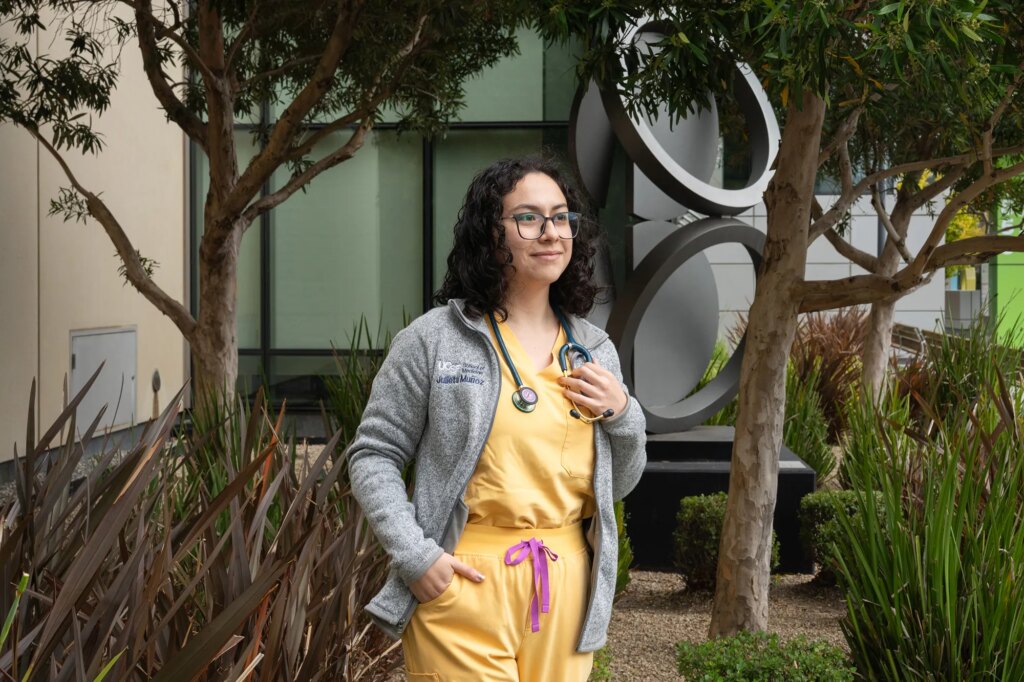
Julieta Muñoz applied to medical school in order to give back to her community in the San Joaquin Valley. She’s from Porterville, a 60,000-person town about halfway between Fresno and Bakersfield, where the nearest comprehensive trauma center is at least 50 miles away.
Like many in the valley, Muñoz’s parents are Mexican immigrants. For years, she said they picked fruit in the fields, worked in food packaging plants and are now retired. As an undergraduate at UC Merced, Muñoz learned how social factors, such as poverty and race, affect the San Joaquin Valley, where residents are less likely to have health insurance or a relationship with a doctor. “It was kind of the first time a name was put to all these health disparities I had seen growing up.”
Muñoz lives in San Francisco now, where she’s a medical student at UCSF, and as part of her program to address access in the San Joaquin Valley, she’ll finish the last two and a half years of medical school in Fresno. It’s the fulfillment of a lifelong dream, she said. “I knew I wanted to come back to the Central Valley no matter what medical program I was doing.”
Muñoz’s program, created in 2011, is a centerpiece of the state’s efforts to increase the pipeline of doctors in the San Joaquin Valley. The other is the residency program at UCSF Fresno, which provides postgraduate training for medical students. UCSF Fresno has had residents since the 1970s and expanded its operations over the years.
After years of advocacy from the valley’s elected representatives, the Legislature said in 2019 that it intended to support a new UC Merced medical school. In 2022, the state launched the California Medical Scholars Program, which now helps about 800 community college students navigate the pathway to medical school. Next year, UC Merced will open a new medical education building on the campus — the largest state-funded UC construction project in history.
But a full-fledged medical school is still years away, said Chin-Hong, who cited the lengthy accreditation process, the need for additional funding and more hospital settings where students can train. Medical schools are only one part of the ecosystem, he said, pointing to local high schools, colleges and residency programs, which help ensure a robust pipeline of students. Muñoz, for instance, first discovered her love of medicine in high school, when she had the opportunity to ride in the back of emergency vehicles as part of a specialized healthcare curriculum.
‘Two different worlds’
In a region as expansive and populous as the San Joaquin Valley, a UC Merced medical school is not enough, said Assemblymember Bains. Kern County needs its own training hospital too.
”Kudos for what they’re doing with UC Merced,” said Bains, but added that the UC should not pit one region against another. “It’s a gross misunderstanding of what is needed in the valley.
The UC has been silent or opposed to many of the legislative proposals to open a medical school in Kern County. Elizabeth Wells, a spokesperson for the UC Office of the President, said the system is focusing its attention on the “multi-year, intensive process” of creating a medical school in Merced.
Gilbert Alvarado, a water technician and Shafter city councilmember, is rooting for a medical school in Kern County. Its largest city, Bakersfield, is 110 miles south of Fresno and over 160 miles from Merced.
“To get a good doctor, even for the children’s hospital, they said you go to Fresno,” Alvarado said. “When people consider central California, they say Fresno. But Fresno and Bakersfield are like two different worlds.”
His family has serious medical needs. He said both his wife and his daughter have had Valley Fever, a potentially deadly fungal infection that’s become increasingly common, especially in dry regions such as Kern County, and his mother recently needed back surgery.
His interest in a medical research hospital is also economic. Kern, like Fresno and Merced, is one of the poorest counties in the state. Alvarado said wants a medical research institute, ideally in Shafter but at the very least in Bakersfield, because it would be good both for “the economy and the quality of life.”
This article was originally published on CalMatters and was republished under the Creative Commons Attribution-NonCommercial-NoDerivatives license.