


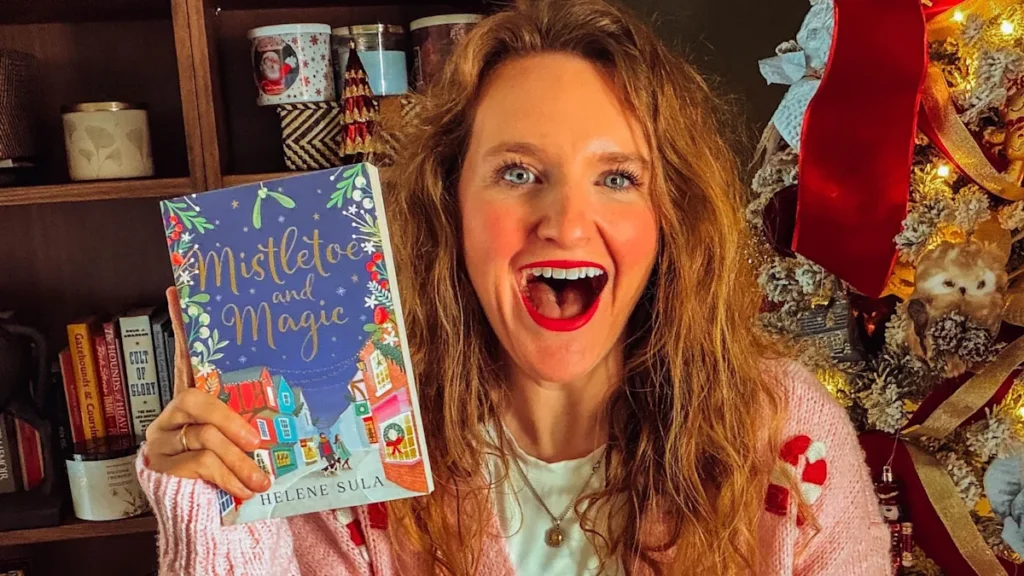
You may know Helene Sula from her very popular blog Helene In Between and her @HeleneInBetween Instagram page. She became a non-fiction author with her memoir Two O’Clock on a Tuesday at Trevi Fountain. Now she is turning to fiction with her debut novel Mistletoe and Magic.
Helene Sula’s new novel was inspired by both a transformative trip to York and her walks along the Cotswold Way in England. The fun novel also draws from her year living in Nashville and her extensive European travels. I was excited to interview Helene to find out more about this compelling novel Mistletoe and Magic and what she’s up to now.

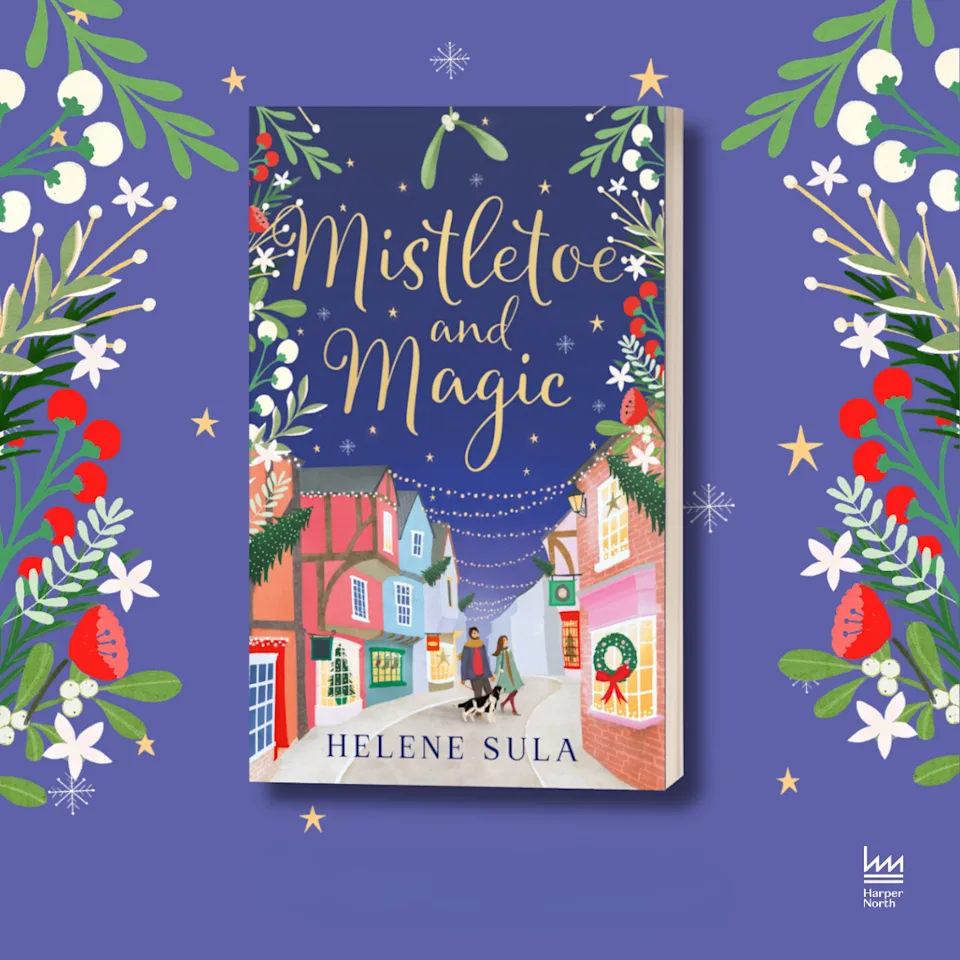
Here’s the book cover of “Mistletoe and Magic” by Helene Sula.
(Helene Sula)
What inspired you to write Mistletoe and Magic?
The spark actually came from a trip to York. I was there feeling completely lost in my life, wandering those ancient streets, and I turned onto The Shambles – this impossibly narrow medieval street where the buildings lean into each other like they’re sharing secrets. Standing there among all that history, I felt this overwhelming sense of possibility. It made me think about what happens when we’re at a crossroads – when who we’re expected to be and who we actually want to become collide.
I imagined a woman coming to York at Christmas time, at her lowest point, and finding magic she didn’t know she was looking for. The image that crystallized it all was a mysterious green book falling at someone’s feet in a hidden London bookshop – like the universe saying, “Here’s your sign, now follow it to York.” I wanted to explore what happens when we finally stop living for everyone else’s approval and start following our own story, letting a place like York work its ancient magic on us.
Have you always wanted to be a novelist?
Yes! I actually grew up surrounded by writing. My parents are both writers, so storytelling was in the air I breathed. I’ve published a memoir last year, “Two O’Clock on a Tuesday at Trevi Fountain,” which let me explore travel and personal narrative, but fiction has always been my first love. Like Eva in the book, I had teachers who believed in my creative writing and encouraged me to pursue it.
Somewhere along the way, even with that literary upbringing, I convinced myself I needed to stick to “safer” forms like memoir and travel writing – documenting real experiences rather than creating new worlds. This novel is me finally giving myself permission to write the stories I’ve always wanted to tell, to do what I’ve watched my parents do my whole life – build entire worlds out of words. It’s like coming home to something I’ve always known I was meant to do.
You’ve previously written a memoir/travel book (Two O’Clock on a Tuesday at Trevi Fountain) and been known as a travel blogger. How did writing a holiday romance differ from your past writing projects?
With travel writing and memoir, you’re bound by facts like what actually happened and what a place really looks like. With fiction, I could take all those observations and experiences and reshape them into something new. The biggest difference was learning to trust the emotional truth over the literal truth. In my travel writing, I describe York as it is; in the novel, I get to show York as it feels – all that ancient magic and possibility.
What skills or mindsets did you bring from your nonfiction/travel writing into fiction, and what did you have to leave behind?
Travel writing taught me to capture the soul of a place through sensory details – that skill translated perfectly into making York feel alive and magical. I brought my eye for those telling details that make somewhere feel real: the way British radiators clang, how Yorkshire rain feels different from Nashville rain. But I had to let go of my journalistic need to stick to facts and explain everything logically.
In fiction, emotional truth matters more than literal accuracy. I had to trust readers to feel the truth rather than proving it to them with evidence. The biggest shift was learning that sometimes the most honest moments come from pure imagination.
Your readers know you for bringing places vividly to life through your travel blog. How did your experience exploring and writing about destinations shape the way you built the world of Mistletoe and Magic?
My travel writing taught me to capture the soul of a place – those sensory details that make readers feel they’re really there. That translated beautifully into fiction. But I had to let go of my journalistic need to explain everything factually. Fiction requires trusting readers to feel the truth rather than proving it to them. I had to learn that sometimes the most honest moments come from imagination, not documentation.
The novel moves between the United States and the United Kingdom. I spent a year living in Nashville, which gave me intimate knowledge of Eva’s starting point – the bachelorette parties flooding Broadway, the pressure to have your life perfectly together, that specific Southern society expectation to be pleasant and appropriate at all times.
Living in Heidelberg gave me my first real taste of European Christmas markets – the wooden stalls dusted with snow, the smell of mulled wine and roasted almonds, the way entire cities transform into these magical winter wonderlands. Then spending time in the UK, especially York, showed me that particularly British kind of magic – not flashy or orchestrated, but found in crooked Tudor buildings, proper pubs where locals become family, and tea shops hidden down medieval alleys.
The combination of all three experiences created the perfect tension for Eva’s journey – from Nashville’s polished expectations to the ancient, cozy magic of a British Christmas. I wanted readers to feel the relief Eva feels escaping Nashville’s performative perfection for somewhere that lets you be messily, authentically human while surrounded by centuries of history and twinkling lights.
When describing cozy winter scenes or small-town charm, did you draw from any specific locations you’ve featured on your blog or Instagram?
Yes, definitely! York itself has been a recurring star on my blog. I’ve photographed The Shambles in morning mist, those impossible medieval streets where buildings nearly touch overhead, and hidden courtyards strung with lights that you stumble upon by accident.
The Christmas markets I’ve featured from Heidelberg and other European cities gave me that vocabulary of sensory details – the way mulled wine steam curls in cold air, how wooden market stalls glow from within like lanterns, the particular crunch of snow under boots on cobblestones.
I’ve written about tiny Yorkshire pubs where the ceilings are so low you have to duck, and the radiators clang like Marley’s ghost but somehow that adds to the charm. The Riddle & Quill inn is an amalgamation of quirky British B&Bs I’ve stayed in, most memorably one I stayed in while walking 100 miles on the Cotswold way!
Do you see this story as a kind of “armchair travel” for readers, an invitation to experience a holiday abroad through fiction?
Yes! I wanted to give readers that delicious feeling of escaping somewhere magical, especially during the holidays. Through Eva’s eyes, they get to discover hidden bookshops, Yorkshire moors, and cozy pubs with terrible radiators and wonderful people. It’s an invitation to experience that particularly British Christmas magic – all the twinkling lights and mulled wine, but also the deeper magic of finding where you belong.
You’ve shared about this already. Can you share more about how real places, books, or personal experiences influence the setting or characters?
York is essentially playing itself in the novel – The Shambles with its impossibly narrow medieval streets, York Minster with its Gothic towers, the ancient city walls. The moors Charlie takes Eva to were inspired by the Yorkshire Dales, those wild, windswept landscapes that make you understand why the Brontës wrote such passionate novels.
The Cotswold Way influenced the cozy village feel and those honey-colored stone cottages that appear when they’re driving through the countryside – that particular English prettiness that feels almost too perfect to be real, like you’ve wandered into a Christmas card.
The hidden bookshop in London was inspired by the actual secret courtyards and passages you can still find if you know where to look, particularly around Marylebone. I spent many summers in London as a kid when my parents taught a study abroad program every year.
Even specific details came from real places. There’s a chocolate shop in York that hand-dips truffles in the window, pubs where the ceiling beams are so low that tall people have to duck, and yes, there really are electric showers in British B&Bs that offer only volcanic heat or arctic cold, nothing in between. I wanted readers to feel they could follow Eva’s footsteps and find these places, even if they might not find Margaret Wells’ mysterious green book waiting for them.
The novel moves Eva from Nashville to a festive UK location (Yorkshire) to rediscover herself. Why did you choose that setting and that transition?
I lived in Nashville during a time when I was questioning everything in my own life, so I knew exactly how Eva felt – surrounded by bachelorette parties and perfect couples, watching everyone else seem to have it figured out while you’re falling apart inside. Nashville represents that pressure to have your life perfectly curated – the right partner, the right job, the Instagram-worthy moments. I set Eva at that same crossroads I faced, when the life that looks perfect on paper feels completely wrong.
Yorkshire, especially at Christmas, is the complete opposite – it’s ancient, unpretentious, and doesn’t care about your five-year plan. The city’s been standing for two thousand years; your personal crisis is just a blip. That perspective shift is exactly what Eva needs – and what I needed when I was questioning everything.
In Nashville, you’re constantly measuring yourself against everyone else’s highlight reel. In York, wrapped in all that history and Christmas magic, you finally have space to ask what YOU actually want. The contrast is essential; Eva needs to be completely removed from everything familiar, from every expectation, to finally hear her own voice over all the noise.
How did you balance the cozy, wintry “holiday romance” elements (mistletoe, mulled wine, mince pies) with the more serious emotional arcs?
The Christmas setting isn’t just decoration; it’s integral to the emotional journey. The holidays intensify everything: loneliness feels sharper, but connection feels warmer. I used traditional elements (mistletoe, mince pies, Christmas markets) as touchstones while Eva navigates real heartbreak and self-discovery. The coziness provides safety for exploring deeper themes about choosing your own path versus meeting expectations.
Eva’s journey is one of rediscovery after heartbreak. How did you develop her arc, and what do you most admire (or empathize with) about her?
Her courage to finally choose uncertainty over safety. It’s terrifying to admit the life you’ve built isn’t the one you want. Eva starts as someone who color-codes her planner and ends as someone following mysterious books to unknown destinations. I admire her willingness to look foolish, to be vulnerable, to believe in magic even when everything logical says not to.
Are there secondary or supporting characters you feel especially close to, or whose backstory you would love to write more about?
I love Florence. I wish I had her in my life!!
A key tension is between self-reinvention and the pull of one’s roots or past. How did you navigate that tension in Eva’s character?
Eva’s journey isn’t about completely abandoning who she was. It’s about untangling which parts of her are authentic and which parts she constructed to please others. I gave her moments where her Nashville instincts serve her well. Her planner personality helps her follow Margaret’s trail, and her Southern politeness actually charms the prickly Yorkshire locals. I also showed how those same traits imprisoned her: the color-coded life that left no room for spontaneity, the constant apologizing for taking up space.
The key was making her realize that self-reinvention doesn’t mean torching your entire past. She keeps texting Courtney, her best friend who knew her before and after. She doesn’t throw away her notebook from Nashville; she just starts writing different stories in it. Even her relationship with her mother evolves rather than ends – Eva learns to set boundaries without severing roots entirely. I wanted to show that you can honor where you come from while choosing where you’re going. The real tension isn’t between old Eva and new Eva – it’s between the Eva others expected and the Eva she actually is. Some roots nourish you; others strangle you. Wisdom is knowing the difference.
What does “magic” mean to you in the context of this story. Is it literal, metaphorical, or both?
It’s both literal and metaphorical. There’s the surface magic – mysterious books, perfectly timed encounters, hidden keys. But the real magic is the courage to change your life, the moment you stop performing who you think you should be. It’s Charlie showing Eva his secret viewpoints, Florence’s fierce protection of her found family, Margaret’s letters still changing lives decades later. Magic is what happens when we stop being afraid of wanting more.
The idea of feeling “unheard” comes up in the blurb. How do you explore voice, silence, or being overlooked in this book?
Eva has spent years editing herself down to fit others’ expectations. She’s literally lost her own voice. Margaret Wells wrote others’ love stories but never her own. Charlie inherited three generations of unspoken feelings. The novel explores how we silence ourselves to keep peace, to be loved, to be safe – and what happens when we finally speak our truth, even if our voice shakes.
Did you plan the plot in detail in advance, or did you discover parts as you wrote?
I started with the ending feeling and worked backward. I knew Eva needed to choose herself, but the journey revealed itself as I wrote. Margaret Wells emerged organically. She wasn’t in my original outline but became the heart of the story. Some of the best moments (like Tilly the dog (p.s. my dog’s name is Millie!), the horrible electric shower, Charlie’s map stall) appeared as I was writing and felt truer than anything I’d planned.
Are there any tools you use as a writer you’d like to share?
I actually started dictating my books!!! I am a huge walker, and this was so helpful and truly a fun way to walk and think about the story! I use the notes section in my phone and a speaker to dictate.
Were there scenes you originally wrote but cut (or vice versa) that you regret or love?
I had a whole subplot about Eva’s friend Courtney coming to visit her in York that I loved but had to cut. It was beautiful but slowed everything down. There was also a scene where Charlie drunkenly confesses his feelings to Tilly while Eva secretly overhears that was probably too much!
How did you manage the balance of romantic tension, emotional growth, and holiday ambience without tipping the tone too light or too heavy?
I treated the Christmas setting like seasoning – enough to flavor everything but not so much it becomes cloying. The key was making sure every festive element served the emotional story. The Christmas market isn’t just pretty; it’s where Eva starts choosing joy over safety. The mulled wine loosens tongues for difficult truths. Even the mistletoe becomes about choosing to step forward rather than magical holiday kisses.
I kept asking myself: would this scene work if it wasn’t Christmas? If the emotional beat depended entirely on holiday magic, it got reworked. The romantic tension had to come from real conflict – Charlie’s inherited fears, Eva’s journey to self-worth – not just festive meet-cutes. I also made sure to include the melancholy side of the holidays: being alone when everyone else seems coupled, family pressure, the gap between expectation and reality. That darkness makes the light moments feel earned rather than saccharine.
What was the hardest part of writing this book?
Letting Eva be messy and imperfect. My instinct was to make her more immediately likeable, but real transformation requires showing the uncomfortable parts – the petty jealousies, the self-doubt, the mistakes. Also, writing Charlie’s emotional walls while still making readers root for him. How do you show someone learning to love when they’ve inherited generations of heartbreak?
Did any characters surprise you by doing or saying something you didn’t expect while writing?
Florence completely took over! She was supposed to be a minor innkeeper character, but she became this fierce mother hen protecting her found family. The moment she told Eva about fighting to save the inn, I realized she was carrying her own love story and loss. Also, Charlie’s dog Tilly wasn’t in my outline at all, but suddenly there she was, this slightly overweight spaniel who judges everyone and becomes the emotional glue between characters. Sometimes Charlie expressed his feelings better through how he talked to Tilly than he could directly to Eva. And Margaret Wells herself – she started as a plot device but became this fully realized woman whose choices haunted three generations. Her letters kept revealing depths I didn’t know were there.
Were there any research or logistical challenges that affected your process?
The biggest challenge was getting British dialogue right without making it feel like a caricature. Americans think British people say “bloody hell” every five minutes, but they don’t. I had to research everything from how Yorkshire people actually argue (more cutting wit, less direct confrontation) to what goes into a proper Christmas dinner (the Christmas pudding politics alone!). I had to research train schedules between London and York, how British pubs actually work, the difference between a B&B and an inn – all those logistics that locals never think about. However, if you get it wrong, readers notice. Also navigating the class dynamics that British readers would pick up on instantly but American readers might miss. Thank goodness for my British friends who corrected my early drafts!
Who do you imagine reading Mistletoe and Magic? What kind of reader do you hope will pick it up?
Anyone who’s ever felt like they aren’t doing enough. Readers who love escaping to magical places but also want emotional depth – not just swoony romance but real transformation. I picture someone curled up with tea (or wine) on a December evening, wanting to be transported but also seen. People who understand that sometimes the bravest thing isn’t having it all figured out – it’s admitting you don’t. Readers who appreciate that love stories can be about falling in love with yourself and your life, not just another person. Anyone who’s ever stood at a crossroads and wondered “what if I chose the scarier path?”
When (or how) did you know the story was “done”? What gives you confidence that a novel is ready to publish?
I knew it was done when Eva’s voice felt complete – when she’d transformed from someone who apologizes for existing to someone who takes up space in the world. The practical moment was after my editor and I went through structural edits and everything clicked into place. But emotionally, I knew it was ready when beta readers started saying they didn’t want to leave York, that they wanted to stay in that world. When the characters feel real enough that readers miss them after the last page – that’s when you know. Plus, when I could read it without constantly wanting to tinker, I knew it was time to let it go into the world.
What does Mistletoe and Magic mean to you personally? Is there a “message” you hope readers take away?
It’s my own act of choosing the life I want over the one that looks good on paper. It’s proof that it’s never too late to follow the dream you tucked away. Every time Eva chooses authenticity over approval, that’s me working through my own journey. This book is my green book falling at my own feet, telling me I’m meant to be here.
How do you celebrate holidays or winter in your own life? Did any personal traditions make their way (directly or indirectly) into the novel?
The chaos and comfort of found family definitely come from my own life. That scene with the “not-Christmas-Christmas dinner” where everyone’s a little broken but choosing to be together – that’s every meaningful holiday I’ve had. Also, my own love-hate relationship with family expectations during the holidays informed Eva’s struggle with her mother’s calls. Also, Christmas crackers were something I had never experienced before, and I love this British tradition!
What’s next for you as a writer? Are there other genres, settings, or stories you’re excited to explore?
I am hoping to write more fiction! I love it!
If you could spend a day in Yorkshire or in Eva’s shoes, what would your itinerary or favorite stop be?
I’d recreate that first magical day that inspired everything: Start with getting properly lost in The Shambles in the morning mist, find that hidden tea shop for proper Yorkshire tea and scones, spend the afternoon exploring York Minster’s hidden corners, then catch sunset from the city walls where you can see the whole city spread out like a medieval painting. End at a pub where the locals treat you like you belong, even though you’re obviously the American who can’t work out the heating in her room. It’s not about ticking off tourist sites – it’s about letting York reveal its secrets to you, one crooked street at a time.