

Perhaps one of the lesser known trails in the Deam Wilderness section of the Hoosier National Forest is the Hayes Trail. I recently had the chance to hike there. The Charles C. Deam Wilderness was designated by Congress as a wilderness in December 1982. It was named after Indiana’s first state forester, who was a pioneer in forest conservation and an author of books on the trees and flora of Indiana.
Charles Deam traveled throughout the state and collected more than 78,000 plant specimens, discovering 25 new plant species. He was largely responsible for initiating the state forest system we have today.
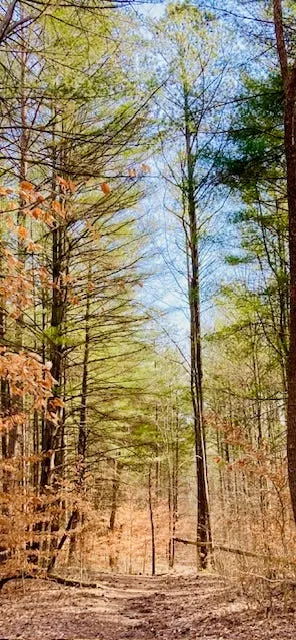
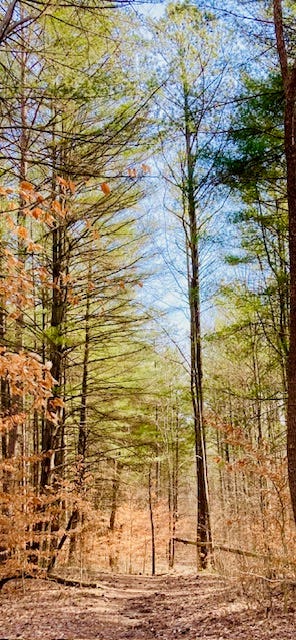
A view of the forest along the Hayes Trail in the Charles C. Deam Wilderness in the Hoosier National Forest.
The U.S. Forest Service acquired the first land in the wilderness boundary in 1935 as abandoned, tax-delinquent farmland. The first priorities were to stabilize erosion, rehabilitate the damaged land and control wildfires. With the Civilian Conservation Corps (CCC) program of the 1930s the Forest Service began reforesting the hillsides.The Deam Wilderness encompasses more than 13,000 acres of the larger Hoosier National Forest, which in total contains 202,814 acres.
Within the wilderness there are 37 miles of trails for hiking and horseback riding. It’s 37 miles of trail that I have come to love. The trailhead for Hayes Trail is easy to access from the other side of the Deam Wilderness off Ind. 446 on Hays Road. (The spelling of the trail and road are different).
The trail is 2.5 miles long and intersects with the Grubb Ridge loop that begins at Blackwell Horse Campground. But this stand-alone trail is worth a second glance.
It is said that Hayes Trail is named after Roscoe Hayes, who was a an early settler in the area, and local legend who lived the area’s rugged hills.
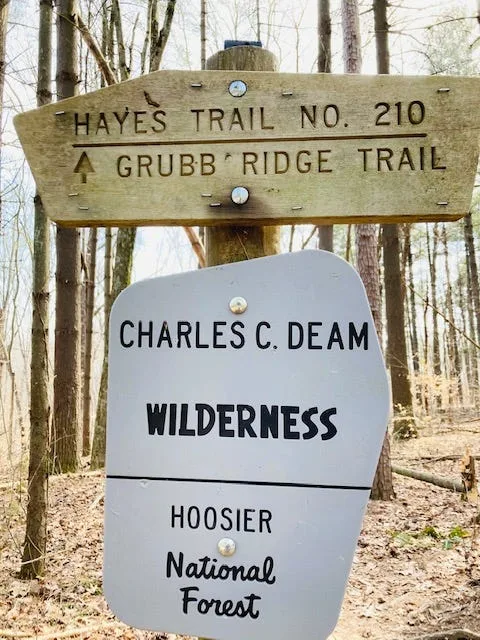
The Hayes Trail is a 2.5-mile path in the Charles C. Deam Wilderness, which is part of the Hoosier National Forest.
It was a beautiful November day when I hiked this trail. It was a bit chilly so I wore my jacket. I found the trailhead easily and took off down trail to explore on a late autumn day. Many of the trees’ leaves had fallen, making it begin to look a lot more winterlike. That was a thought for another day.
I enjoyed walking through the colorful forest that surrounded me. Every step I took on the dirt path made a crunching sound from the leaves under my feet. I still enjoy being in the forest this time of year. The scent of the damp forest mixed with pine and moss always brings a smile to my face.
I soon started a descent down a rather steep trail. At the bottom, there was a streambed with a lot of rocks, so I had to spend a few minutes exploring. I was in my element!
The next section of the trail was an ascent of 250 feet to a high ridge. Once on top, I found a beautiful view of the valley below. The ridge paralleled the creek down in the valley.
The forest was very quiet, with exception of an occasional pileated woodpecker, calling out from a tree in the distance. I enjoyed the quiet and the solitude. Getting out in nature always refreshes me. Sometimes I do my best thinking when I’m out in the woods.
After following the ridge for a short while, the trail dropped back into the valley and then, ascended again to the top of a beautiful ridge.
After this ridge, the trail went back into the valley where it intersected with the Grubb Ridge Trail. This is a good turn around spot. If you continue on the trail, it will take you on a more rugged hike along the Grubb Ridge Trail. That trail is a loop trail, so if you want to add mileage to your hike, it is a great trail to hike.
I decided to head back to my car. I had taken quite a few photos. It had been a good hike.
To get to this place: From Bloomington, take Ind. 446 for approximately 10 miles ( across Lake Monroe causeway). Turn left onto Hays Road. Drive 1/10 of a mile to the trailhead and parking lot.
A quote for your week: “It had to do with how it felt to be in the wild. With what it was like to walk for miles with no reason other than to witness the accumulation of trees and meadows, mountains and deserts, streams and rocks, rivers and grasses, sunrises and sunsets. The experience was powerful and fundamental.” — Cheryl Strayed, author.
Until the next trail, Susan.
This article originally appeared on Evening World: Hayes Trail in Charles C Deam Wilderness in Hoosier National Forest