Instant mashed potatoes are ready in a few minutes, and one of the main processes behind them, the potato flake, was developed in the 1950s and 1960s at the U.S. Department of Agriculture’s Eastern Regional Research Center outside Philadelphia. The flake work there centered on drying cooked, mashed potatoes so they would keep on a shelf and come back quickly with water or milk.
The patent behind the flakes
U.S. Patent 2,780,552, titled “Dehydration of cooked potato,” was filed on April 1, 1954, by Miles J. Willard Jr. of Glenside and James Cording Jr. of Philadelphia, Pennsylvania, and granted on February 5, 1957, with the rights assigned to the United States as represented by the Secretary of Agriculture. Its stated goal was a dried mashed potato that would store well and could be reconstituted quickly into something with the color, flavor, and consistency of fresh mashed potatoes.
In the patent, the potatoes were cooked with live steam for 35 to 45 minutes, mashed, and fed onto a heated rotating drum in a thin, closely regulated film that dried quickly and was then removed. The first claim calls for drying the mash to a final moisture content of 4 to 10 percent, and the patent describes the result as thin, porous flakes about 4 to 6 thousandths of an inch thick that can be reconstituted almost instantly with water or milk at any temperature from room temperature up to boiling.
The chemistry landmark in Wyndmoor
On April 18, 2007, the American Chemical Society named the center’s food dehydration research a National Historic Chemical Landmark at a ceremony in Wyndmoor, Pennsylvania. USDA’s news release on the ceremony credits the center with “novel dehydration techniques, such as the potato flake and explosion puffing processes,” and says that work made possible “convenience foods such as instant mashed potatoes and crispy potato snacks.” The landmark essay reprinted by Invention & Technology says the most successful form of instant mashed potatoes came from the flake process developed there in the 1950s and 1960s.
What’s in a box today
Betty Crocker’s page for its Potato Buds mashed potatoes lists the ingredients as dried potatoes and mono and diglycerides, with freshness “preserved by sodium acid pyrophosphate, sodium bisulfite and citric acid.” The same page describes the product as made with 100% real mashed potatoes, and its stovetop directions bring the dried potatoes back with hot liquid, much like the water-or-milk reconstitution the 1957 patent describes. The directions say to heat water, butter, and salt to boiling, take the pan off the heat, stir in milk and the potatoes, and let it stand two minutes before whipping it with a fork or spoon.
Sodium bisulfite is a sulfiting agent, and two federal rules cover how it is used and labeled. Its listing in the FDA’s rules, 21 CFR 182.3739, says it is generally recognized as safe except in meats, in foods recognized as a source of vitamin B1, and on fruits and vegetables served or sold raw or presented to the consumer as fresh. Under 21 CFR 101.100, a sulfiting agent that carries over into a food without doing any job there can be left off the label only if less than 10 parts per million remains in the finished food, while in Potato Buds the sodium bisulfite is added on purpose to keep the potatoes fresh and is listed by name.
Anyone cooking for a guest with a sulfite sensitivity has a reason to read that line. The Cleveland Clinic’s page on sulfite sensitivity says about 4% to 5% of people with asthma have some form of sulfite sensitivity, lists dried potatoes among foods with high or moderate sulfite levels, and names sodium bisulfite among the ingredients to check for.
Mashed potatoes from fresh potatoes
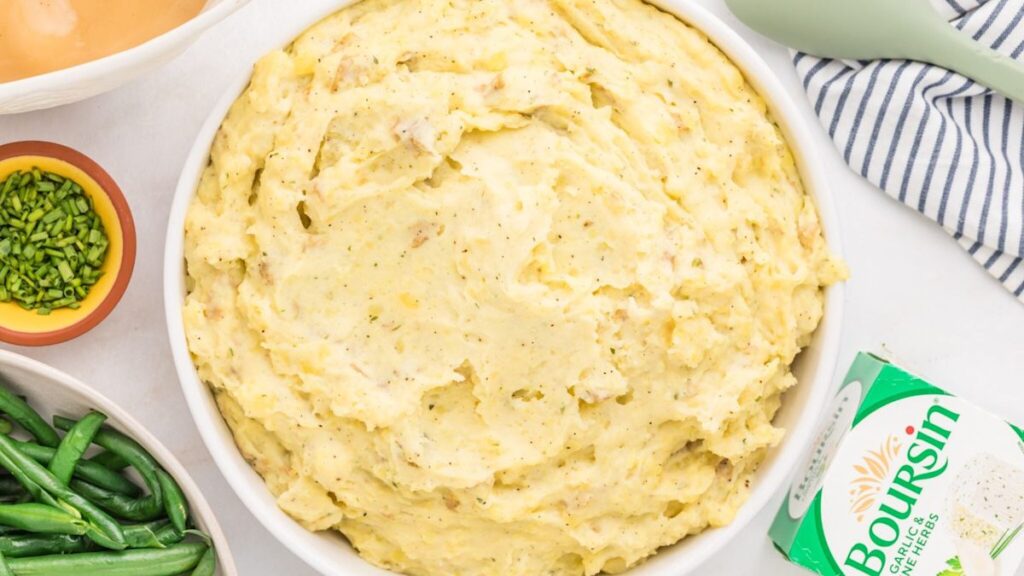
A bag of fresh potatoes skips the drum dryer entirely and takes about 40 minutes from start to finish. Real Balanced’s Boursin mashed potatoes start with a 3-pound bag of Yukon Gold or yellow potatoes cut into equal pieces, covered with cold water, brought to a boil, and cooked for 18 to 20 minutes, until a fork slides through easily. After draining, the potatoes are mashed with 1/2 cup of softened unsalted butter and a 5-ounce package of Boursin cheese, then finished with 1/2 cup of heavy whipping cream, 3/4 teaspoon of salt, and 1/2 teaspoon of black pepper, with chives on top, for 8 servings.
Whichever bowl ends up on the table, the instant kind owes its most successful form to a flake process federal researchers developed in the 1950s and 1960s, and a box today still lists dried potatoes first, followed by mono and diglycerides and the three ingredients that keep them fresh on the shelf.