

The temperatures may have been a stifling 95 degrees with a UV index of 10 while I rode a beach cruiser down Mt. Pelia Road in Bluffton, South Carolina, in late July, but my mind was elsewhere. Even as I sweated profusely and dodged the sun’s rays beneath the live oak trees around Montage Palmetto Bluff, I was thinking about the months of December and January, my favorite time in the Lowcountry.
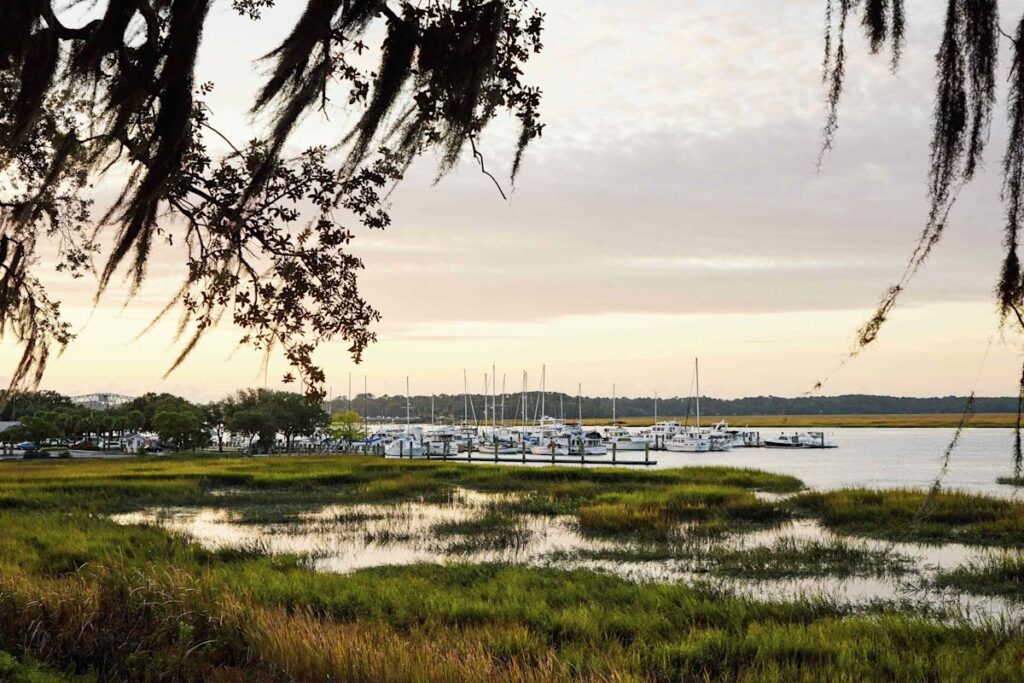
While I’m a Virginian through and through, I spent several years living in Charleston and grew up vacationing on Kiawah Island, so I try to return to this part of the country whenever I can. And as much as I love summer, it doesn’t appeal to me as much as the chillier season, when the thought of a roaring fireplace doesn’t send a shiver down my spine, and I can comfortably wear a sweatshirt on a morning walk. There’s a coziness to the Lowcountry that only reveals itself when the beach crowds have dispersed, the spartina grass transitions from green to golden, and stepping outside doesn’t require going toe-to-toe with a thick layer of humidity.
During my recent trip to Bluffton, a small town along the May River, I heard a similar sentiment expressed to me multiple times. “You’ll have to come back around the holidays,” I was repeatedly told by staff at the Montage property, with some mentioning the bows, lights, and seasonal programming, and others touting the general celebratory ambiance and natural beauty that settles around the inn, the guest cottages, and the winding pathways. I nodded again and again, knowing full well the accuracy in our shared belief.
Advertisement
Advertisement
There’s nowhere quite like the Lowcountry—a region known for its tidal creeks, salt marshes, Spanish moss-draped trees, and a resounding dedication to the art of Southern hospitality—in the winter. I’m already planning my return road trip back down I-95, and the guide below will help you plan your own winter getaway to this 3,306-square-mile corner of the Palmetto State.
What to See in the Lowcountry in the Winter
Snapshots of historic Charleston homes adorned with fresh greenery—and the city’s famed restaurants serving dishes made with winter produce—may be reason enough to visit in the weeks leading up to the New Year, but you’ll need to step off the peninsula to glimpse the flora and fauna that make this time of year so magical. Birders have their binoculars firmly planted on migratory species that venture to this part of the country in the winter—the yellow-rumped warbler, the northern pintail, the hermit thrush, and the red-breasted merganser, among them.
Those who revel in spotting colder-weather blossoms will keep their eyes peeled for the famous pink, white, and red camellias, otherwise known as the “rose of the winter.” The bright yellow Carolina jessamine, the official state flower of South Carolina, typically starts to bloom in January.
Outside of these hard-to-miss florals, the Lowcountry’s natural beauty takes a more subtle—but equally exquisite—form. The stalwart live oaks continue to produce new leaves as they shed their old ones, and the wax myrtle’s berries feed local wildlife. The Southern magnolia and the saw palmetto remain photo-ready, even if the former’s flowers won’t make their long-awaited appearance until spring. Perhaps the surest sign that it’s winter in the Lowcountry is the shift in the colors of the sweetgrass and the salt marsh cordgrass, both of which transition from their various shades of green to golden hues.
Where to Go
Red velvet ribbonâchosen to coordinate with the color of the roofâpunctuates the magnolia, left unadorned to focus the attention on the architecture.
Credit: PHOTOGRAPHS BY BRIE WILLIAMS; STYLING BY G. BLAKE SAMS
The Greater Charleston Area
Winter in Charleston is far from desolate, but if you can squeeze in a midweek trip—versus a weekend stay—you’re more likely to find a bit more breathing room as you explore the city and its neighboring beaches, islands, and towns. To take in all the glory of downtown’s pine wreaths, sparkling lights, and magnolia leaf garland, stay at The Cooper, the waterfront hotel with some of the best views of the Holy City.
Advertisement
Advertisement
If you’d prefer a bit more breathing room and river views instead of harbor views, book a room at The Dunlin, Auberge Collection, which sits on the banks of the Kiawah River. Both hotels put you within driving distance of some of the area’s best winter activities—searching Folly Beach for shark teeth and shells, taking a boat out on the local waterways, joining oyster roasts, and embracing the joy and nostalgia of the Holiday Festival of Lights at James Island County Park.
Credit: Peter Frank Edwards
Beaufort
Located between Charleston and Savannah, Georgia, Beaufort, South Carolina, is often billed as a quieter version of the Holy City—and winter is one of the best times to visit. Make the historic Cuthbert House your base camp, returning to one of its 10 individually designed guest rooms after a day exploring Hunting Island State Park or biking the 10-mile Spanish Moss Trail.
Credit: Peter Frank Edwards
Hilton Head Island
You may associate Hilton Head Island with idyllic summer beach days, but its main draws—the pristine sands, the fishing, the golfing, and the biking—are arguably even better in the winter. The daytime highs rarely rise above the low 60s, reservations are easier to make, and the wide, hard-packed beaches are perfectly suited for beach cruisers. You may even want to plan your visit around some of the island’s annual winter festivals; the Gullah Celebration and the Hilton Head Island Seafood Festival both take place in February.
Credit: Pam Ullman/Getty Images
Bluffton
Bluffton is another one of those Lowcountry gems that shines all year round, even if the weather doesn’t allow you to sit poolside sans a few layers. Guests of Montage Palmetto Bluff have their pick of activities to fill their days—golfing at the May River Golf Course, joining educational naturalist-led excursions around the property, seeing the Lowcountry by horseback at Longfield Stables, and fishing for speckled trout, flounder, redfish, and sheepshead. At night, a table by the fire at River House and a platter of fresh oysters serve as proof that winter is far and away one of the most inviting seasons in the Lowcountry.
Read the original article on Southern Living
Source link