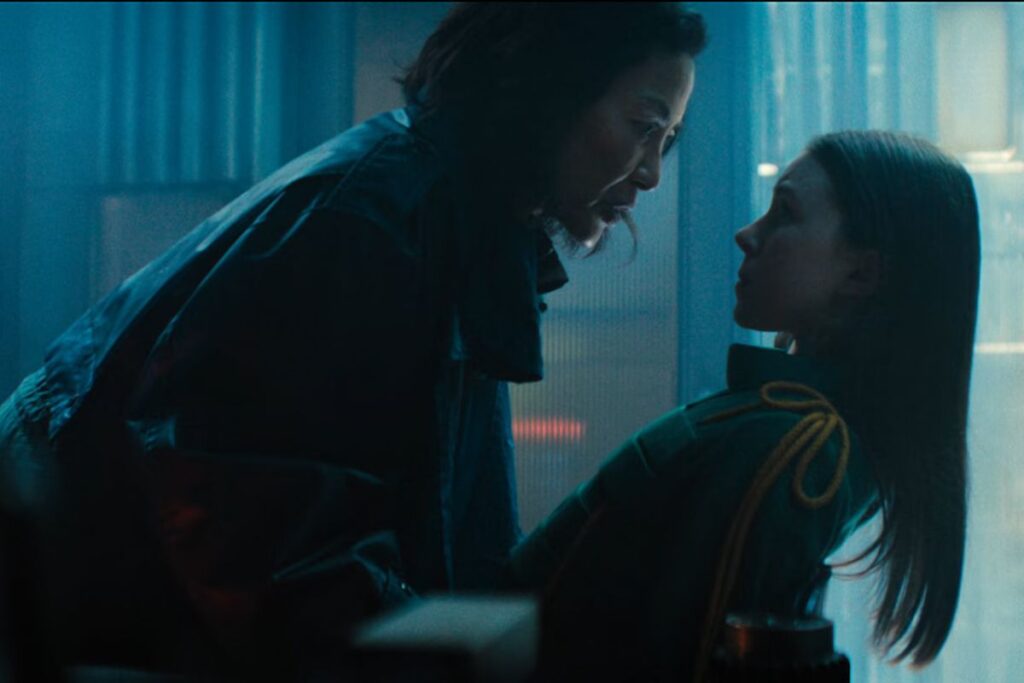


The centerpiece scene of this episode of Blade Runner 2099 features one of our heroes threatening a little girl. Like a horror-movie villain, she puts on he creepy amber memory mask of Eldon Tyrell, the father of replicant technology to intimidate her. Like an ICE agent, she threatens to have the girl deported to slave labor camps in the off-world colonies unless she tells her what she wants to know. Like a classic abuser, she tells the girl that if she tells anyone else what happened, no one will believe her, because “you are a little girl, and I am a blade runner.” That’s our Olwen, ladies, gentlemen, and friends beyond the binary. A real class act.
It’s not just that the scene is a scorcher in terms of what it says about Olwen specifically and the plight of humans generally. It’s a gorgeous scene, filmed in cramped closeups, with an image so grainy you want to run it through a colander. The beautiful cinematography, the lovingly constructed retrofuturistic technology, the mannered and meticulous performances of Michelle Yeoh as Olwen and Katelyn Rose Downey as the blade runner and the young human Voight-Kampff Test administrator, the nagging sense that there’s always something more going on beneath the surface that we can’t observe…everything good about Blade Runner 2099 that isn’t Hunter Schafer or an awe-inspiring vista of brutalist architecture is rght here in this scene. (Don’t worry, you get plenty of those elsewhere.)
Olwen gets what she wants out of the girl. She plays her Marek’s VK recordings, revealing that he thought and talked about her often. The girl didn’t report this anomaly because no one asked her to, as it’s only empathy for humans that worries the LAPD, not empathy for other replicants, however unusual that is. We’ve seen close personal relationships between replicants before several times in the franchise, though it doesn’t seem to be a culture-wide value.
The replicants who live at Olwen’s, for example, don’t seem at all precious about who sleeps next to them or who sees them in their underwear; an embarrassed Cora eventually notes that none of them, not even the nosy and loathsome Conrad (Josh Finan), know Olwen has a boyfriend either. Other than believing that they’re superior to humans, I don’t get the sense that there’s much that binds replicants together, emotionally or romantically, except in exceptional circumstances.
The location the girl gives her for Marek’s last known destination, however, proves to be either a goof or a deliberate ruse. Olwen merely gets mugged and has her police car stolen. She has more luck at a no-tell hotel whose owner records the goings-on in his hourly-rate rooms, which she knows because she and Marek used to go there for their illicit trysts. Turns out Marek visited all by himself and watched what sounds like a commercial for the first replicant model, which I’d guess would be the Nexus-1. I’d also guess that this ties into Olwen’s flashback to one of their love hotel liaisons, during which Marek complained about Olwen’s impending death as if dying were potentially optional. The original Blade Runner suggests that for the earliest replicant prototypes, it might have been.
Meanwhile, Cora goes her own way when she hears Yahya preparing to raid an apartment where her own brother is hiding. Once again she white-knuckles her way through a brush with discovery. First, she watches Yahya show off her family photo and ask if the eyewitness (Ella Schrey-Yeats) who ratted Elias out recognizes him as a kid. She’s got her hand on her gun as Yahya checks to see if anyone in the apartment can’t stand up and move on their own two feet, since he knows his quarry can’t walk. Having no idea that her brother’ Elias’s paraplegia has been cured, Cora is stunned and relieved to watch hop down from his perch and strut confidently. Of course neither she nor Elias nor Bebeto, who is also present, reveal their connection until everyone else is out of the room.
Elias’s successful avoidance of capture presents a nasty problem for the informant. Believing that they’ve been lied to, the blade runners nearly toss her over the apartment building’s square spiral staircase. Cora is forced to put one of those horrifying hoods on the girl’s father (Joe Absalom) before growling at her “You didn’t see anyone!” But surely it’s only a matter of time before the blade runners return.
Bebeto and Elias have further adventures together. They travel to a human dance club, with a playlist consisting of Suicide and Siouxsie, to meet the elusive Buyer (Maurizio Lombardi). (“Buyer” just feels like it should be capitalized.) Charming and worldly, he is also deadly: He personally assassinated the real blade runner whose identity Cora assumed. He makes a pitch to Elias that he is “a time traveller” who “came from the future to tell you what all our lives could be.” He’s after “a way to make your city feel like home again” and to make Elias “the man your mother thought she was raising.” To that end he leaves him a supply of the meds that help him walk. (Cheekily, the brand name is VALIS, matching one of author Philip K. Dick’s other most famous works.) A quick callback to the female “Joi” hologram companions from Blade Runner 2049 finishes out the sequence.
Reunited, Cora/Marian and Olwen make real progress on the Marek case. Pivoting off a comment by one of Olwen’s housemates about the ridge on the mask’s nose, they figure out that the memory Marek is searching for belongs to none other than Tyrell himself. They track Muller, the guru who led Marek astray, to a massive industrial complex (in this universe, is there any other kind?), where he and Olwen have a knock-down drag-out fight. Cora wins, sending Muller hurtling and spiraling and bouncing over the edge of a tower to his death.
But first, Muller reveals what the memory they’re after contains: “Only the creator can repair what he makes.” What could replicants possibly need repaired if not their expiration dates? Sure enough, Marek himself pulls up in a flying car to investigate the fracas and sees Olwen. Rather than blow him out of the sky, Olwen tosses a tracking device on it.
The tracker leads Olwen and Cora through a gargantuan mechanical hellmouth in the side of a mountain. They exit the sand-and-soot colored world of California and emerge into the beautiful blue of Mexico City. The blue color signals coolness and comfort and humanity, as it does in a lovely scene set in a softly glowing tunnel where Bebeto tries to light a fire under Cora’s ass.
But it’s not a cityscape that sprawls before Cora now. It’s a necropolis. Mexico City, where humans go to be free, is dead.
This raises some intriguing questions. Is Bebeto lying to her about getting her to freedom in Mexico City, or does he legitimately not know whatever the hell happened down there? Revolutionaries are liars by trade, but so are authoritarians, so I could see either side being the source of the disinformation.
It’s also fascinating to see blade runners become such a clear-cut metaphor for the brutalization of minority populations by ICE and the everyday police. It used to be that humans were in charge in this universe, hunting down and killing rogue replicants like slave catchers. Then they programmed replicants to police their own kind, forcing them to betray their own artificial species. Now replicants are firmly in charge, a slave revolution that has become authoritarian in turn.
But that’s only because the replicants are what humans made them to be. Empathy was programmed right out of them, presumably to make them more pliable slaves. Instead it had the opposite result in the end, enabling them to do what it takes to both defeat and subdue the human population that made and enslaved them, and to detach from one another when their expiration dates are reached. If replicants are as cruel as their former masters, they’re only following an example set for them by those masters. As a couple of wise humans once wrote, you’ve got to be carefully taught.
Sean T. Collins (@seantcollins.com on Bluesky and theseantcollins on Patreon) has written about television for The New York Times, Vulture, Rolling Stone, and elsewhere. He is the author of Pain Don’t Hurt: Meditations on Road House. He lives with his family on Long Island.
Source link