

☰Cited 7 sources
You’d think a free train that connects all five terminals would be the easy part of a DFW trip. For most people it is, until the day it isn’t. DFW handles more than 87 million passengers a year, and plenty of them are quietly using Skylink wrong.1
The mistakes are small, but the consequences aren’t: a missed connection, a second trip through security, a long hike nobody planned. One terminal can’t be reached on foot from any other, a few sneaky shortcuts beat the train entirely, and a sixth terminal is being wired into the system while it keeps running. Start with the part that surprises people most.
#1 – It’s Free, and It Never Shuts Down
#1 – It’s Free, and It Never Shuts Down (Image Credits: Picture)
The train linking every DFW terminal costs you nothing. DFW calls Skylink a free light rail train that connects all five terminals, with no ticket or pass needed.2 You just walk up, step in and go.
Advertisement
Advertisement
It’s also built for the middle of the night. The airport says Skylink runs 24 hours a day.2 A lot of airport shuttles quit once the last big bank of flights clears out, and this one doesn’t. A 2 a.m. connection is still a short train ride, not a death march with a carry-on.
Did You Know: The platform beside the track is for emergencies only. Passengers normally step through sliding doors directly into the terminal.
The speed is what really changes how you plan a connection.
#2 – Two Minutes Between Trains, Nine Minutes at the Very Worst
#2 – Two Minutes Between Trains, Nine Minutes at the Very Worst (Image Credits: Image)
The longest Skylink ride at DFW is shorter than most TV commercial breaks. DFW lists trains arriving every two minutes, an average ride of five minutes, and a maximum of nine minutes between the farthest points.2 That’s the official promise, and it’s a tight one.
Advertisement
Advertisement
Here’s the catch. The ride isn’t the slow part. One transfer guide estimates 10 to 20 minutes gate to gate, because the walk to and from the station gets added on top. A gate at the far end of a terminal can quietly eat more time than the train does.
Fast Facts
Trains arrive about every 2 minutes.
The average ride is 5 minutes.
The farthest points are 9 minutes apart at most.
One guide budgets 10 to 20 minutes gate to gate, walking included.
That walking math is why one comparison keeps surprising people in #3.
#3 – The Walk From Terminal E to Terminal B Is Longer Than Anyone Expects
#3 – The Walk From Terminal E to Terminal B Is Longer Than Anyone Expects (Image Credits: Editorial photo)
Some travelers insist on walking between terminals. At DFW, the distances suggest that’s a mistake. One airport map guide puts the walk from Terminal E to Terminal B at over two miles.3 That’s a real hike with a carry-on and a connection ticking down.
Advertisement
Advertisement
Here’s the opinion that starts arguments. For neighboring terminals, walking can be fine. For the far ends of the airport, plenty of frequent flyers say the train wins every time. DFW’s own numbers back that up, since the farthest Skylink trip is nine minutes. Nobody walks two miles in nine minutes.
Why It Works: Skylink runs along the outskirts of the terminal semicircles. That lets it connect one terminal to the next in a straight line, so you don’t trace every curve on foot.
But there’s a hard limit on who can ride it, and it catches people off guard in #4.
#4 – The Train Is Locked Behind Security, and That Trips People Up
#4 – The Train Is Locked Behind Security, and That Trips People Up (Image Credits: Accompanying image)
You can’t ride Skylink from the curb. The system operates airside and is inaccessible to anyone who hasn’t cleared security.4 If you’ve just walked out of a terminal with your bags, the train is no longer an option.
Advertisement
Advertisement
It also doesn’t go where many people assume. Skylink only connects terminals. It doesn’t travel to the parking lots or the rental car facility, which the old system once served.4 The mistake is picturing an airport-wide train that goes everywhere.
The real surprise is that one terminal gets treated differently from all the others. That’s #5.
#5 – Terminal E Is the Odd One Out
#5 – Terminal E Is the Odd One Out (Image Credits: Picture)
Four terminals can be walked between. Terminal E is the exception. It’s the only terminal not directly connected to another, so connections to and from E must use Skylink or the landside Terminal Link bus.5 If E is on your ticket, the train isn’t a convenience. It’s the plan.
That makes the rule simple. Skylink is the only way to stay inside security and reach E. Miss that and you may end up outside, re-clearing a checkpoint you’d already passed. Picture watching your connection shrink while you stand in a second security line you never needed.
Advertisement
Advertisement
By The Numbers: Terminal E is the only DFW terminal with no walkway link to another terminal.
The other terminals, meanwhile, hide a few on-foot shortcuts most travelers never find. Those are in #6.
#6 – The Walkway Shortcuts Hiding Between Terminals
#6 – The Walkway Shortcuts Hiding Between Terminals (Image Credits: Photo)
Sometimes the best Skylink trick is not riding Skylink. From Terminal B, you can continue past gate B4 and take the elevator to the Skylink walkway. Moving walkways there lead to Terminal A. It’s a connection most people walk right past.
Terminal D has similar tricks. Terminals B and C are reachable airside from D. For B, walk past gate D40 and around the corner. For C, take the escalator or elevator to the Skylink connector bridge. Neither route needs a wait.
Advertisement
Advertisement
Try This: DFW publishes a 2026 terminal map with Skylink on its connection page. Pull it up before landing and note which station is closest to your next gate.
Even a perfect map can’t fix the bigger problem that hits some travelers the moment they land. That’s #7.
#7 – Your Bags and Your Ticket Can Cancel the Skylink Plan
#7 – Your Bags and Your Ticket Can Cancel the Skylink Plan (Image Credits: Photo)
The “stay airside” plan has fine print. Skylink keeps you inside the secure area only if your arrival allows it, depending on customs and immigration requirements. For international arrivals, that’s not a detail. It decides whether you ride at all.
Bags are the other trap. Transfers without a new security screening work if your bags are checked through, so you stay airside and ride the train. With separate tickets, you may have to collect and recheck your luggage, which means leaving security. Many travelers book that way to save money, then pay for it in time.
Quick Compare
One ticket, bags checked through: you stay airside and ride Skylink.
Separate tickets: you may have to collect and recheck bags, which means leaving security.
International arrival: customs and immigration rules decide whether you can stay airside.
Advertisement
Advertisement
When that happens, there’s another free option. It just isn’t as quick as people hope. That’s #8.
#8 – The Terminal Link Bus Is Skylink’s Slow Cousin
#8 – The Terminal Link Bus Is Skylink’s Slow Cousin (Image Credits: Picture)
If you’ve left security, the free Terminal Link shuttle bus is your option. It stops at every terminal and starts running at 5 a.m. One guide describes it as outside security only, built for moves like rechecking bags. It does the job, but it isn’t a two-minute train.
Even its schedule depends on who you ask. One guide says it runs every 8 to 10 minutes. Another says every 10 to 15. A third suggests budgeting 20 to 40 minutes for the whole trip, including re-screening. Treat the bus as a backup, not a shortcut.
Insider Tip: One guide notes that if you’re already outside at Terminal D, re-clearing security and taking Skylink can beat the bus, which can be slower. Check the checkpoint lines first.
Advertisement
Advertisement
Then there’s the late-night version of this story, with surprises of its own in #9.
#9 – After Midnight, the Whole System Changes Shape
#9 – After Midnight, the Whole System Changes Shape (Image Credits: Editorial photo)
The train never stops, but the bus does. Terminal Link serves every terminal from 5 a.m. to midnight, and one guide says it’s available by phone outside those hours.6 Skylink has no closing time. That gap matters if you land late and are still outside security.
Skylink itself works differently overnight. Between midnight and 5 a.m., one track may be taken out of service for maintenance.4 The system has crossovers between the D and E stations that make this possible. So your midnight ride may be using only half the railway.
That overnight maintenance hints at how long DFW has been moving people this way, and the history in #10 is stranger than most expect.
#10 – The Old Train Left Its Tracks Behind
#10 – The Old Train Left Its Tracks Behind (Image Credits: Image)
Skylink isn’t DFW’s first people mover. It replaced the Vought Airtrans, which ran for 31 years, from 1974 to 2005, and carried a quarter of a billion passengers.4 It was a different design from today’s elevated train.
Advertisement
Advertisement
The old system was also slow. Airtrans topped out at 17 mph and followed a one-way loop, which made it a poor fit as DFW grew into a major connecting hub. The strangest part is what happened next. The system was decommissioned soon after Skylink opened, but the old guideways were left in place throughout the airport. Pieces of a retired airport train are still out there.
Editor’s Note: The best compliment for a people mover is that nobody thinks about it. Skylink’s job is to make a five-terminal airport feel smaller, and it mostly does.
The size of the current system might be the biggest surprise of all. That’s #11.
#11 – It’s Much Bigger Than It Feels
#11 – It’s Much Bigger Than It Feels (Image Credits: Photo)
Riders experience short hops. The whole thing is far larger. Skylink has 10 stations, two per terminal, and 4.81 miles of elevated track.4 Most people only ever see one or two stops.
The behind-the-scenes details are just as specific. It uses Innovia APM 200 vehicles and is operated by Alstom under contract with DFW.4 So a ride that feels like a quick shuffle between gates is actually a full-scale rail operation. It’s one more reason it runs so steadily.
Why It Stands Out
10 stations, with two serving each terminal.
4.81 miles of elevated track.
Innovia APM 200 vehicles.
Operated by Alstom under contract with DFW.
And that elevated track is about to change, which is the biggest Skylink story of 2026. That’s #12.
#12 – A Sixth Terminal Is Being Wired Into Skylink Right Now
#12 – A Sixth Terminal Is Being Wired Into Skylink Right Now (Image Credits: Photo)
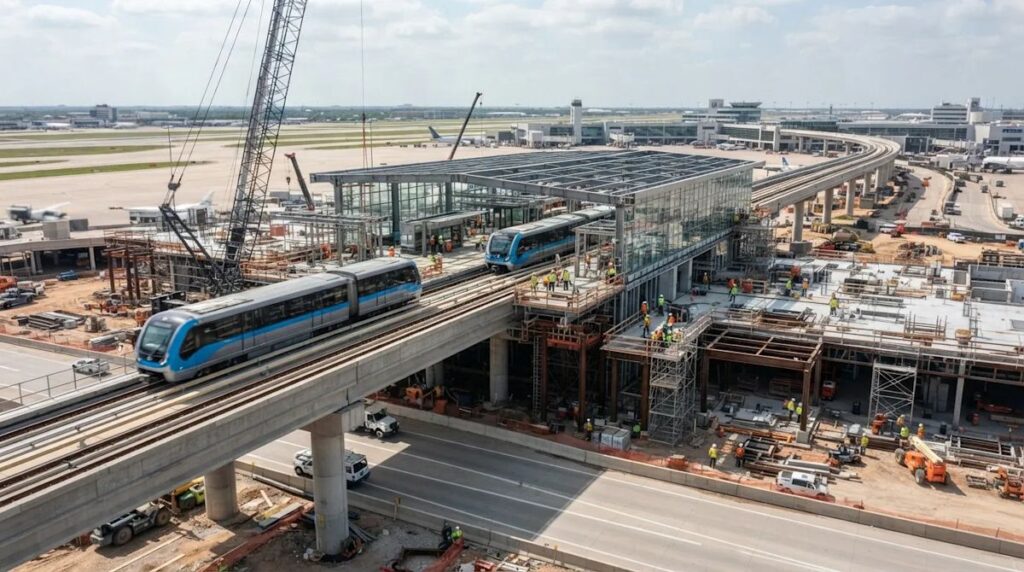
The system you ride today is being rebuilt around a new terminal while it runs. DFW has lifted all six prefabricated modules into place for the new Terminal F Skylink station, which will connect the train to the future terminal.7 The eight-hour project integrated the new station into the existing system.
There’s more coming. Jacobs has been selected to design alterations to the guideway bridge spans, while keeping the system fully operational throughout construction. That includes room for dual taxi lanes beneath the train.1 Terminal F is expected to open in 2027, and one report says travelers should expect construction around Skylink and Terminal F to continue for years, which may affect how they reach gates.
Did You Know: Terminal F will be the first new terminal built at DFW since 2005.
Skylink is free, runs around the clock, and covers even the farthest terminals in nine minutes or less. But it only works while you’re inside security, and Terminal E can’t be reached on foot from any other terminal. The old Airtrans left its tracks behind, and a sixth terminal is being wired in while the train keeps running.
What’s the Skylink trick you wish you’d known sooner? Drop it in the comments.
Sources:
Source link