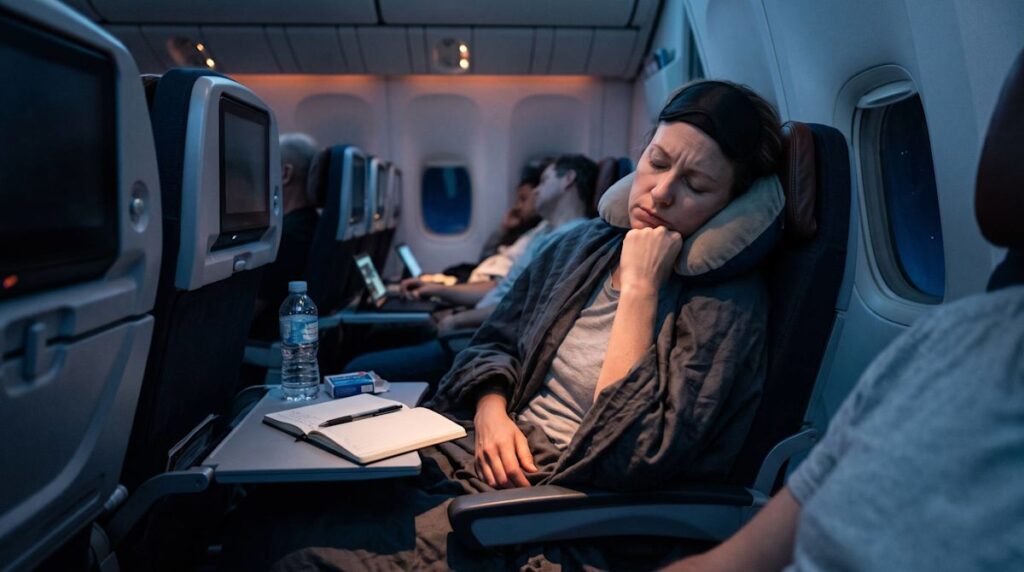
Thanksgiving week is one of the busiest travel periods of the year. A predictable share of those traveling to different time zones will step off the plane convinced they’re experiencing jet lag. Most will not, at least not in the technical sense. That’s because jet lag is essentially the mismatch between your internal clock and local time after crossing time zones. Unless you’re traveling to a different country, a flight from one coast to the other spans three hours at most. What’s happening isn’t true jet lag but rather a combination of separate problems that happen to coincide. A sleep schedule wrenched by a pre-dawn alarm, a dehydrating plane cabin, a gut full of expanding gas from lousy plane food, and legs that have most likely not moved in hours. It’s no wonder you’re feeling off!
What to do if you’re truly jetlagged
If you are crossing three or more time zones, flying internationally for the holiday, or traveling across the country and immediately flipping your schedule, you have a genuine circadian problem. If you are flying one or two zones, or mostly losing sleep due to an early flight departure, you do not have jet lag so much as a disrupted schedule. Priority shifts to getting enough sleep, staying hydrated, and moving on the plane if possible. Nearly everyone, regardless of distance, deals with the bloating, the dryness, and the stiffness during a flight.
Of all the factors that influence our circadian rhythm, light exposure is the most powerful. The body clock responds to morning light by shifting your rhythm earlier. Light in the evening shifts it later. Flying east, you’re advancing your clock, so morning light helps and late-evening light hurts. Flying west, you need to delay it, so evening light helps, and early-morning light works against you.
Advertisement
Advertisement
For an eastward trip, seek light early in the day. For a westward trip, do the reverse. On arrival, getting outdoors into daylight on the destination’s schedule is the single most effective thing you can do, because natural daylight is far brighter than any indoor lighting and anchors the clock to local time. For shorter domestic trips, you mainly need to get daytime light where you land and keep your phone out of your face in the hours before you want to sleep.
If you need to nap after arrival, keep it short. A 20- to 30-minute nap may help with alertness, while a longer daytime nap can make it harder to fall asleep at the local bedtime.
Time meals to where you are going
In controlled studies, meal timing can shift human circadian rhythms. Eating later shifted peripheral clocks, independent of the light cue. During travel, the best practice is to start eating on the destination’s schedule as soon as possible, ideally from the moment you board if your flight crosses a meaningful time zone. Having your meals land at the new local breakfast, lunch, and dinner spots helps your body align faster than with light exposure alone.
Avoiding a heavy, poorly timed meal is sensible, and a modest fast that pushes your first real meal to destination morning can help, but a rigid airport-to-landing fast is unnecessary and often counterproductive if it leaves you depleted and irritable.
How to combat bloating, dryness, and stiff legs
These in-cabin problems have nothing to do with time zones and everything to do with the environment. Aircraft cabins are pressurized to the equivalent of roughly 6,000 to 8,000 feet of altitude. At that lower pressure, the gas already in your digestive tract expands by about a quarter, which is the main reason for that in-flight bloating. While it will be impossible to avoid it completely, what will help is avoiding the things that will make bloating worse. Carbonated drinks, high-sodium meals right before boarding, and, for some people, gum chewing, which makes you swallow air, can make bloating worse. Fortunately, the bloat will resolve on its own once back at normal pressure.
Advertisement
Advertisement
The same cabin is also extremely dry. Humidity is often below 20%, which is well under the comfortable indoor range. As a result, moisture is drawn from your airways and skin, compounding the sluggishness people often blame on jet lag. Drinking water steadily through the flight will help. Those on longer flights may want to include electrolytes, especially those who are prone to dehydration. Unfortunately, alcohol and excess caffeine are the worst for bloating, so they are worth limiting in the air.
Sitting still for hours is the one in-flight issue that could potentially cause medical problems in some people. Immobility slows blood flow in the legs and raises the risk of a clot. Standard travel guidance is to move regularly on any flight longer than a few hours. Walk the aisle every couple of hours, flex and circle your ankles, raise your calves in your seat, and stay hydrated. Most travelers do not need anything beyond that. People prone to swelling may benefit from compression socks or stockings.
How to add Melatonin correctly
For trips that cross several time zones, timed melatonin has the strongest evidence of any supplement for jet lag, but timing matters more than dose. Taken at the appropriate time for the direction of travel, a low dose, often 0.5 to 1 milligram, can help shift the clock. More is not better here. The CDC advises against doses above 5 milligrams because they can leave excess melatonin in the body at the wrong time of day. For a one- or two-zone domestic trip, melatonin is rarely necessary.
The protocol, by phase
|
Phase |
Light |
Food and fluids |
Body |
|
1 to 2 days before |
Shift light earlier (east) or later (west) if crossing zones |
Start nudging meals toward destination time |
Protect sleep; bank rest before an early flight |
|
In the air |
Control light with window and eye mask by direction |
Water steadily, add electrolytes, go easy on alcohol |
Walk every couple of hours; ankle and calf moves |
|
On arrival |
Get outdoor daylight on local schedule |
Eat on local meal times, keep it light at first |
Light activity; sleep at local bedtime |
A general framework. The light and meal-timing steps matter most when crossing several time zones; the fluids and movement steps apply to every flight.
What does not help much?
Drinking alcohol to sleep on the plane disrupts sleep quality and worsens dehydration. Detoxes, cleanses, and anti-bloat supplements do nothing to address gas because it forms for purely physical reasons. Sleeping pills may knock you out but do not shift the underlying clock. They treat a symptom while leaving the jet lag in place.
Frequently asked questions
Is coast-to-coast travel jet lag?
It is mild jet lag at most. A three-hour change does shift you out of sync with local time, so an East Coast traveler landing in California may feel wired at the local bedtime, but the effect is small and resolves within a day or two. The heavier fatigue most people feel on these trips comes from the early departure, the travel stress, and the dehydration, not from the time change itself. Treat the sleep and hydration first, and the small time shift tends to sort itself out.
Should I fast on the flight to beat jet lag?
You do not have to. Eating on the destination’s schedule helps your body clock adjust, and a modest fast that moves your first real meal to the local morning can support that. A strict, all-flight fast is not necessary, and if it leaves you depleted, it can do more harm than good. Aim for timing rather than deprivation: light food in the air, real meals on the new clock.
What stops the in-flight bloat?
Nothing stops it entirely, because it is caused by the lower cabin pressure expanding the gas in your gut, which is normal and temporary. You can reduce how bad it gets by avoiding carbonated drinks and large meals right before and during the flight, limiting gum chewing, and walking a little during the flight. It resolves on its own after landing. No supplement or cleanse changes the underlying physics.
Do I need compression socks or aspirin for a short flight?
Most people on a short flight need neither. Moving regularly, doing calf and ankle exercises in your seat, and staying hydrated are enough for the average traveler. Graduated compression stockings are worth discussing with a clinician if you have a higher risk of clot, such as a prior clot, recent surgery, or pregnancy. Aspirin is not recommended as a general clot-prevention measure for flights, so do not start it on your own for that reason.
Advertisement
Advertisement
Get medical care immediately for new leg swelling, pain, or tenderness after travel, especially if the area is warm or red. Sudden difficulty breathing, chest pain, coughing up blood, or fainting can signal a pulmonary embolism and also requires immediate care.
This story was originally published by Men’s Fitness on Nov 24, 2026, where it first appeared in the News section. Add Men’s Fitness as a Preferred Source by clicking here.