

Mid-morning, strolling along the 2,000-year-old colonnaded street that lies at the heart of the ancient Greco-Roman city of Perge, in the Turkish region of Antalya, and I am fast becoming a sweaty mess. The sun is beating down, I’ve drunk all my water and am spending most of my time trying to find corners of shade while my guide regales me with ancient Greek myths and stories of Alexander the Great and Paul the Apostle. I suppose wearing jeans and a jumper might not have been the best idea, but then it is the middle of February. And, er, 25C.
Turkey isn’t widely known as a winter-sun destination – at least not in Britain. We tend to opt for the Canary Islands, Morocco, Egypt or further afield. But as I realised when I visited the city in the depths of a dark, dank February earlier this year, the Germans and the Scandis have already realised that this stretch of the Lycian coast is the perfect place to escape the Northern European winter.
The gargantuan Taurus Mountains, which rise behind the city and its long stretches of sandy beach, block the northern winds and continental air masses that descend from the freezing plains of Central Anatolia, creating a kind of natural amphitheatre that holds the sun.
Colonnades at the Agora of Perge, with a view of the Hellenistic Gate – iStockphoto/JackF
Although direct flights from Britain also go to Dalaman and Bodrum, for me, Antalya is the region to head for, simply because the winter weather is more reliable than anywhere else in the country.
Advertisement
Advertisement
The city and its surroundings boast 300 sunny days a year, with average winter temperatures of around 20C. There’s the chance to explore nearby ancient sites, dramatic scenery and a charming old town in relative peace and quiet – at least compared to the summer months, when millions descend on what, according to Euromonitor, is the fourth-most-visited city in the world.
After my meltdown at Perge, I opt for shorts and a T-shirt to visit Aspendos, which turns out to be one of the most extraordinary historic sites I’ve ever visited. The 2nd-century structure is one of the best preserved Greco-Roman theatres in the world, and still holds concerts and performances. Yet when I visit, there are fewer than 20 other people clambering over the steep curve of seating.
Aspendos Ancient Theatre, one of the best-preserved Roman theatres in the world – Emad Aljumah
It’s hard to explain just how different these sites feel when you have them almost to yourself. The history becomes tangible, the atmosphere almost entirely undisturbed by the clatter and selfie sticks of contemporary life. Visiting Ephesus in September, submerged in cruise-ship crowds, only highlights the vastly different experience.
Alongside the history, Antalya has its fair share of natural beauty, too. One of my favourite spots is the Upper Düden Waterfalls, which tumble through leafy parkland, with a walkway carved into the rockface around and behind the falls.
Advertisement
Advertisement
In summer, the waterside pathway is flanked with restaurants set on decked terraces over the river – in winter most, if not all, are closed – but it’s a small price to pay to have the park almost to myself.
Wander through parkland to the majestic Upper Düden Waterfalls – iStockphoto/saiko3p
Back in the centre, there’s no shortage of places to eat (this is a working city after all). I follow the river nine miles to the coast, where the Lower Falls tumble 40m into the sea. The Düden Fish Market offers communal tables and the chance to pick your fish from the counters and have it cooked to order (quite possibly the best sea bream I’ve ever had).
Then there’s the Kaleiçi, a tangle of pedestrianised streets that wind and fold around the small Roman harbour. It’s lovely to be able to wander without being jostled by crowds, to sit in one of the leafy café courtyards with a cold Efes beer and a pide (Turkish pizza) and watch the world go quietly by. And there’s no problem getting a table at one of my favourite restaurants, Parlak, famous for its velvety, smoky chicken, cooked over an open fire, and traditional meze dishes.
With most tour operators offering winter packages to the Antalya region, it won’t be long before people catch on, more hotels will stay open and it will become – if not as packed as the summer, then considerably busier than at the moment. My advice? Go now – or rather, in February. Just remember not to wear a jumper.
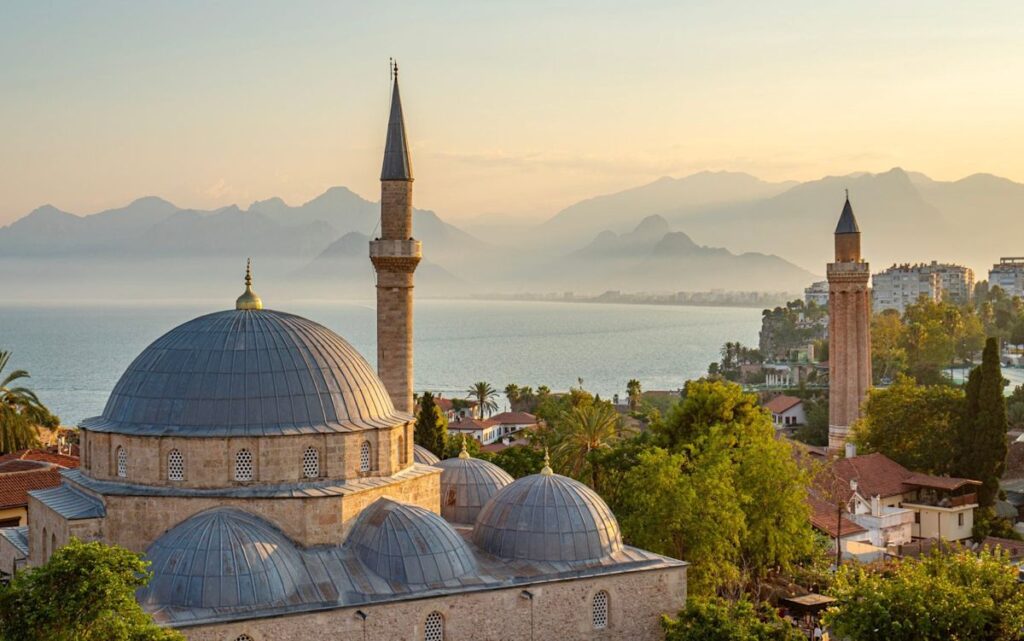
Kaleiçi Marina, the historic harbour beneath Antalya’s Old Town – iStockphoto/ozgurdonmaz
Five great winter-sun breaks in Antalya
For relaxation
Most of Antalya’s all-inclusive resorts are set along the 7.5-mile stretch of Lara Beach, but not all stay open in winter, making the beach blissfully quiet. The Bayou Lara offers everything from outdoor yoga to evening entertainment, with a private stretch of beach; double rooms cost from £201 in January, as opposed to £503 in July. A four-night break in January costs from £607pp, all-inclusive, including flights (see Trip).
For golfers
Belek, an hour’s drive east of the city, is Turkey’s premier golfing resort, with a clutch of luxurious all-inclusive hotels and roughly 17 different courses. Winter temperatures are ideal for teeing off – often around 16C – and green fees drop to their lowest rates. A week at Voyage Belek costs from £1,238pp, all-inclusive, including flights and transfers (see Olympic Holidays).
For families
World-class water-parks and hotels with packed schedules of activities and entertainment make Antalya a great choice for families. A week at the five-star all-inclusive Regnum Carya would cost £2,632pp in August; in February half-term, it costs from £899pp, based on a family of four sharing a room, including flights and transfers (see Destinology).
Take a dip in Regnum Carya’s Main Pool, surrounded by lush greenery
For history lovers
An hour’s drive from Antalya, Side offers a good mix of beach and history. A former Greco-Roman port, the waterfront ruins are spectacular, along with a massive 2nd-century theatre and colonnaded streets. A week at the Barut Hemera costs from £749pp all-inclusive, including flights – in June, the price would be £1,249pp (see Tropical Sky).
For hikers
Further afield, Kalkan reverts to a small, sleepy town in winter, but the mountains behind form a suntrap that creates warmer temperatures than nearby towns such as Kaş. It’s ideal for walking stretches of the Lycian Way, which runs through the town. A week at the Fidanka costs from £1,030pp B&B, including flights, transfers, full-day boat trip, one dinner and a village trip (see Fleewinter).
Try full access to The Telegraph free today. Unlock their award-winning website and essential news app, plus useful tools and expert guides for your money, health and holidays.
Source link