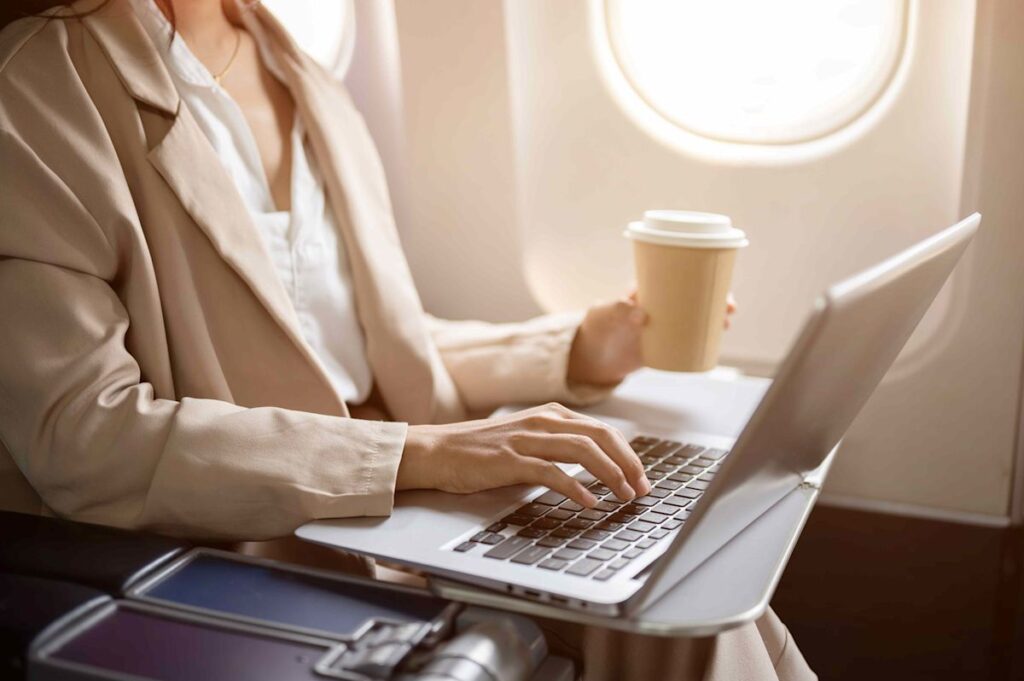
Whether you have work to accomplish or a favorite movie lined up, a strong Wi-Fi connection can make all the difference when you fly. Nothing is more frustrating than apps that won’t load or emails that won’t send. Your flight now feels a whole lot longer.
Airplanes use external antennas designed to seamlessly pick up Wi-Fi signals from towers and satellites while you travel. Service can get spotty when you’re crossing terrain with no signal, but how close you sit to a plane’s Wi-Fi equipment also matters.
“If you’re hoping to get the best possible Wi-Fi experience on a flight, where you sit can make a small but worthwhile difference,” explains Mark Stallings, co-founder of Casely, a tech accessory company based in New York. “It’s important to remember, though, that your seat is only one factor.”
Advertisement
Advertisement
Find out where to sit on the plane for the fastest Wi-Fi and what else affects your streaming experience during a flight.
The Best Seat on a Plane for Fast Wi-Fi
“Generally speaking, the middle section of the aircraft, around the wings, tends to offer the most reliable connection,” Stallings says. “On many modern aircraft, the Wi-Fi equipment and satellite antenna are positioned on the upper fuselage near the center of the plane, so sitting closer to that area can sometimes mean your device has a shorter path to the onboard network.”
The exit row also offers extra legroom for travelers. If you don’t like sitting in the exit row, there should be plenty of seats available in the center section of the plane.
“It’s not a magic solution, and it won’t suddenly turn in-flight Wi-Fi into fiber broadband, but every little advantage helps if you’re trying to work or stay connected,” Stallings says.
Advertisement
Advertisement
Here’s what else can make a difference in the speed of your Wi-Fi connection.
Other Ways to Get Faster Wi-Fi on a Plane
Stallings says that the technology on your plane will have a much bigger impact on the speed of your connection than where you sit. If working from the air is important to you, he recommends researching an airline’s Wi-Fi service before you book your flight.
“Some airlines have invested in newer satellite systems that provide faster speeds, lower latency and a more consistent connection throughout the flight, while others still rely on older technology that can struggle when the cabin is full of passengers streaming videos, uploading photos, or joining online meetings,” Stallings explains. “Think of it like public Wi-Fi in a busy café—the more people sharing the connection, the slower it can become.”
If your airline offers it, “paying for a premium Wi-Fi package can often be money well spent,” he adds. “Premium plans typically provide faster speeds or give you access to more bandwidth, making tasks like downloading documents, accessing cloud storage, or responding to emails much smoother.”
Advertisement
Advertisement
Here are a few more tips for staying connected while you fly:
-
Download anything important before you arrive at the airport, or connect as soon as the network becomes available and download the files before takeoff.
-
Close any apps you don’t need that are syncing in the background. You can also change device settings to prevent apps from refreshing in the background.
-
If you have multiple devices, try not to connect them all at once. They will be competing for the same bandwidth as the device you’re using.
-
When you don’t need to use the Wi-Fi, turn on airplane mode, which also saves battery life.
“In-flight Wi-Fi has improved enormously over the past few years, but it’s still a shared resource, so a bit of preparation and realistic expectations will go a long way towards getting the best performance,” Stallings says.
Read the original article on Southern Living