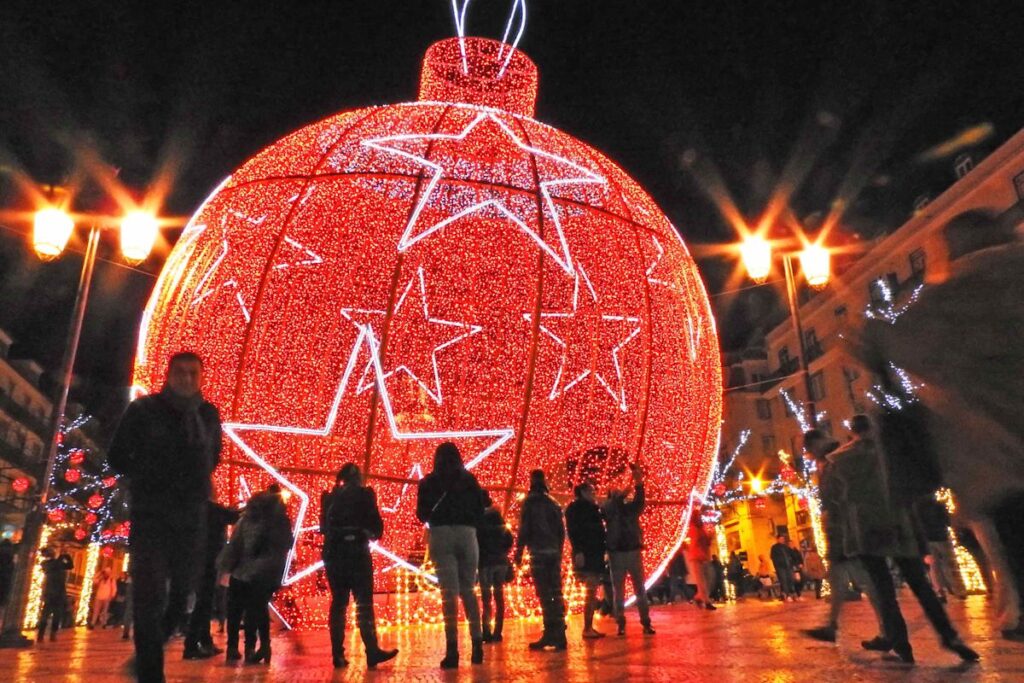


In Lisbon, the first sign of the holiday season isn’t a string of lights; it’s the soft scent of charcoal smoke rising from the chestnut carts that start popping up on street corners in November.
Five years ago, I moved to Portugal ready to fall in love with all its distinctive traits. What I didn’t expect was just how much I’d adore the holiday season here. In particular, I’ve come to treasure those chestnut vendors selling castanhas assadas in paper cones—the ideal snack to enjoy while strolling through one of Lisbon’s charming Christmas markets, from Rossio to Wonderland Lisboa in Parque Eduardo VII.
A vendor in Lisbon sells roasted chestnuts at the Praça do Comércio.
Credit: Horacio Villalobos/Corbis via Getty Images
These markets also have their own sweet Portuguese surprises. The tastiest among them is sonhos, which translates to “dreams”: tiny puffs of fried dough coated in sugar (think: Christmas doughnuts).
Advertisement
Advertisement
Then there’s ginjinha—a sour cherry liqueur famed in Lisbon—which pairs perfectly with sonhos. At these markets, it comes in an edible chocolate cup—a tradition that started in the walled town of Óbidos. Drink the liqueur, eat the cup, and leave nothing behind.
Of course, I still miss my holiday traditions: Christmas Eve at my grandmother’s, devouring pretzels dipped in a hot mustard sauce; waking up on Christmas morning to find my stocking placed outside my door by “Santa”; and never missing a performance of A Christmas Carol at Trinity Repertory Company in Providence, Rhode Island, with my mom and sister. But I’ve adopted these delightful holiday rituals in Portugal as part of my own seasonal lore, too. And Lisbon isn’t the only European destination with holiday traditions worth crossing a border for. I asked fellow transplants (and one local) to share their favorites, so you can find a new one worth adding to your holiday lineup.
Athens, Greece
A woman holds an open pomegranate in Athens, Greece.
Credit: Thanasis Zovoilis/Getty Images
Kathleen O’Donnell moved from Boston to Athens about four and a half years ago, and she now kicks off every January with a sticky mess. “In Greece, it’s traditional to smash a pomegranate on the threshold of your front door to start the New Year off right,” she says. “The messier, the better, as more arils coming out means more luck in the year ahead.”
The fruit has long symbolized fertility and prosperity in Greece, the Dartmouth Folklore Archive explains, and some families hang one above the door at Christmas, then break it on New Year’s Eve. “I love it because it’s a very ancient tradition that is still common today,” O’Donnell adds.
Bavaria, Germany
A Krampus celebration in Munich, the capital of German Bavaria.
Credit: Martin Zwick/REDA/Universal Images Group via Getty Images
Brian Mahany moved his family from the U.S. to a Bavarian village on the Austrian border about two years ago. Like me, he’s come to appreciate trading in the mass mall sales for smaller, local markets. “It doesn’t start with Black Friday. It starts with small village Christmas markets,” he says. “Many are only open for a single evening, and they’re less about shopping than about standing around a fire with a mug of glühwein and running into your neighbors.”
Advertisement
Advertisement
While St. Nikolaus still makes his rounds on Dec. 6, passing out sweet treats, Mahany has also come to love his darker, hairier companion, Krampus. According to the Austrian National Tourist Office, Krampus is in charge of punishing and scaring “any misbehaving townsfolk while the [well-behaved] receive their treats.” Growing up in the U.S., he says, “I only knew Krampus from a horror movie. Here, he’s a real, living village tradition.”
Madrid, Spain
Revelers pass plates of 12 grapes on New Year’s Eve in Madrid, Spain.
Credit: Getty Images
Sarah Willats moved from Dayton, Ohio, to Spain in 2014, and quickly found that if you move here, you better love grapes—at least on New Year’s Eve. According to Muy Interesante, the tradition of eating 12 grapes at midnight (known as las doce uvas de la suerte, or the 12 lucky grapes) to kick off the new year began more than a century ago when Madrileños first ate them as a way to poke fun at the city’s upper class who tended to eat the fruit alongside their expensive Champagne. By the 1900s, it became a symbol of good luck, as long as you can finish all 12 before the clock stops chiming at midnight. “I love how it’s both challenging to finish all 12 before the clock finishes striking and a fun way to start the next year on a positive note,” Willats says.
Provence and Paris, France
For Ashley Parsons, one of the joys of celebrating the holidays in Europe lies in not one, but 13 desserts, meant to represent Jesus and the 12 apostles. However, these may not be the cookies, cakes, and sweets you’re imagining. “The first Christmas I was expecting 13 magnificent French desserts, as you see in the windows of dessert shops,” Parsons says. “Imagine my surprise when out came a plate with almonds, dates, figs, oranges—13 things I did not consider desserts.”
And the sweets don’t stop at Christmas. Come January, families gather around a galette des rois (king cake), which has a small charm hidden inside. Whoever finds it is crowned king or queen for the day. “There’s always a little excitement around who gets to hide under the table and call out whose slice is whose,” says Julien Alvarez, international executive pastry chef and global head of creation at Ladurée. “I love how these traditions turn a simple dessert into a shared memory, passed down from one generation to the next.”
Budapest, Hungary
Szaloncukor candy wrapped in colorful foil in Budapest, Hungary.
Credit: iStockphoto/Getty Images
Denae McGaha spent more than seven years in Budapest, where she learned you can decorate a Christmas tree with far more than ornaments. “I loved decorating my Hungarian Christmas tree with szaloncukor instead of candy canes,” she says. “These chocolate bonbons come in a myriad of flavors (my favorite is marzipan), and their colorful foil wrappers create a cozy glow among the tree lights.”
Advertisement
Advertisement
The tradition also comes with a bit of mischief. As the Budapest tourism website explains, “It’s great fun to steal the sweets from the tree, and then leave the paper hanging there so that other family members don’t discover the trick. True masters of szaloncukor stealing can (re)shape the empty wrappings so perfectly that the ‘crime’ does not come to light for a very long time.”
Slovakia
A traditional Slovakian Christmas dinner of fried carp and potato salad.
Credit: iStockphoto/Getty Images
For Adriana Falisova, growing up in Slovakia meant things could get a little fishy around Christmas. There, she says, the holiday is celebrated on Dec. 24, with fried carp and homemade potato salad taking center stage at the dinner table. But the carp would often arrive a few days early, becoming a temporary houseguest. “When I was growing up, it wasn’t unusual for families to buy a live carp a few days before Christmas and keep it swimming in the bathtub until Christmas Eve,” she explains. “It’s probably one of the strangest Christmas traditions to explain to someone who hasn’t grown up with it.”
According to The Slovak Spectator, the Christmas meal begins with oblátky, thin wafers eaten with honey and garlic. In some homes, someone also dips a finger in honey and draws a small cross on everyone’s forehead, wishing them health and sweetness in the year ahead. While bathtub carp is harder to come by today, the wafers and honey remain holiday mainstays. “That’s what I love most about Slovak Christmas,” Falisova says. “It’s not just about the food or the presents, but all these little traditions, stories, and superstitions that have been passed down through generations.”
Read the original article on Travel & Leisure
Source link