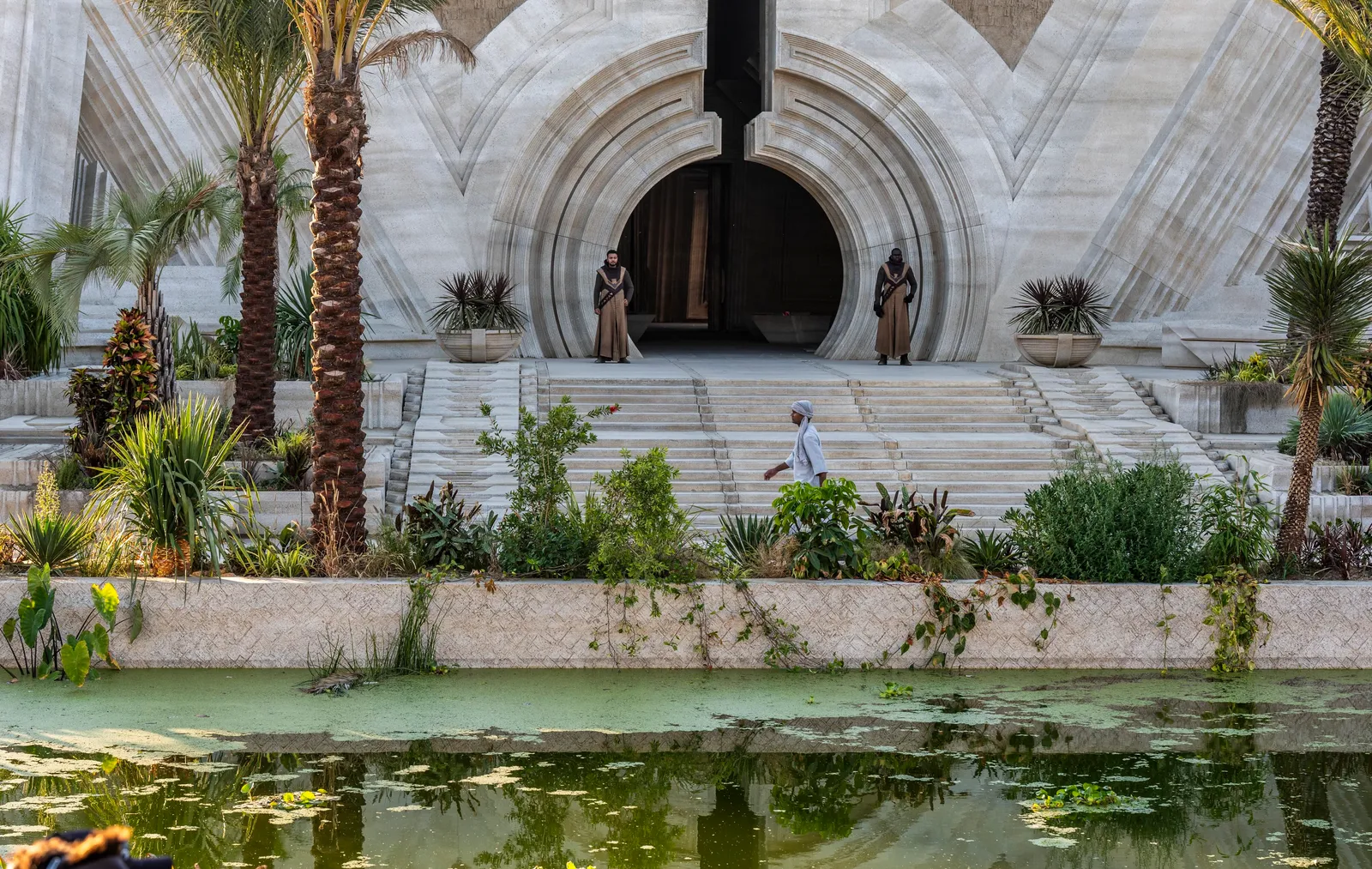
Over 450,000 square feet of interior stages and 475,000 square feet of backlots were used for scenes shot in Budapest alone, with each set typically taking 14 to 16 weeks to build. (Filming also took place in Abu Dhabi and Iceland.) Even the sandworms that slither through the titular dunes got grander this time around: Instead of the relatively small platforms that were used to film worm-riding sequences as in the previous films, the production team built a 300-foot-long by 65-foot-wide sandworm in the middle of the desert.
Like in Dune: Part Two, Vermette was challenged to create entirely new sets for this installment, which adapts Frank Herbert’s 1969 novel Dune Messiah. One of the new settings viewers can expect is Wallach IX, the home of the powerful and secretive Bene Gesserit sisterhood. Throughout their planet, Vermette incorporated stone etchings that resemble human cells seen through a microscope, referencing the Bene Gesserit’s breeding program that has gone on for millennia. Mother nature also informed the architecture. “When you arrive on the planet, the buildings are basically eggs of a spider, like crops of spider eggs as you find them in nature,” Vermette explains. “Ecology has always been a huge source of inspiration for me, and also for the storytelling it gives—you know, they’ve got their web across the universe, for the genealogy they create.”
Another new setting is the Veteran’s District, where the Fremen, the native inhabitants of the desert planet Arrakis, retire after fighting in the catastrophic holy war spurred by Paul Atreides, aka Muad’Dib (Timothée Chalamet). In the previous films, the Fremen lived in communal residences lined with hand-carved stone that recorded their history and culture. Returning from the battlefield, they find mass-produced housing units instead of the “green paradise” they were promised would await them. Made of ceramic instead of rock, with stamped-on rather than hand-carved markings, the Veteran’s District represents an artificial facsimile of their former homes. “And when you put all these units together, and you look at the rooftops, it’s there to represent sand dunes,” Vermette explains. “All these triangles align [to look like dunes], but it’s fake.”
Source: www.architecturaldigest.com
Source link