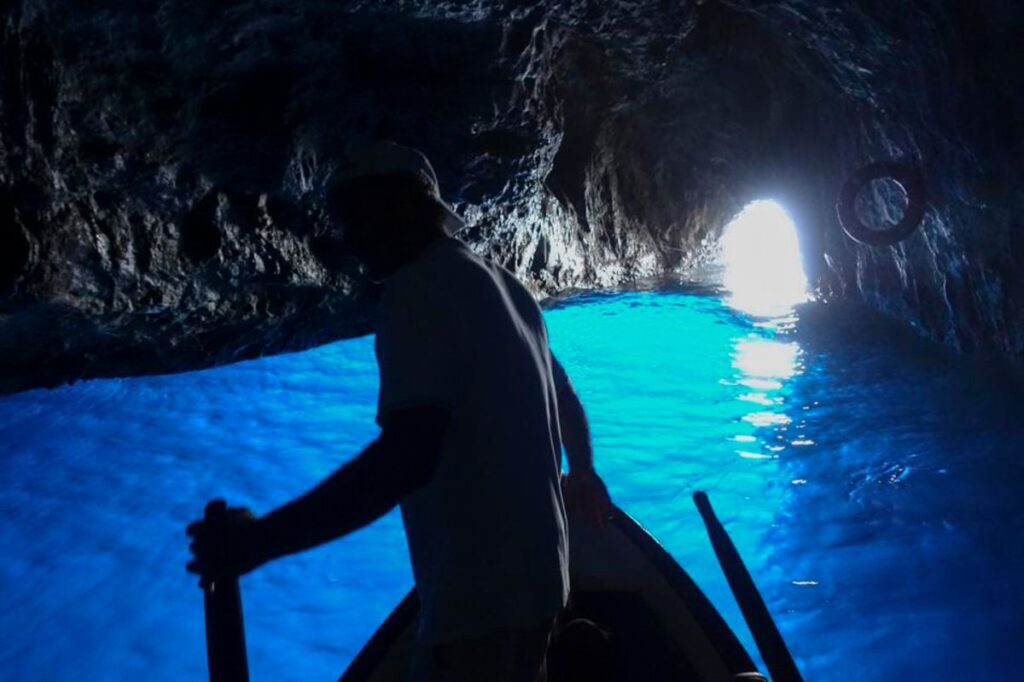


I am flat on my back in the bottom of a small wooden gozzo, chin tucked to my chest so my nose doesn’t catch on the rock sliding past inches above my face. Next to me, Darius, my husband is folded into the hull, and our skipper, Giuseppe, who has been patiently reading the swell, is simultaneously ducking into his lap and hauling us through the cave’s mouth by pulling hand over hand on a rope. Just a minutes earlier, we were inside the Blue Grotto, a chamber of contrasting inky darkness and electric, lit-from-below blue luminescence – one of the most beautiful natural wonders in Italy, and, to be honest, one I had never planned to visit.
Rowing the azure waters in the Grotta Azzurra
The Blue Grotto is a tourist cliché of the most epic kind: a nebulous 19 euro ticket, an hour in the queue and a mosh pit of rowboats equaling a five-minute peek inside. Half the time you can’t go at all, if the tide runs too high. The other half the time, you might find yourself lined up for half an hour between arguing tourists. It is also one of the most beautiful experiences and best stories of the island. The cliché, it turns out, is a cliché for a reason.
Two hundred years ago, Capri was a quiet fisherman’s island, a pitstop for pirates and the odd Grand Tour tourist until local innkeeper Giuseppe Pagano met August Kopisch, a German painter who had fallen in love with the Capri landscape. Pagano pitched Kopisch an idea – an adventure to otherworldly location and sent him off with a fisherman. Kopisch returned, raving about the light and what happened in 1826 was less discovery, and more launch party.
Advertisement
Advertisement
How do I know all this? Partly from Kopisch’s own letters, in which he recorded Pagano’s precocious pitch: “Don Augusto, let us now speak of something serious. Our grotto is such a marvel that it could draw visitors from all over the world to Capri. Write a description of it in my visitors’ book. Who knows? It may one day benefit me and my children.” And also because, as Darius and I waited in the Grotto’s queue, we fell into conversation with his great-grand-niece and -nephew. First-timers to the cave, like us, they had come to mark its two-hundredth anniversary and see the thing that had amazed their great-grand-uncle. And just like us, they had goosebumps.
Here’s the thing about Capri: it has been an It island for about as long as it’s been on the map. Four square miles of hills, cliff paths and improbable rock stacks rising out of the Bay of Naples, it was a retreat for Roman emperors: Augustus made it an imperial playground (and nicknamed it Apragopolis, the city of doing beautifully nothing), and Tiberius ran the empire from a clifftop here for the last decade of his life. After the emperors came priests, pirates, and Grand Tour travelers. And then Kopisch spread the word, so came the rest of the world. By the twentieth century Capri itself was a fixture for the literati and glitterati; during the war the Allies made and R&R camp here. (The villa that is now the Hotel Punta Tragara is said to have hosted a secret meeting between Churchill and Eisenhower). By the Dolce Vita decades, Capri was the backdrop for every jet set summer.
La Certosa di San Giacomo, Capri
I had a front-row seat to the Capri legend, with a bit of island exploration on the side. It began at the Certosa di San Giacomo, a Carthusian monastery a short walk from Capri’s famed Piazzetta and home to Capri’s archaeological museum. With Luca Di Franco, director of the island’s Musei e Parchi Archeologici, we explored the cells of the charterhouse, which was hosting the final days of the bicentenary exhibition Il Mito di Capri, an exhibit of paintings, sculptures, postcards, photographs and documents charting, and celebrating, how a feared sea cave became the most romantic address in the Mediterranean.
We walked through the medieval complex to the archaeological museum, which has an exquisite collection of more than 120 sculptures and statues, among them a remarkably complete gallery of Julio-Claudian portrait busts, plus a room dedicated to the Blue Grotto’s own Roman statuf which were hauled off the cave floor in the 1960s and ’70s. A dim, blue-lit chamber does its theatrical best to put you inside the grotto.
To give ourselves the full Tiberian experience, we hiked up to Villa Jovis, forty-five sweaty minutes uphill from the Piazzetta. Villa Jovis was the probably grandest and most notorious of the dozen villas Tiberius was said to have scattered across the island, clocking with a 5,500-square-metre sprawl of terraces, bedrooms, entertaining chambers and cisterns from which Tiberius ran the Roman Empire by letter from AD27 until his death in AD 37. Less than century later, Suetonius would immortalize the architecture and the imperial debauchery in his Twelve Caesars, deftly mentioning the Salto di Tiberio, Tiberius’s Leap, a vertiginous cliff where the emperor supposedly pitched off guests.
Advertisement
Advertisement
But for all the empire he ran from this clifftop, Tiberius kept one pleasure strictly for himself. You guessed it, the Blue Grotto, which served as his personal nymphaeum and a private, marble-dressed swimming pool.
The “Casa Rossa” (Red House) in Anacapri/
The next morning we took a taxi over to Anacapri .(We were press on time, but you can also hike up in about forty-five minutes, or take the bus.) Anacapri is the opposite of Capri town, more residential, less flashy. Keeping with the Blue Grotto theme, we headed to Casa Rossa, a hard-to-miss Alhambra-inspired folly built in the late 1800s by John Clay MacKowen and named for its blood red color. Licking his wounds after the American Civil War, the colonel wrapped his home around a fifteenth-century watchtower and filled its rooms with art and antiquities pilfered from ruins around the island. Today it is a museum staffed by La Sciuscella, a local social cooperative that trains and employs neurodivergent young adults.
Darius loved the eclectic display of antiquities (several embedded into the walls), while I was particularly taken by a small exhibit on Casa Rossa’s ground floor. MacKowen was obsessed with the Grotto. Not only did he collect antiquities from ancient Roman Villa di Gradola (which sits on the cliff above the cave), he claimed the rights to the Blue Grotto itself and made plans to blast out a private tunnel blasted straight through the rock. Thankfully, he never dug it, and even more thankfully, Casa Rossa has set up an immersive Blue Grotto Experience, transforming a room into the grotto complete with music, plaster copies of the grotto’s Roman statues, and 3D scaled architectural model of Mackowen’s dream tunnel connecting the villa to the grotto.
We didn’t have time to visit Villa Damecuta, the second best-preserved of the emperor’s dozen villas after Jovis itself and located on Anacapri. Instead we made for the Blue Grotto. Before we headed down to the water, Di Franco pointed out the Villa di Gradola, the Roman residence directly above the cave, where he is leading a large-scale excavation which he hopes will open to the public in 2027.
Advertisement
Advertisement
The Blue Grotto is, one way or another, where every Capri story begins. But in our case, it’s where it ended, waiting for our own peek at the gambit Pagano and Kopisch pulled off two hundred years ago.
The Details
Getting to Capri is easy. Ferries and hydrofils depart from Naples port Molo Beverello (and Sorrento) every hour and take about 45–80 minutes. Once at Capri’s Marina Grande, you’ll want head up to Capri town, so you’ll need to queue for the funicular, otherwise face the island traffic.
Visiting the Blue Grotto takes a little bit of patience. The Ministry of Culture lists the entry ticket at €13. For this, you’ll wait in line on the cliffside steps. Plan to dish out at least another €6 cash for your rowboat escort. For a 360 degree island experience, hire a private charter from the Marina Grande, which (usually) gives you an island tour, aperitivo and occasionally dip in the sea, as well bringing you to the Grotto. You’ll still need €6 for the rowboat. Keep in mind, the Grotto closes whenever the sea is rough, so make sure to check in advance
We stayed at Pazziella, a Luxury Collection Hotel, chosen for its hidden garden of lemon trees and whitewashed calm just off Via Camerelle, one of Capri’s fashions streets. We hid out making limoncello spritz in the garden and made plans to come back again for a tennis lesson on the nearby clay courts of the century old Tennis Club Capri.
Advertisement
Advertisement
For those who want a deep dive into Blue Grotto origin story, splurge on Hotel La Palma (an Oetker hotel), an Art Deco palace beautifully renovated with subtle references to Villa Jovis and other details pull from history. And it is also a landmark – opened in 1822 as Locanda Pagano, this is the inn where Kopisch and Pagano plotted.
This article was originally published on Forbes.com
Source link