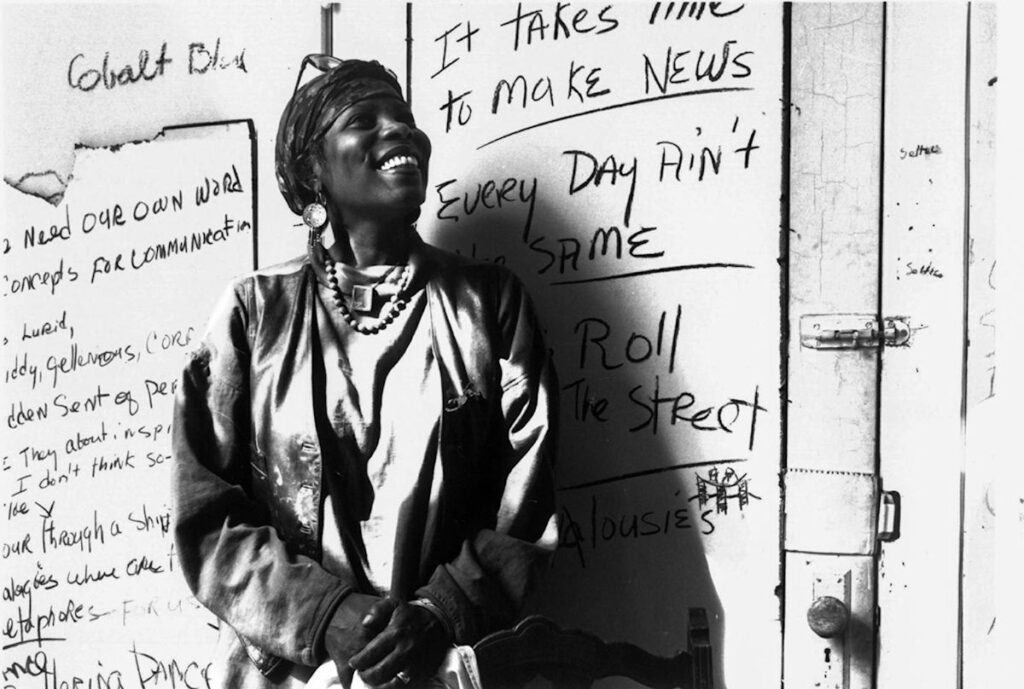


Mary Lovelace O’Neal moved to New York in the late 1960s at the height of the Black Arts movement. The Mississippi-born artist enrolled at Columbia’s School of the Arts in 1968, where she honed her distinct take on Abstract Expressionist painting. Blazing a trail as one of the few Black women in this field, she faced criticism from her peers, who felt her work should engage more directly with the political issues of the time, that it was not “Black enough.” She responded with her so-called “lampblack” paintings; radical, pitch-black abstractions made with carbon soot, allowing her to retain her expressionistic sensibility while answering the social question of Black art.
But this response to socially conscious art through Minimalism never fully defined her career. Lovelace O’Neal relocated to San Francisco after graduating from Columbia, where she reignited her exploration of color and abstraction. Her black color fields “unzipped,” as she called it, to reveal new, kaleidoscopic abstractions. By the 1980s and through the ’90s, O’Neal developed her idiosyncratic expressionistic style, often meditating on tangible subjects through obscure, gestural paintings. Perhaps the best example, Requiem for a Daffodil (1997), a six-by-11-foot painting, embodies this bold, high-energy approach. It features floral forms, from yellow bouquets to a field of delicate white flowers running across the top border, gathered together for what can only be understood as a funeral. Lovelace O’Neal’s vigorous brushstrokes streak across the canvas, yet the work retains a sensitivity, a delicate and caring touch for the subjects that populated her abstract works. It is perhaps the best representation of the middle part of her six-decade career. These two decades are the subject of the appropriately titled “Requiem,” at New York’s Marianne Boesky Gallery, her first posthumous show on view through December 19.
Mary Lovelace O’Neal,© Estate of Mary Lovelace O’Neal. Courtesy of Boesky Gallery
“The painting, Requiem for a Daffodil, to me, is an expression of the depth to which Mary could feel for her subjects,” gallerist Marianne Boesky tells Bazaar. “A funeral dedicated to a flower, attended by flowers, delivered with such solemnity, is a reflection of Mary’s acceptance and understanding of the loss of something beautiful, innocent, fleeting.”
Lovelace O’Neal died on May 10 at her home in Mérida, Mexico, at 84. Born in Mississippi and raised in Arkansas, she left home in 1960 to study under David Driskell at Howard University in Washington, D.C., before briefly attending Maine’s Skowhegan School of Painting and Sculpture in 1963. At this school, she devoted herself to Abstract Expressionism, studying the work of Franz Kline and Willem de Kooning.
Mary Lovelace O’Neal, Panthers with Socks (from the Panthers in My Father’s Palace Series), 1985-90Pierre Le Hors
Lovelace O’Neal lived what can only be called an exciting life, documented through archival material in the back room of Boesky Gallery. While living in California, she also traveled the world, collecting memories and experiences on jaunts from South America to Africa that informed her paintings. Panthers with Socks (1985–90) epitomized this process; the frenetic abstraction of a leaping white cat draws on both her twenties in New York and her 1984 trip to Morocco.
“In Panthers with Socks, the brushy figure of this leaping animal makes for a clear allusion to the Black Panther Party and the artist’s involvement in the Civil Rights Movement,” Boesky explains. “While the sights, sounds, and memories of the artist’s time in Morocco inspire the bold colors and theatrical architecture of the composition.”
Although Lovelace O’Neal leaned away from overt political work during the 1960s, her abstract painting never abandoned concerns about race and notions of Blackness. One example in the show, Juke Joint (1997), referenced the Jim Crow-era establishments where Black communities gathered, places Mary witnessed firsthand growing up in the Southern United States. The gestural work conveys the movement of dancing legs, evoking the free spirit of these establishments.
The eighties and nineties were largely defined by her life as a teacher. The artist joined the Department of Art Practice at the University of California, Berkeley, as a professor in the ’70s and received tenure in 1985. “I wanted to pay tribute to her as both an epic painter and as a lifelong teacher,” Boesky says. To do so, the gallerist intentionally paired Lovelace O’Neal’s show with Michaela Yearwood-Dan, a 32-year-old Black Abstract painter, who opened her solo show, “A Woman of Will,” the same night.
“[When I first saw Mary’s paintings,] it was really the first time I felt like I had really come across a female Black abstract painter who felt uncontained,” Yearwood-Dan tells Bazaar. “There was a real sense of freedom, lack of control. but in an intentional, free-spirited way.”
By juxtaposing these two shows, Boesky facilitates a cross-generational dialogue between the two artists, who, despite admiring one another’s work, never met in person. “Mary admired the energy and color in Michaela’s abstract paintings and quickly grasped Michaela’s commitment to activism, which also underpinned her paintings,” Boesky says. “Michaela had known about and followed Mary’s work, unbeknownst to me, at the time I began working with both of them. Completely different generations and geographies but kindred spirits nonetheless. It felt like kismet to present their shows side by side.”
Mary Lovelace O’Neal, What’s time to a pig, c. 1990s© Estate of Mary Lovelace O’Neal. Courtesy of Boesky Gallery
That the work still resonates across generations underscores Lovelace O’Neal’s lasting power. The paintings on view at Boesky reveal how the artist used abstraction to layer unmitigated expression and feeling into her subjects, from people and animals to place and memory. “She understood early that ideas and emotions had the potential to be conveyed more powerfully through abstraction than through identifiable narration,” Boesky says. Viewers can catch glimpses of a pig in What’s time to a pig (c. 1990s), or potted plants in A Tree Branch (c. 1990-91) amid the frenzied mark-making. Boesky says these images “stampede across a canvas or hover like a dream.”
Lovelace O’Neal offers a sneak peek into her dreams—her mind—through these paintings. The beauty of “Requiem” is that it compiles works from the undeniable turning point of her career. The works still feature the lampblack foundation, while also capturing how color furiously reemerged in her practice. Seen for the first time since her passing, the work remains as potent as ever, a product of a life devoted to her idiosyncratic vision.
“She referred to the act of painting as labor, her life’s labor,” Boesky says. “And she referred to the paintings as her children, the product of that labor, put out into the world to make their own mischief.”
You Might Also Like
Source link