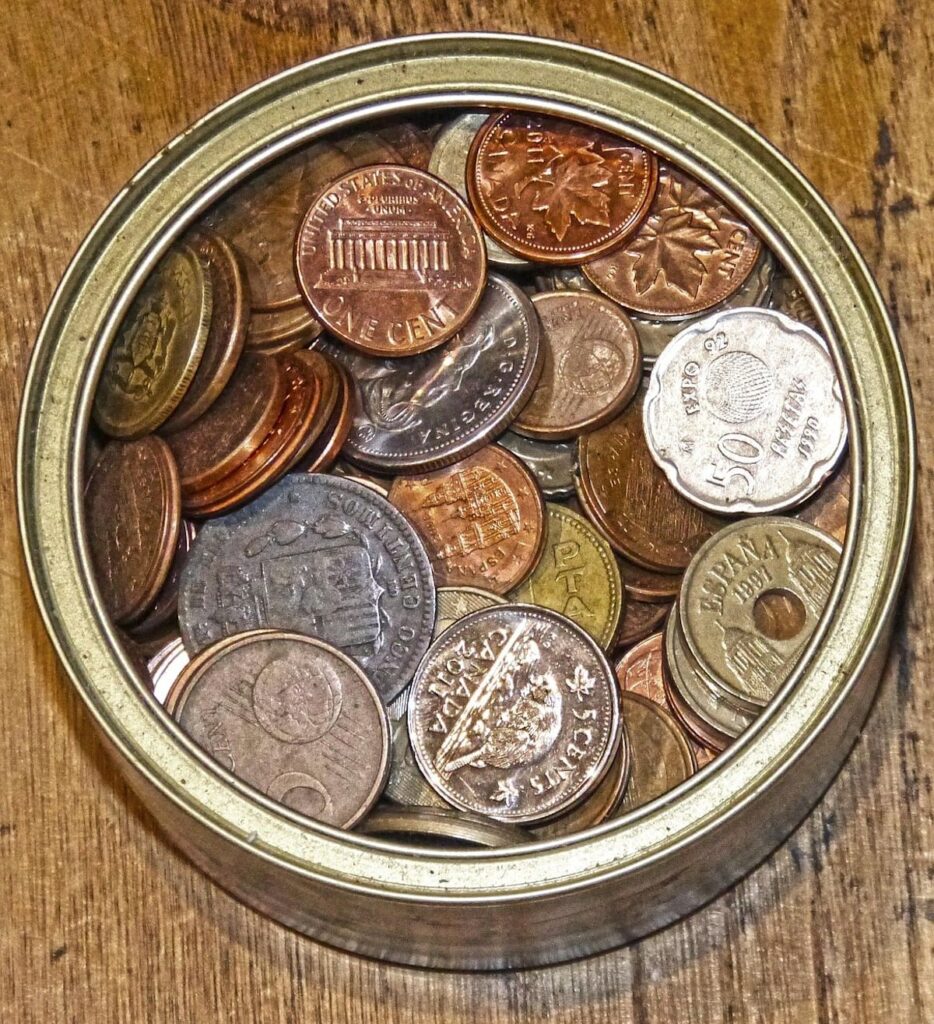


You know the moment. You’re at the gate, your pockets clink with euros, yen or pounds, and the café next to you has a small sign saying it only takes cards. Coins have always been the awkward part of leftover travel money, and cashless payment adds to the problem.
This guide covers what actually works. It’s based on what banks, charities and travel publications say about foreign coins, and it avoids promising payouts that don’t exist. Some options are practical, some are generous, and some are just sentimental.
Why Cashless Airports Make Coins a Bigger Headache
Why Cashless Airports Make Coins a Bigger Headache (Image Credits: Unsplash)
Cashless operations are spreading at airports, though not evenly. In the U.S., restaurants at Syracuse Hancock International Airport went cashless from April 7, 2025, including Johnny Rockets and Dunkin'[1]. In Nigeria, the Federal Airports Authority banned cash transactions at major airports from March 1, 2026[2], and that covers access gates, car parks and VIP lounges[2].
Advertisement
Advertisement
These examples are real, but they don’t mean every airport has dropped cash. Policies vary by airport, and even by shop within a terminal. The safe assumption is that the last-minute coin dump you used to rely on may not be available, so plan ahead.
Spend Them Before You Reach the Terminal
Spend Them Before You Reach the Terminal (Image Credits: Unsplash)
The easiest fix is to spend coins before you get to the airport. Travel writers often suggest using leftover cash on your taxi to the airport[3]. If you’re paying with mixed methods, you can put a handful of foreign coins toward the fare and pay the balance by card[4].
Corner shops, bakeries and station kiosks are other good places to use up change. Many of these small businesses still take coins even when the airport shops don’t. Buy a bottle of water, a snack or a transit top-up and keep the card for whatever’s left.
Don’t Count on Your Bank for Coins
Don’t Count on Your Bank for Coins (Image Credits: Pexels)
This is where many travelers get caught out. TD Bank, for example, states that foreign banknotes are accepted for exchange but coins are not[5]. UK-based exchange specialists say the same about high street banks, noting that banks only accept foreign banknotes, not coins[6].
Advertisement
Advertisement
The reasoning is mostly about cost. One explanation is that coins involve more work, storage and training for a smaller return[6]. Money.com makes a similar point, saying that the cost of exchanging foreign coins often outweighs the value banks and exchange providers can recover[7]. That’s why your local branch will likely turn you away, even if you’re a long-standing customer.
Airport Exchange Counters: Read the Fine Print
Airport Exchange Counters: Read the Fine Print (Image Credits: Unsplash)
Airport exchange desks look like the obvious answer, but they come with caveats. Afar notes that many airport exchange counters only accept banknotes, not coins[8]. It also says that banks typically offer better rates than airport stands[8], so convenience costs you.
Some providers are more flexible than others. One Fox News travel roundup says Travelex airport stores swap bills and most coins on the spot, but each store sets its own rates and fees[9]. That advice is dated, and other sources say Travelex won’t take coins, so check with the specific counter before you queue.
Donate Them Through Change for Good
Donate Them Through Change for Good (Image Credits: Pexels)
If the coins aren’t worth much to you, donating is the cleanest solution. UNICEF’s Change for Good is a partnership between UNICEF and the international airline industry[10]. In the U.S., American Airlines has been the participating airline since 1994[10], and travelers on selected international flights can donate extra U.S. and foreign currency[10].
Advertisement
Advertisement
You can also give at some airport donation points. Money.com says some airports have boxes that collect foreign currency for charities, such as UNICEF’s Change for Good[7]. Availability differs by airport and airline, so treat a donation box as a pleasant surprise rather than a guarantee.
Mail Them In or Use a Specialist Service
Mail Them In or Use a Specialist Service (Image Credits: Pixabay)
If you’re already home, you can still donate. UNICEF USA’s mailing address for the program is Change for Good, UNICEF USA, 125 Maiden Lane, New York, NY 10038[11]. Be aware that foreign coin donations are processed in bulk by a third party, so the acknowledgment won’t specify the amount[12].
If you’d rather get something back, a few specialist firms buy foreign coins. One is Leftover Currency, which takes both notes and coins, including discontinued currencies, and says it will pay by PayPal, check or bank transfer, or donate the funds to charity[9]. One blog suggests payouts of 75 to 85 cents on the dollar[13] from coin kiosks. That’s a vendor-style claim, so check each service’s fees and postage costs first. Heavy parcels of low-value coins can easily cost more to send than they’re worth.
Save Them, Share Them or Swap Them
Save Them, Share Them or Swap Them (Image Credits: Pixabay)
If you travel to the same place often, keep the coins. Greenlight suggests putting them in an envelope labeled with the country name[14]. Small coins are handy on arrival, and one traveler on the Rick Steves forum keeps the small coins needed for toilets[15].
Advertisement
Advertisement
You can also pass them to someone else. If a friend is heading to the same country soon, you can give them your leftover currency[14]. Teachers are another option, since one travel writer says teachers may be able to use leftover currency in a geography lesson[9].
Turn Them Into Keepsakes
Turn Them Into Keepsakes (Image Credits: Pixabay)
Some coins are better as souvenirs than as spending money. Money.com notes that coins can be displayed in shadow boxes, used in crafts or jewelry projects, or saved with photos and mementos[7]. A frame with a few coins from each trip costs almost nothing and holds up well.
Collectors may also want older or unusual pieces. Afar says that rare or unique banknotes and coins can fetch a decent price from collectors[8]. Everyday change usually won’t, so don’t expect much from a pile of common coins.
The Bottom Line
The Bottom Line (Image Credits: Pixabay)
Foreign coins are hard to cash in, and cashless airports narrow the options further. Banks generally won’t take them, airport counters often won’t, and specialist buyers may charge fees. The most reliable approaches are to spend them before the airport, donate them, or keep them for another trip.
Advertisement
Advertisement
If you’re planning ahead, the simplest fix is to pay by card in the last few days and withdraw only what you need. Whatever coins remain can do some good in a charity box or sit in a frame. Either way, they beat a drawer you never open.
Source link