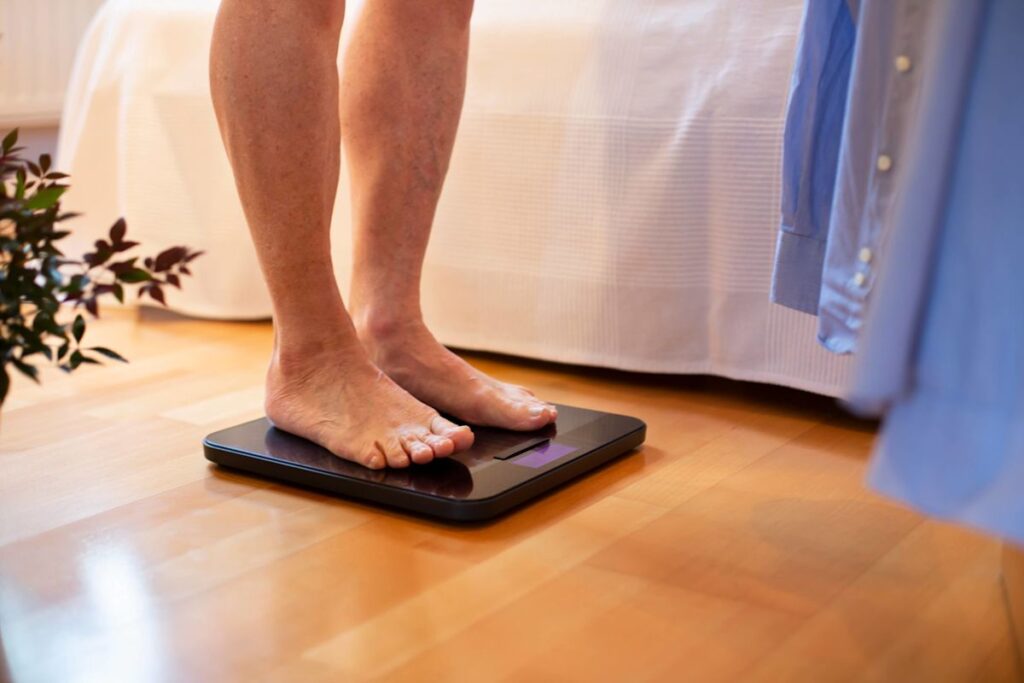
You start working out, clean up your diet, and wait for the scale to reward you.
Instead, it goes up.
That feels like failure. Often, it is a measurement problem: the scale can tell you that your total mass changed, but it cannot tell you what changed.
A higher number might reflect fat gain. It might also reflect water, stored carbohydrate, food still being digested, or lean tissue. Those possibilities become especially important when a new training program changes several of them at once.
Your Weight Normally Moves Around
Body weight is not supposed to produce the same number every morning.
Advertisement
Advertisement
In a study of 65 active men, first-morning weight varied by approximately 0.51 kilograms, or 1.1 pounds, from day to day during repeated exercise in the heat, even while participants followed guidance to replace their fluid losses. A separate analysis of 9,521 standardized measurements from one healthy man found a one-day variability of about 0.53 percent.
Neither study defines what is “normal” for everyone. They demonstrate why a single weigh-in is a weak verdict on fat loss.
Water intake, sodium, carbohydrate, bowel contents, sweat loss, and the time of the measurement can all move the number before body fat meaningfully changes.
New Training Changes Your Water Balance
An unfamiliar workout can create local muscle damage and temporary swelling while the tissue recovers. That is not new muscle, and it is not new fat.
Advertisement
Advertisement
The effect should not be exaggerated. In a 2026 experiment involving 13 trained men, any measured increase in thigh-muscle thickness had resolved within 24 hours after lower-body sessions containing seven, 14, or even 21 total sets. Beginners or people performing an unfamiliar routine may respond differently, and the experiment did not measure scale weight.
Training also changes glycogen, the carbohydrate stored in your muscles and liver. A National Institutes of Health body-weight model estimates that every gram of glycogen is stored with approximately 2.7 grams of water. When you train consistently and replenish carbohydrate, glycogen and its associated water can raise body weight without adding fat.
Then there is the simplest explanation: everything you eat and drink has mass until your body uses or excretes it.
You Can Gain Lean Mass While Losing Fat
Fat loss and muscle gain are separate processes. They can happen at the same time, particularly in beginners, people returning after a break, and some trained people following a structured plan.
Advertisement
Advertisement
In a small 2026 randomized trial, 30 resistance-trained participants completed 10 weeks of four-day-per-week lifting. Both groups receiving supervised, high-protein nutrition plans increased fat-free mass and averaged lower fat mass; the fat-mass reduction reached conventional statistical significance only in the calorie-deficit group. The other group ate at estimated maintenance calories.
That does not prove everyone can easily “replace” each pound of fat with muscle. The study was small, lasted 10 weeks, used high protein intake, and measured fat-free mass—which includes water and other nonfat tissue, not only muscle. It does show why body composition can improve more than scale weight suggests.
How to Tell Whether Your Plan Is Working
Standardize the measurement before interpreting it. Weigh yourself after waking and using the bathroom, before eating or drinking, and under similar clothing conditions. Do that several mornings per week and compare weekly averages.
Then add evidence the scale cannot provide:
Advertisement
Advertisement
-
Measure your waist in the same place and under the same conditions.
-
Take front, side, and back photos in consistent lighting.
-
Track gym performance and how your clothes fit.
If your weekly weight average is flat or slightly higher while your waist is shrinking and your performance is improving, the scale may be hiding useful progress.
If both your average weight and waist keep rising for several weeks, you may be eating more energy than you are using. Water can explain a short-term jump. It should not be used to dismiss every long-term trend.
The Bottom Line
A heavier weigh-in after starting a workout program does not automatically mean you gained fat.
Advertisement
Advertisement
Give the scale less authority and better data. Standardize your weigh-ins, follow the average for several weeks, and compare it with your waist, photos, and performance.
One number tells you what you weigh. The trend—and the rest of the evidence—tells you whether your body is changing.
This article is for informational and educational purposes only and is not individualized medical, nutrition, or exercise advice. Rapid or unexplained weight changes, swelling, shortness of breath, or other concerning symptoms should be discussed with a qualified healthcare professional. Men’s Fitness did not participate in the cited studies, and no company or product paid for or influenced this coverage.
This story was originally published by Men’s Fitness on Oct 31, 2026, where it first appeared in the News section. Add Men’s Fitness as a Preferred Source by clicking here.