

By Ana B. Ibarra, CalMatters

This story was originally published by CalMatters. Sign up for their newsletters.
Thirty years ago, Jim O’Hara Jr. woke up from a coma, unable to walk, talk or eat. An 18-wheeler had broadsided his car, leaving him, then 18 years old, with a severe brain injury, according to his father, Jim O’Hara. Doctors said the young man’s condition wouldn’t improve much. But O’Hara refused to leave his son in a nursing home.
After more than a year of hospital stays and rehabilitation, he brought Jim Jr. home, knowing he’d need far more help than one person could provide. California’s system of regional centers seemed like an answer. These centers purchase and coordinate support services for people with developmental and intellectual disabilities, and are designed to do exactly what Jim Jr. needed: help rebuilding his life.
Then O’Hara learned his son didn’t qualify. Under California law, a person’s disability must begin before age 18 to qualify for the regional centers system.
California’s ‘age of onset’ rule that determines eligibility is narrower than federal law and stricter than most states. O’Hara has spent years fighting to change it, pushing to extend access to people whose disability commenced as young adults, up to age 22. Now he’s trying again, this time alongside his state representative Assemblymember Pilar Schiavo, a Santa Clarita Democrat.
Schiavo said she is seeking to make this change through the annual budget process. She acknowledged the task could be an “uphill battle” given the state’s projected budget troubles, but said it’s a change that’s long overdue.
“California has really fallen behind the rest of the nation on this issue,” Schiavo said. “It’s hard to look at new programs or expansions when you’re looking at cuts.” But “Last year we were able to find new dollars for priorities, so we’re hoping this will be one of the priorities we can figure out how to make happen.”
The promise of early intervention
Without the regional center system, O’Hara became the advocate and case manager he wished his son had. He trained as a behavioral aide, appealed to insurance companies, shuttled his son to appointments and therapies, and designed a home schooling program.
“I devoted 10 years of my life to my son’s rehab. I don’t regret a single second of it,” he said.
It paid off. Gradually, Jim Jr.’s humor and his self-awareness began to resurface.
Today, at 49, he talks, walks, and cracks jokes. He loves to read and bowl – progress beyond what doctors anticipated.
To O’Hara, that trajectory proves just how much early intervention matters. “But the insurance and the rehab systems are not set up for that,” he said. “The regional center is. We didn’t have it; I had to create it myself.”
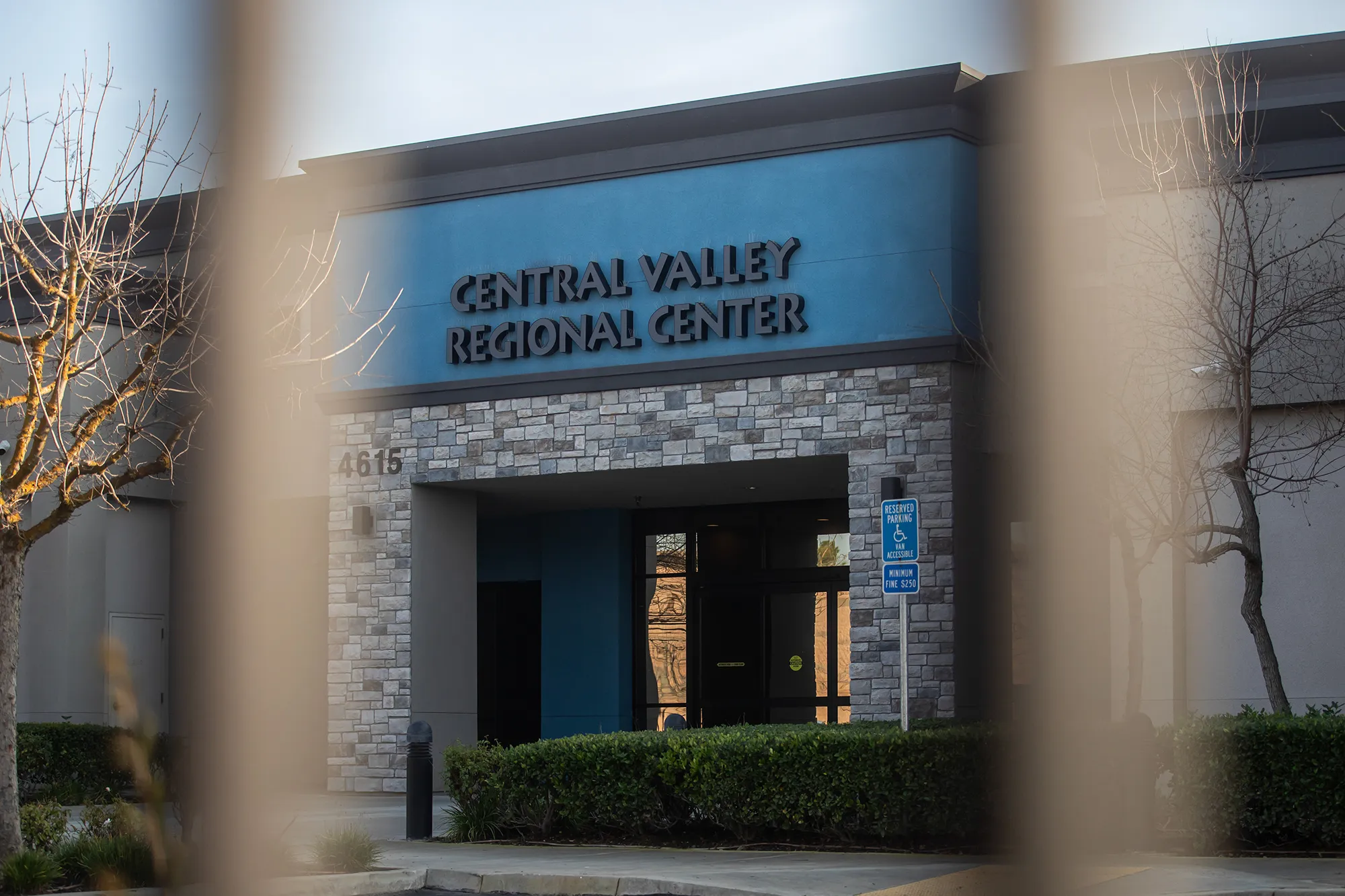
Today, 21 regional centers serve nearly half a million Californians with conditions including autism, cerebral palsy and epilepsy.
Regional centers act as a hub, connecting people to therapies, adult day programs, social skills training, independent living support and job training – all managed through a single point of contact.
The California Department of Developmental Services, which regulates regional centers, says people whose disabilities begin after age 18 are generally directed to other programs: in-home supportive services, the state department of rehabilitation, and independent living centers. Pathways exist.
But parents like O’Hara say this misses the point. Regional centers offer something those programs don’t – comprehensive, coordinated services for life.
A years-long fight
Since 1978, federal law has defined developmental disabilities as severe, chronic conditions “attributable to a mental or physical impairment” that manifest before age 22. California’s cutoff of 18 puts it out of step with both federal policy and a growing body of research showing that the brain continues developing well into the mid-20s – meaning a traumatic brain injury acquired in late adolescence or early adulthood could disrupt development just as profoundly as one earlier.
California lawmakers have tried several times before to close that gap. In 2022, a bill authored by State Sens. Anthony Portantino, a Democrat from La Cañada Flintridge, and Scott Wilk, a Santa Clarita Republican, made it to Gov. Gavin Newsom’s desk. Newsom vetoed the bill, pointing to cost. While his veto message expressed support for extending services to people whose disabilities originated before age 22, he said covering more Californians would require tens of millions of dollars from the state’s general fund that had not been set aside that year.
Such a request, Newsom said, would have to go through the budget process.

At the time, the independent Legislative Analyst’s Office estimated that extending regional center services to people whose disability started between ages 18 and 22 retroactively would expand eligibility to 1,000 to 2,000 people in the first year, at a cost of $15 million to $60 million.
Schiavo is now pursuing the expansion through the budget rather than standalone legislation and said she expects her ask to fall in that range.
The Association of Regional Center Agencies supports the idea, with a caveat: that the state allocate adequate funding for this expansion.
The population regional centers serve is already growing quicker than the general population, with the Department of Developmental Services projecting a 7.6% increase in clients for the coming fiscal year. That growth is driven partly by rising autism diagnoses, according to the state, and partly by more aggressive outreach to communities of color – centers have faced criticism in the past for inequitable services.
People with brain injuries acquired in young adulthood may also need additional or different support than those with disabilities from birth, said Amy Westling, the association’s executive director.
“It’s not that there is a fundamental disagreement that people with acquired and traumatic brain injury particularly in this age range need additional support,” Westling said. “It’s just a question of, does this proposal include enough consideration of the financial support that would be necessary to make it possible?”
‘What will happen when I’m gone?’
Katherine Graham gets emotional thinking about what will happen to her son’s care when she is no longer around.
In June of 2002, her son Joe was a 21-year-old psychology student in Santa Rosa. A traffic accident threw him 40 feet from his car, first responders told her.
He didn’t break any bones, but he did suffer a devastating brain injury.
“Right after the accident, they said ‘He will be a vegetable. He will never walk, he will never talk,’” Graham said.
Like Jim Jr., Joe Graham is not eligible for regional center services because his brain injury happened after age 18.


For nearly a quarter century, Katherine Graham has overseen every aspect of her son’s care, constantly searching for activities and services that could help his recovery, sometimes paying out of pocket. Today, at 44, Joe walks, talks, volunteers and lives in his own apartment. He gets some help through Medi-Cal’s in-home supportive services, including assistance with personal care, shopping and laundry. But transportation, managing appointments, staying on top of medication and even looking for opportunities to socialize have largely fallen on his mother.
A retired school teacher from Ukiah, Graham has advocated long and hard for her son.
More than anything, Joe wants to work again and be independent. But his disability makes it difficult to read social cues and understand personal boundaries, Graham said. She believes that if her son had had prompt access to social skills training and job coaching that regional centers provide, he’d be further along in his recovery.
“My concern is what will happen when I’m gone and can no longer support him or provide help. Who is going to continue to protect, to guide, as well as fill out leases and recertifications for services?” Graham said.
O’Hara, too, says he will keep pushing for his son and so that people with disabilities can more easily access critical support services proven to help them become more self-sufficient.
“As long as he has me, my son will keep moving forward, but if something happens to me that could stop,” O’Hara said. “My goal is to never let that happen.”
Supported by the California Health Care Foundation (CHCF), which works to ensure that people have access to the care they need, when they need it, at a price they can afford. Visit www.chcf.org to learn more.
This article was originally published on CalMatters and was republished under the Creative Commons Attribution-NonCommercial-NoDerivatives license.