


When you buy through links on our articles, Future and its syndication partners may earn a commission.

Credit: Shutterstock
I’d never claim that the plank is a “bad” core exercise. It’s great for working the deep stabilizing muscles in your core as well as your abs and lower back, and it’s an approachable move that most people can do in their workouts.
It’s also very boring, in my opinion. While isometric exercises like the plank, where you hold a position to challenge your muscles, are effective, doing your best to stay still for long periods is not my idea of fun, and I much prefer workouts made up of dynamic core exercises.
One such move is the plank drag, which adds movement and weight to the classic plank for a variation that I find more enjoyable and effective. If you’re not excited by the idea of doing planks in your core workouts, it might be worth giving the plank drag a go instead.
How to do the plank drag
To do the plank drag you’ll need a weight of some kind. I tend to use a dumbbell or a kettlebell, but anything heavy you can drag with one hand will do, like a full water bottle.
-
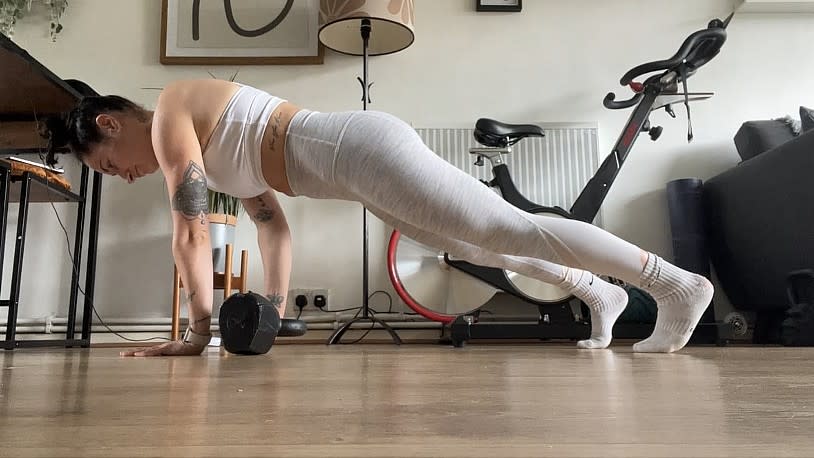
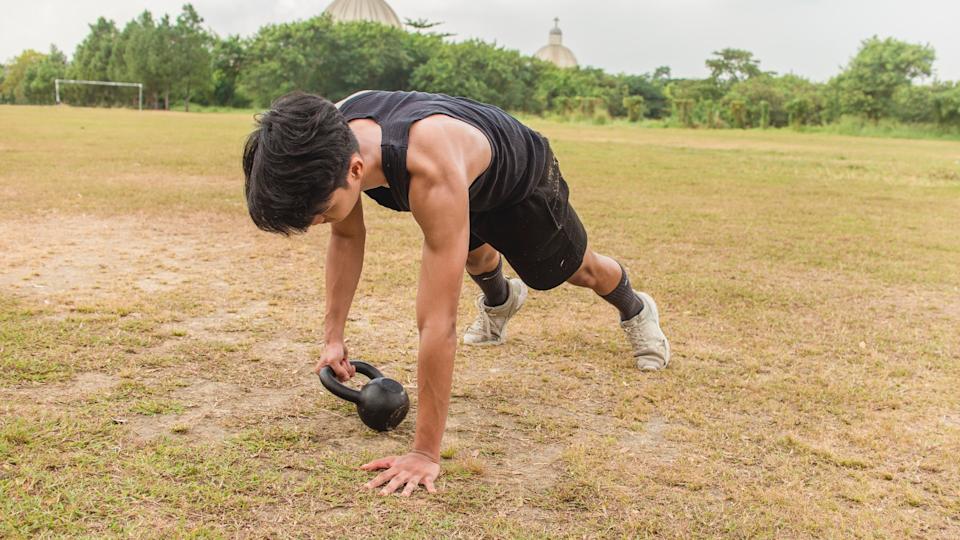
Start in a high plank position with your hands under your shoulders and your feet shoulder-width apart. Your weight should be next to your right wrist.
-
Engage your abs, glutes and quads to maintain a strict plank position.
-
Hold this position while reaching your left hand under your body to grab your weight and drag it to your left side.
-
Use your right hand to drag the weight from left to right. Continue for reps.
While doing the plank drag, plank pull-through, or plank passthrough, as it’s also known, it’s vital to keep your core engaged so you don’t twist or drop your hips while moving the weight.
You can also lift the weight and place it on the other side of your body if you’d rather not drag it for any reason.
If you find you can’t maintain a good plank position while moving the weight, try either reducing the weight you’re dragging or going back to unweighted plank variations to build up your strength.
Why I love the plank drag
Credit: Future
The main reason I prefer the plank drag to the classic plank is that it’s more interesting. Do a minute of the normal plank, then a minute of the plank drag and you’ll see how much faster the time passes with the latter.
It’s also a move that really makes you focus on the muscles you’re trying to engage with the exercise. You have to work hard to keep your body in the right position and not rotate your hips, and it’s very effective in building strength throughout your core.

Credit: Getty Images
The addition of weight also brings an extra element to the move, making it more challenging and recruiting more muscles in your upper body as you shift the weight from side to side.
I also find it fits better into other workouts than the classic plank, especially fast-paced sessions where I’m looking to get cardio benefits as well as boost strength.
With a normal plank, it slows your workout and heart rate right down, even as it works wonders on your core strength. With the plank drag, you get those core benefits while also keeping your heart pumping as you pull the weight from side to side.
Benefits of the plank drag
Credit: Shutterstock images
The plank drag is a move that comes with a long list of benefits, improving your core strength, stability, endurance and balance, plus building upper-body strength.
On top of that, I find it makes me very aware of my body position and ensures I don’t let my hips drop or rotate, and that awareness spreads to other plank variations, helping me lock in and keep the right muscles engaged.
If you want to add the plank drag to your workouts, you can start by doing a small number of reps, maybe doing five on each side, or work to time by plank dragging for 30-60 seconds.
Using a light weight and doing more reps for time will boost the cardio aspect of the move, while using a heavy weight and doing fewer reps will switch the focus to strength.

More from Tom’s Guide
Follow Tom’s Guide on Google News and add us as a preferred source to get our up-to-date news, analysis, and reviews in your feeds.