

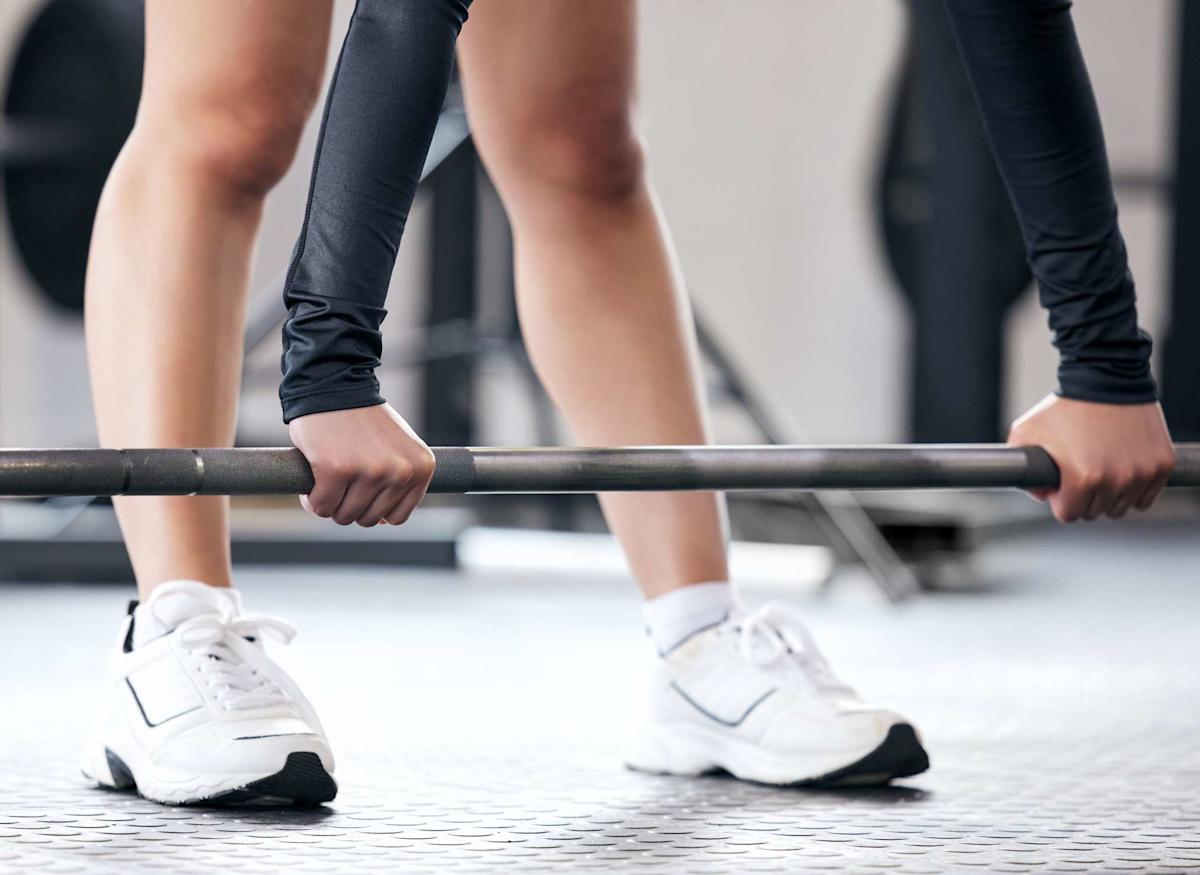
I still remember the first time I walked into a weight room. I was completely, totally, and utterly overwhelmed by all the chunks of metal and clanking machines. I was a run-on -the-treadmill-and-duck-out-ASAP sort of person. A sometimes pilates girly. But I thought I’d at least take a look. A friend was with me, and they walked me through a handful of the contraptions, but I still left feeling like weight lifting wasn’t the right space for me.
Fast forward a good decade—many HIIT, boxing, and barre classes later—and I was forced to find a new gym when my own closed down abruptly. This was a few years ago, right on the cusp of the weight training boom (especially among women), so I signed up for a circuit-style, weightlifting-meets-cardio studio called F45. And I loved it. My confidence grew around all the bells—dumbbells and barbells and kettlebells. I got stronger. And it inspired me to venture into what I now call “the big gym.”
The Surprising Side Effects of Lifting Heavy
With this newfound self-assurance, I decided to start experimenting with heavy compound lifts—specifically deadlifts and squats. The first time I did a weighted squat, I remember experiencing a feeling of sheer power followed by a curiosity to see what else my body could do.
Since then, I’ve been slow and consistent in “the big gym,” pairing this time with classes at my F45 studio. In the last 18 months, specifically, I’ve really focused on perfecting my form and gradually building weight. Today, I’m routinely putting in 245-pound working squat sets, which, when I really think about it, seems wild. That’s more than my husband weighs, and encroaching on double my own weight! But more than sheer strength and power (and more than the beauty of focused alone time), the lessons have actually been pretty profound for me.
I’m Performance Driven, Not Body Obsessed
Lifting heavy shifted my relationship with my body from being super appearance-focused to way more performance-driven. Yes, I still want to look good and feel confident in my clothing, but my top priorities now involve feeling stronger and wowing myself with new personal records (PRs). It also got me thinking more about my internal health. My recent blood panels have notably gotten better from years past, and I do credit consistent strength training with the improvement.
“Muscles are responsible for glucose metabolism, maintaining blood sugar balance. It is important to build as much muscle mass as possible to combat insulin resistance that occurs during estrogen decline,” explains Wendie Green, LPTA, clinic director at Bethesda Physical Therapy. She adds that muscle building can even prevent disease processes and slow problems commonly associated with aging, including heart disease, osteoporosis, type-2 diabetes, and even cognitive issues.
All that said, weight training has quieted my physical critiques and helped me see my body as something to nourish, care for, and build (not shrink or torture).
I’m Thinking About My Granny Self
One of the first reasons I got into weight training was because I knew it was important from a longevity standpoint. Strength and independence in old age are inextricably tied together. A strong body with robust stabilizing muscles, joints, and tendons will make everyday tasks—like walking, carrying things, getting off the floor, hoisting my suitcase into the overhead compartment—manageable (maybe even easy?) as I get older.
This is something I’ve especially thought about moving into midlife as a woman, as hormone levels shift dramatically and affect things like my muscle mass and bone density.
“We are finally recognizing the research proving positive outcomes associated with strength training in midlife: easing the peri-to-menopause transition, and the multitude of side effects women experience during this transition,” says Anna Aiken, a certified coach specializing in women’s strength and endurance. “It can benefit cognitive function, bone density, muscle preservation, mood stabilization, reduction in anxiety, and mobility.”
My Posture Is Better
This one I didn’t even notice until other people started commenting on the way I was carrying myself. I thought maybe it was just a little pep-in-my-step confidence, but it turns out that strength training is one of the best things you can do for posture.
Basically, consistent strength training bolsters your postural muscles in the upper back, core, and glutes. It can also correct muscle imbalances in your chest, hip flexors, and core. And it improves endurance, so you’re able to stay in good posture for longer.
Posture is something that I’ve always been aware of, and I’ve tried all sorts of tricks to improve mine. Better office chairs, more walking, little devices that beep at you when you start slouching (so annoying). Who knew working the muscles that keep you upright is the key?
Injury Instances Are Way Down
Back in my super duper HIIT era, I had injuries all the time. They were mostly back issues, and sometimes would have me sitting on the sidelines for two to three weeks at a time. It was really frustrating.
You can still get injuries with strength training due to poor form or unsafe overload, but I haven’t had a single back issue since I started heavy compound squats and deadlifts. And the injuries I’ve experienced have been minor and quick to repair. Multiple factors are at play here. First, there’s a lot of emphasis on excellent form in strength training. You’re watching yourself in the mirror, slowly and carefully working your way up to a higher weight, and maintaining proper technique along the way. If you bring a friend, you’ve even got some friendly spotters keeping an eye on you.
Another factor is that stronger muscles, tendons, and ligaments absorb and distribute force better, which better protects joints and connective tissue. This improves movement mechanics, stability, and coordination, which overall lowers the risk of strains and overuse injuries.
I’ve Learned to Embrace Failure
This was one of the hardest concepts to wrap my mind around at the gym, but failure is a good thing in this sweaty space. You want to get to this point of controlled progressive overload where your muscles literally cannot go any further. When you hit this point, it means that your muscles have been pushed to their furthest limit, and that the fibers have broken down and will rebuild stronger.
There’s obviously a parallel you can draw here for everyday life. Often, failure means that you tried something and it didn’t work out. You could frame it as embarrassing or as an excuse to stop going, but here’s the thing: you still learned something from that experience. You pushed yourself to the edges of your comfort zone. And when you try again, you’ve catalogued the data for moving forward smarter, steadier, and stronger. That is an invaluable takeaway for me.
Read the original article on Real Simple