

If the idea of getting stronger with the help of a single, compact tool sounds like your type of vibe, kettlebells are where to start. A single bell is all you need to develop strength, power, and conditioning without taking over your living room. As a strength and conditioning coach, I can attest that the thick handle and off-center load are two features that help you learn clean movement patterns while maintaining full‑body tension during exercises in ways that dumbbells don’t.
Because a kettlebell’s mass sits farther away from your grip, your smaller stabilizing muscles must “wake up” to help you maintain proper form as you hinge, squat, press, pull and carry the load. As you progress and lift more weight over time, you’ll build strength, aerobic fitness, and functional capacity, all of which can help support a healthier body composition as well. Smart resistance training with kettlebells may also support markers linked to healthy aging. Additionally, kettlebells are often incorporated into short, efficient sessions, making it easier to maintain a workout program, and this consistency is what ultimately drives results.
While kettlebells may be known for their swinging capabilities (the kettlebell swing is a popular conditioning exercise, after all), I recommend starting with the basics and building from there. I also tapped kettlebell coaches Cole Francum, and Jahkeen Washington, and trainers Tyler MacDonald, and Corey Brueckner to learn why they love kettlebells for effective, efficient workouts and which moves are their favorites for beginners.
How to start out with kettlebell training
Before starting this routine, warm up with a few minutes of mobility or light cardio, then try out these five kettlebell exercises. “Beginners will want to stick to the same or similar exercises [at first] to build up their technique and form for a period of time,” says Francum. The experts suggest starting with 20 to 30 minutes of work to build strength, progressing your weight or reps over the course of 6-8 weeks. McDonald recommends training 2-3 non‑consecutive days per week, prioritizing excellent form over volume.
1. Kettlebell row
Strengthen your back and core with this straightforward row.
Kettlebell rows build balanced upper-body strength while your core braces to fight rotation. They also help improve posture and counteract the pressing movements you make in the gym, as well as the slouching that is so common in daily life. Francum and Washington both recommend rows in a beginner lineup to help you nail the pulling movement before progressing to more complex lifts.
How to do it
-
Start in a split stance with your right foot forward and your left foot back, your weight evenly distributed between both feet.
-
Hinge at the hips with a flat back and plant the kettlebell on the ground in front of your rear foot, under your shoulder.
-
Place your right hand on your right thigh for support. From this position, grasp the kettlebell’s handle with your left hand and lift it slightly off the floor (rolling your shoulder back as you do so), keeping its weight directly under your left shoulder.
-
Keep your shoulders level and your ribs braced and aligned between your shoulders and hips.
-
Pull the bell toward your hip, keeping your elbow close to your side.
-
Pause briefly at the top without twisting through your torso.
-
Lower the kettlebell with control until your arm is straight.
-
Complete all reps on one side, then switch sides.
-
Try 2-3 sets of 6-10 reps per arm.
2. Goblet squat
Don’t have heel blocks? No problem. Do this move with your heels flat on the ground.
“The KB goblet squat improves squat depth and posture, strengthens legs, core and upper back,” says Brueckner. They’re a beginner-friendly squat variation that teaches abdominal bracing and depth while building strength in the quads, glutes, and upper back.
How to do it
-
Stand with your feet about shoulder‑width apart, feet flat on the ground, toes angled slightly outward. Hold the bell by the horns at chest height. (Our video shows the exercise performed on heel blocks, but if you don’t have heel blocks, simply perform the exercise with your feet flat on the floor.)
-
Brace your core and keep your chest lifted. You may want to direct your eyes upward to help remind yourself not to allow your chest to tip forward.
-
Squat back, aiming your hips between your heels as your knees track over your mid‑foot.
-
Keep your elbows close to your body and descend to a comfortable depth.
-
Drive through your feet to stand tall. There should be very little movement of your torso and upper body throughout the exercise.
-
Maintain a neutral spine throughout.
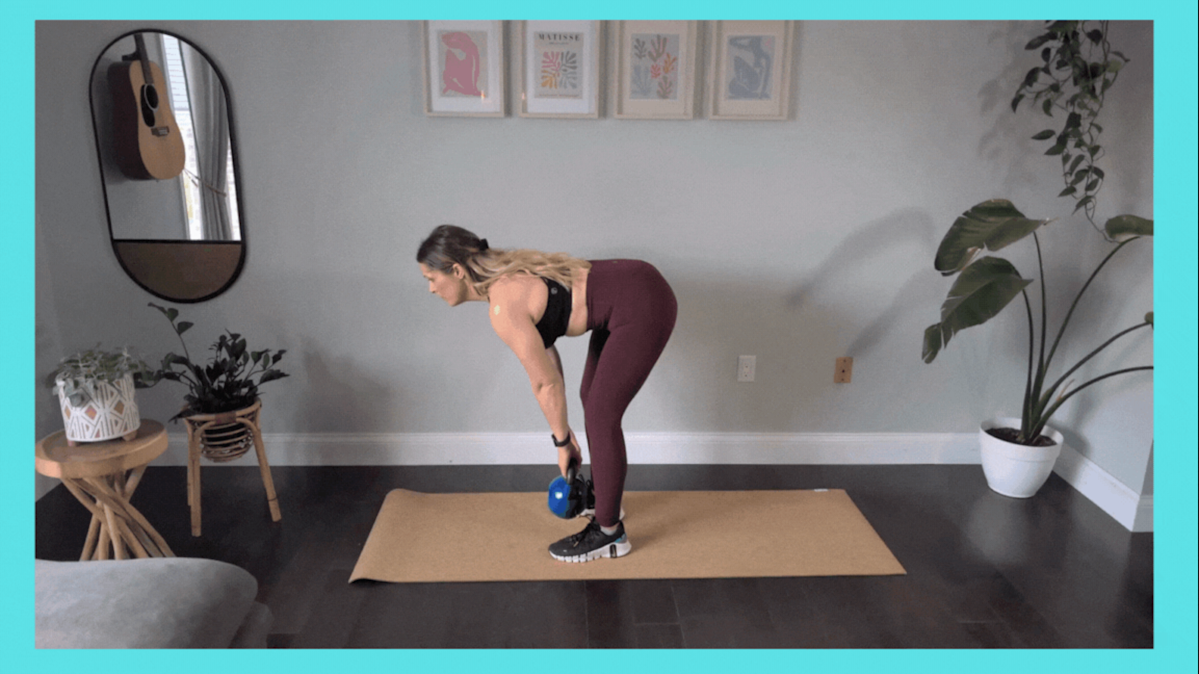
3. Kettlebell stiff‑leg deadlift
Build your glutes and hamstrings with this helpful hinge move.
Stiff-leg deadlifts build hamstring and glute strength, and the kettlebell version is ideal for learning a safe hip hinge — one of the most important movement patterns to master. This variation teaches tension along the posterior chain (the back of the body) that carries over to kettlebell swings. Francum recommends that beginners build hinge strength before attempting more advanced ballistic exercises like cleans and swings.
How to do it
-
Start with the weight on the ground, centered between your feet. Stand tall, brace your core and make sure you have good posture — your shoulders “stacked” over your hips, knees and heels.
-
Soften your knees slightly. Press your hips back as your torso simultaneously tips forward.
-
Keep your back flat and shins nearly vertical. The movement should be isolated almost entirely to your hips.
-
Grip the bell with both hands, engage your lats and brace your core.
-
Stand by engaging your glutes and hamstrings and driving through your heels as you extend your hips, returning to the starting position.
-
Squeeze your glutes at the top of the exercise without leaning back.
-
Lower under control (exactly as you did to initially pick up the weight), keeping the bell close to your shins.
4. Farmer’s carry
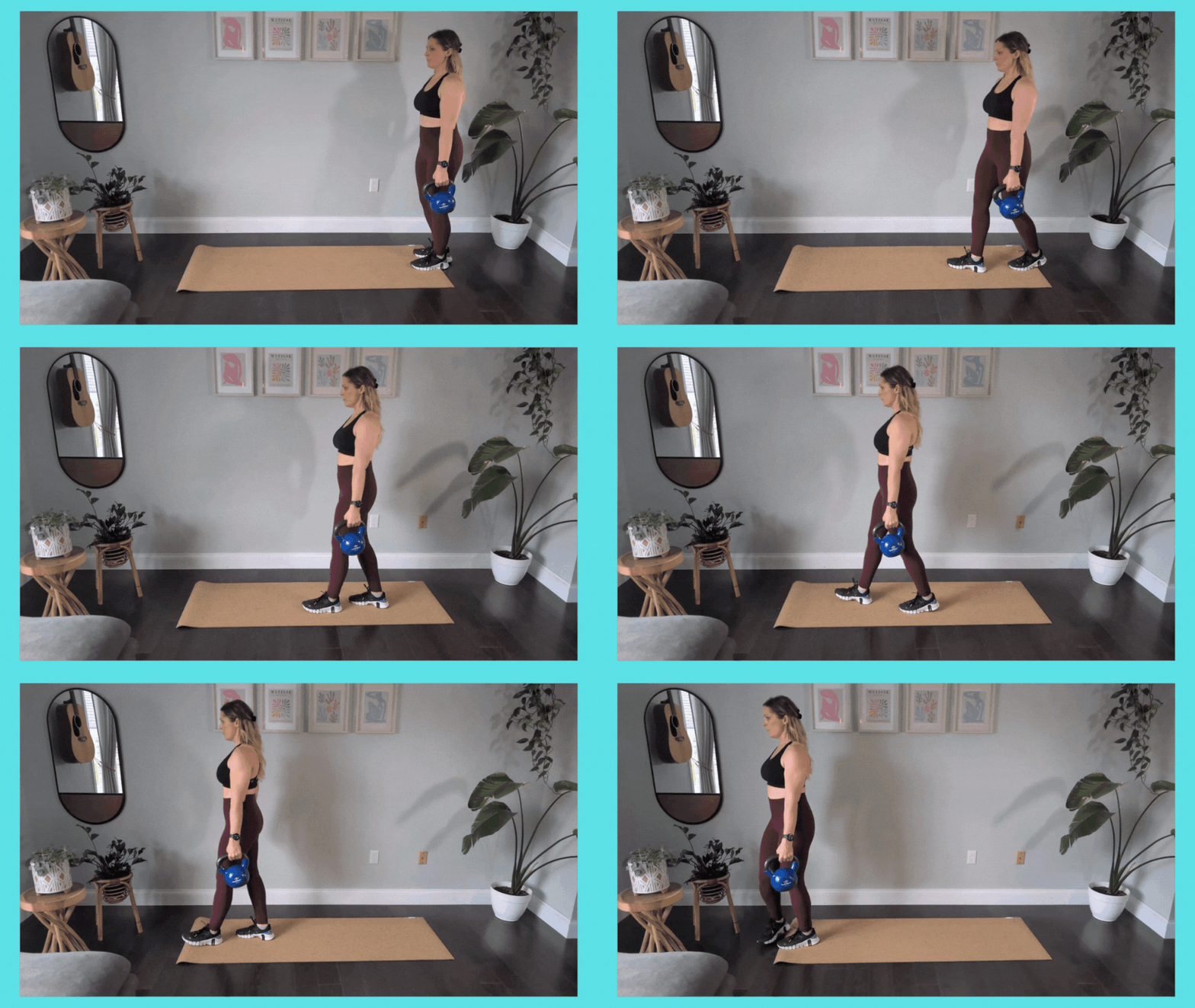
This functional move helps with more than you might think (plus, it’s good practice for carrying in heavy bags of groceries).
Simple and effective for grip, core stability and posture, carries are a favorite for developing functional strength — movements that easily transfer to day-to-day life — in small spaces.
How to do it
-
Stand tall, holding a single kettlebell at your side. If you’d like, you can perform this movement bilaterally, carrying a kettlebell in each hand
-
Set your shoulders down and back. Brace your core lightly.
-
Walk forward with quiet, controlled steps, keeping your pelvis level.
-
Maintain good posture as you walk, your ribs stacked over your hips. If you’re performing the exercise while carrying a single kettlebell, avoid leaning sideways toward the weight.
-
Turn smoothly. Maintain an even pace.
-
Rest, then repeat for the prescribed distance or time.
-
Try 4-6 carries of 20-40 seconds. If you have more space to move, aim to perform each carry 20-40 yards.
5. Single‑arm shoulder press

Get stronger shoulders and a well-balanced core when you regularly incorporate this single-arm move into your workout arsenal.
Shoulder presses build shoulder and upper‑back strength while challenging your core stability, particularly when isolated to a single side. Start with a strict press before trying any leg drive that would take you from a kneeling to a standing position.
How to do it
-
Stand or kneel tall with your glutes engaged and ribs between your hips and shoulders.
-
“Rack” the kettlebell at your shoulder, the bell resting on the back of your forearm.
-
Press the bell overhead until your biceps align next to your ear.
-
Pause briefly with your elbow locked out and shoulder strong.
-
Lower the kettlebell back to the starting position with smooth control.
-
Keep your hips level and avoid side‑bending or arching as you lift the weight.
-
Try 2-3 sets of 5-8 reps per arm.
Our favorite kettlebells
Here are two of our top picks. For more options, see our full list of the best kettlebells.
.jpg)
Rogue
The Rogue kettlebell is a durable tank of a bell made from cast iron with a classic silhouette and a flat base so it doesn’t wobble. The lightly lustrous finish wipes clean and helps fend off rust, which is clutch if you train in a garage. With sizes that work for beginners to “beast mode,” there’s a fit for every program, just know the prices rise as the weights do.
$35+ at Rogue
REP
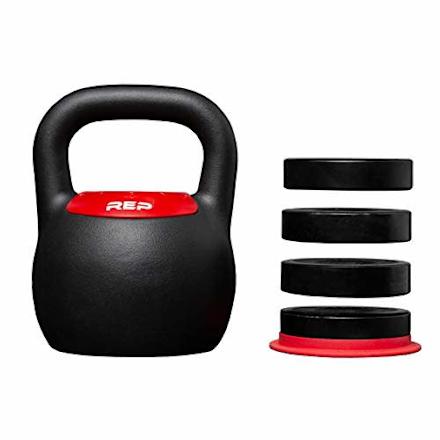
The REP adjustable kettlebell has a small footprint but a wide range of resistance to select from. Press down and twist to swap plates between sets — no momentum lost, no circus of parts on the floor. An internal nylon thermoplastic fastener keeps the core snug, preventing the annoying rattle of plates inside a shell. The rubber bottom is gentle on your floors, and the quick-change setup makes progressive training easy.
$150 at Amazon
FAQs
What weight kettlebell should a beginner start with?
Pick a bell you can lift for 5-8 clean reps (with good form), but challenging enough that after those 5-8 reps, you could only perform maybe one more rep. “Our initial sessions are about testing their ‘5 rep max,’” says Francum, adding that they then practice moderate reps before increasing reps or weight over 6-8 weeks. For quick starting points, Washington suggests trying between 8-16 kg for women and 16-24 kg for men, adjusted to fitness level, the specific exercise and experience. Brueckner suggests women start with 8-12 kg for lower body exercises and 6-8 kg for upper body exercises; men 12-16 kg for lower body and 8-12 kg for upper body. If you’re between sizes, choose the lighter bell, master the technique, then progress when you comfortably can.
How long should a kettlebell workout be for beginners?
Keep your beginner kettlebell workouts bite-size. “Aim for 20-30 minutes,” says McDonald, who also suggests training 2-3 days per week on non-consecutive days. Both Francum and Brueckner emphasize starting with fundamentals and small increases in weight. Keep your sets tight and stop before your form slips; only add time once the movements feel automatic.
Is a 20‑minute kettlebell workout enough?
A 20 minute kettlebell workout is enough if you make it count. Pair two or three fundamentals (like a hinge, squat, press or row) and keep your rest between sets and exercises short. McDonald points out that kettlebell work is built for efficiency, and Brueckner says many sessions mix strength, conditioning and mobility to hit multiple goals in one session. Research shows that kettlebell programs can boost aerobic fitness and functional capacity with short, consistent sessions, allowing you to reap the benefits over time.
Is kettlebell cardio or strength?
Kettlebell exercise is both cardio and strength in one. “The dynamic nature of kettlebell movements engage the entire body,” says McDonald. By adjusting sets, reps and rest periods, you can push aerobic fitness, build functional capacity and support healthier body composition.
Meet Our Experts
-
Cole Francum, NASM‑CPT, SFG I, Nike Trainer and coach at Session Training in Brooklyn, N.Y.
-
Jahkeen Washington, owner and coach at Harlem Kettlebell Club in New York, N.Y.
-
Corey Brueckner, Certified Personal Trainer and Club Leader at Life Time in Hackensack, N.J.
-
Tyler McDonald, NASM‑CPT, CNC, senior brand marketing manager for the National Academy of Sports Medicine and certified personal trainer
Our health content is for informational purposes only and is not intended as professional medical advice. Consult a medical professional on questions about your health.