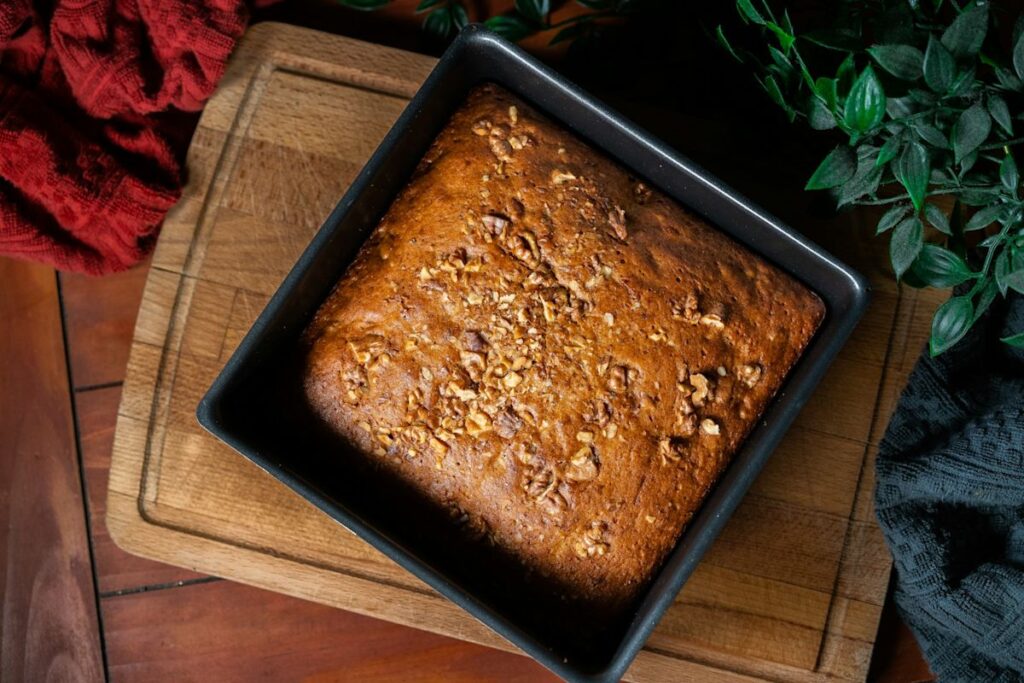
Before the relatives came for Christmas, plenty of home kitchens in the 1950s through the 1970s already had a cake or two baked, wrapped and waiting, in the cake carrier on the counter, in a foil-covered tin on a cold back porch, or on a shelf in the basement. A fruitcake wants a few weeks to mellow, a spice cake tastes rounder the next morning, and a sturdy butter cake keeps two or three days under a glass dome, so baking ahead meant the cake was at its best on the day the company sat down.
The seven cakes here run across those three decades. The older ones lean on the pantry and on Southern home canning, like a light fruitcake full of candied pineapple and a fig preserve cake soaked in a hot buttermilk glaze. The later ones came out of the Bundt pan years and the box of yellow cake mix, including a Harvey Wallbanger cake made with orange juice and Galliano and a Sock-It-To-Me cake named for a line on television. Every one of them was built to be made ahead, and every one tastes better after a night of sitting.
1. Light white fruitcake
The fruitcake went first on the baking calendar, usually the weekend after Thanksgiving, and then sat wrapped in a cotton dish towel inside a tin on the back porch or a spare-room shelf while the rest of the holiday cooking got planned. By the time the cousins arrived it had two or three weeks on it, and the fruit and the crumb had settled into each other.
This light version shares very little with the dark, molasses-heavy fruitcake most people picture. White sugar, candied pineapple, golden raisins and red and green candied cherries give it a pale crumb studded with color, and the coconut keeps it moist. Some women brushed it with brandy once a week through December, while others brushed it once with apple juice and left it alone until the tin came open for company.
Ingredients (Makes two 8×4-inch loaves, about 24 slices)
-
2 cups all-purpose flour, divided
-
1 cup (2 sticks) unsalted butter, softened
-
2 tablespoons light corn syrup
-
1 teaspoon vanilla extract
-
1/2 teaspoon almond extract
-
1 1/2 cups candied pineapple, chopped
-
1 cup candied red and green cherries, halved
-
1/2 cup sweetened shredded coconut
-
2 tablespoons brandy or apple juice, for brushing
Instructions
1. Preheat the oven to 300°F. Grease and flour two 8×4-inch loaf pans, then line the bottoms with parchment paper.
2. In a large bowl, toss the candied pineapple, golden raisins, cherries, pecans, and coconut with 1/4 cup of the flour until everything is lightly coated. Set aside.
3. Whisk the remaining 1 3/4 cups flour with the baking powder and salt in a separate bowl.
4. Beat the butter and sugar together with an electric mixer on medium speed until pale and fluffy, about 4 minutes.
5. Add the eggs one at a time, beating well after each addition. Add the corn syrup, vanilla extract, and almond extract and beat until combined.
6. Add the flour mixture in two additions, stirring by hand after each just until no dry streaks remain.
7. Fold in the floured fruit and nut mixture until evenly distributed throughout the batter.
8. Divide the batter between the prepared pans and smooth the tops. Bake for 1 hour 15 minutes to 1 hour 30 minutes, until a wooden skewer inserted in the center comes out clean and the tops are deep golden.
9. Cool in the pans for 20 minutes, then turn out onto a wire rack. While the cakes are still warm, brush the tops and sides with the brandy or apple juice.
10. Once fully cooled, wrap each loaf tightly in plastic wrap, then in foil. Store at room temperature for up to 3 weeks or refrigerate for up to 6 weeks.
2. Eggnog layer cake
The eggnog cake tasted better on day two. The flavors settled overnight, and a cold slice from the refrigerator with a cup of coffee was something a lot of women considered the best part of having made it in the first place. The frosting firmed in the cold, the nutmeg came forward, and nobody in the house needed to be talked into finishing it off before Christmas week was out.
Ingredients (Serves 12 to 16)
-
1 tablespoon baking powder
-
1/2 teaspoon ground nutmeg
-
1 cup (2 sticks) unsalted butter, softened
-
4 large eggs, at room temperature
-
1 cup eggnog, at room temperature
-
2 teaspoons pure vanilla extract
-
1 cup (2 sticks) unsalted butter, softened (for frosting)
-
4 cups powdered sugar, sifted
-
1/4 cup store-bought eggnog (for frosting)
-
1/2 teaspoon ground nutmeg (for frosting)
-
1/4 teaspoon salt (for frosting)
Instructions
1. Preheat the oven to 350°F. Grease two 9-inch round cake pans, line the bottoms with parchment paper, and grease the parchment.
2. Whisk the flour, baking powder, nutmeg, and salt together in a medium bowl.
3. Beat the butter and sugar in a large bowl with an electric mixer on medium-high speed until pale and fluffy, about 4 minutes.
4. Add the eggs one at a time, beating well after each addition. Beat in the vanilla extract.
5. Reduce the mixer to low. Add the flour mixture in three additions, alternating with the eggnog in two additions (flour, eggnog, flour, eggnog, flour), beginning and ending with flour. Mix just until the flour disappears after each addition.
6. Divide the batter evenly between the prepared pans. Bake until a toothpick inserted in the center comes out clean and the edges have pulled slightly from the pan sides, 28 to 32 minutes.
7. Cool the layers in the pans for 10 minutes, then turn them out onto a wire rack and let them cool completely before frosting, at least 1 hour.
8. Make the frosting: beat the butter on medium-high speed until smooth, about 2 minutes. Add the powdered sugar 1 cup at a time, beating on low after each addition. Add the eggnog, nutmeg, and salt, then beat on medium-high until the frosting is light and spreadable, about 3 minutes.
9. Place one cake layer on a serving plate. Spread about 1 cup of frosting evenly over the top. Set the second layer on top. Spread the remaining frosting over the top and sides of the cake.
10. Refrigerate the finished cake for at least 1 hour before slicing. Covered, it keeps in the refrigerator for up to 5 days.
3. Southern fig preserve cake
Fig preserves are whole figs, or large ones halved, cooked slowly in a heavy sugar syrup until the fruit turns translucent and the liquid thickens around it. Southern women kept quart jars of them on the pantry shelf right alongside peach preserves and strawberry, either put up in August from the backyard tree or bought at the grocery in the jam aisle. The cake takes a full cup of preserves, figs and syrup both, with the figs roughly chopped first, and the syrup and the oil keep the crumb moist on the counter for three days.
What comes out of the oven is dark, fragrant and well spiced. The usual finish is a hot buttermilk glaze poured over the cake the moment it comes out, so the glaze soaks into the top rather than hardening on the surface. The pecans go into the batter, a whole cup of them, and pecans and figs both grow well across the Gulf South. The Celeste fig, often called the Sugar fig across the South, is the most popular fig in Louisiana and a longtime favorite for preserves, and its fruit is small enough to put up whole.
Ingredients (Serves 12 to 15)
-
1 teaspoon ground cinnamon
-
1 teaspoon ground allspice
-
1/2 teaspoon ground nutmeg
-
1 cup fig preserves, figs roughly chopped (syrup included)
-
1 teaspoon vanilla extract
-
1 cup granulated sugar (for the glaze)
-
1/2 cup (1 stick) unsalted butter (for the glaze)
-
1/2 cup buttermilk (for the glaze)
-
1 tablespoon light corn syrup
-
1/2 teaspoon baking soda (for the glaze)
-
1 teaspoon vanilla extract (for the glaze)
Instructions
1. Preheat the oven to 350°F. Grease and flour a 9×13-inch baking pan.
2. Whisk together the flour, 1 cup sugar, 1 teaspoon baking soda, cinnamon, allspice, nutmeg, and salt in a large bowl.
3. In a separate bowl, whisk the eggs, oil, 1 cup buttermilk, and 1 teaspoon vanilla until smooth.
4. Pour the wet mixture into the dry ingredients and stir until just combined.
5. Fold in the chopped figs with their syrup and the pecans.
6. Pour the batter into the prepared pan and bake 40 to 50 minutes, until a toothpick inserted in the center comes out clean.
7. While the cake is in its last 10 minutes in the oven, combine 1 cup sugar, the butter, 1/2 cup buttermilk, the corn syrup, and 1/2 teaspoon baking soda in a large saucepan over medium heat. Stir constantly and bring to a full boil, then boil for 1 minute. Remove from heat and stir in 1 teaspoon vanilla.
8. As soon as the cake comes out of the oven, poke it all over with a fork or skewer, then pour the hot glaze slowly and evenly over the top. Let the cake sit at least 20 minutes so the glaze soaks in before cutting.
4. Seven-Up Bundt cake
The Seven-Up cake is a pound cake with three-quarters of a cup of lemon-lime soda standing in for the milk. Plenty of cooks credit the soda’s bubbles with a lighter crumb, and the lemon extract and lemon glaze give the cake a clean citrus taste that sits well next to a heavy holiday dinner. Nobody has pinned down who baked the first one, but it has been a fixture of Southern church and community cookbooks for decades.
Like most pound cakes, it keeps. Wrapped well, it stays moist for two or three days in a cake carrier, and the tight crumb slices cleanly even when cold, which made it an easy cake to bake midweek and set out when the relatives came.
A two-to-one ratio of butter to shortening gives the crumb more flavor than an all-shortening cake while keeping the sturdy pound-cake structure. Beating the fat and sugar a full five minutes before the eggs go in, longer than many recipes ask for, works enough air into the batter to give the cake a fine, even crumb instead of a heavy one.
Ingredients (Makes one 10-inch Bundt cake; serves 12 to 16)
-
1 cup (2 sticks) unsalted butter, softened
-
1/2 cup vegetable shortening, softened
-
5 large eggs, at room temperature
-
3/4 cup Seven-Up, at room temperature
-
2 teaspoons lemon extract
-
1 teaspoon vanilla extract
-
2 tablespoons fresh lemon juice
Instructions
1. Preheat the oven to 325°F. Grease a 10-inch Bundt pan generously with softened shortening or butter, then dust with flour and tap out the excess.
2. Whisk the flour and salt together in a medium bowl and set aside.
3. Beat the butter and shortening in a large bowl on medium speed until combined, about 1 minute. Add the sugar and beat on medium-high for 5 full minutes, until the mixture is very pale and fluffy.
4. Add the eggs one at a time, beating well after each addition before adding the next.
5. Reduce the mixer to low. Add the flour mixture in three additions, alternating with the Seven-Up in two additions, beginning and ending with the flour. Mix only until each addition is just combined; do not overmix.
6. Add the lemon extract and vanilla extract and mix briefly, about 15 seconds.
7. Pour the batter into the prepared pan and smooth the top. Bake for 70 to 80 minutes, until a wooden skewer inserted near the center comes out clean and the surface springs back when pressed lightly.
8. Cool the cake in the pan on a wire rack for 15 minutes, then invert onto the rack and cool completely, at least 1 hour.
9. Whisk the powdered sugar and lemon juice together until smooth. Drizzle evenly over the cooled cake and let the glaze set for 20 minutes before slicing.
5. Harvey Wallbanger Bundt cake
The Harvey Wallbanger cake came out of the 1970s, when the cocktail it is named for was everywhere. The drink is vodka and orange juice with Galliano, the Italian herbal liqueur, floated across the top. The cake folds the same three ingredients into a yellow cake mix and a box of instant pudding, bakes it in a Bundt pan and finishes it with a glaze that carries more of each. It took about twenty minutes of actual work.
Galliano is an unusual ingredient for a cake. It’s herbal in a way that smooths out once it hits the eggs and oil, pulling toward anise and vanilla rather than anything medicinal. Much of the vodka bakes off in the oven, though not all of it, leaving the liqueur to carry the flavor. The glaze is uncooked, so it keeps its kick: powdered sugar, more orange juice, more Galliano and another measure of vodka, which makes this a cake for the grown-ups’ table. Under a glass dome it held well for two or three days.
The glaze works best on a warm cake. Cool the cake in the pan for fifteen minutes, turn it out onto a rack and give it another fifteen minutes, so it is firm enough to hold its shape but still warm in the center. Glaze spooned over a warm cake soaks partway into the crust, while glaze poured over a cold one mostly sits on top as a thin sugary coat.
Ingredients (Serves 12 to 16)
-
1 box (15.25 ounces) yellow cake mix
-
1 box (3.4 ounces) instant vanilla pudding mix
-
1 cup powdered sugar, sifted
-
1 tablespoon orange juice
-
1 tablespoon Galliano liqueur
Instructions
1. Heat the oven to 350°F. Grease every surface of a 12-cup Bundt pan with softened butter or shortening, then dust lightly with flour and tap out the excess. Any bare patch will tear the cake when you invert it.
2. Combine the cake mix, pudding mix, eggs, vegetable oil, 3/4 cup orange juice, 1/4 cup vodka, and 1/4 cup Galliano in a large bowl. Beat with an electric mixer on medium speed for 2 minutes, scraping down the sides once, until the batter is smooth and slightly thickened.
3. Pour the batter into the prepared pan and spread it level. Bake for 45 to 50 minutes, until a wooden skewer inserted near the center comes out clean and the top springs back when pressed lightly.
4. Set the pan on a wire rack and cool for 15 minutes, then invert the cake onto the rack. Let it rest for another 15 minutes. It should still feel warm through the center.
5. While the cake rests, whisk together the powdered sugar, 1 tablespoon orange juice, 1 tablespoon Galliano, and 1 tablespoon vodka until the glaze is smooth. It should fall from a spoon in a slow, steady ribbon. If it seems too thick, add orange juice a teaspoon at a time.
6. Place the rack over a sheet of parchment or a rimmed baking sheet to catch drips. Spoon the glaze slowly over the warm cake, letting it run down into the flutes. Allow the glaze to set fully before cutting, about 20 minutes.
6. Sock-It-To-Me cake
Sock-It-To-Me cake starts with a box of yellow cake mix, a cup of sour cream and some oil, with a ribbon of brown sugar, cinnamon and pecans running through the middle. The sour cream makes it close-grained and moist, the kind of cake that keeps two or three days under a cover, which suited a house where relatives arrived over a long holiday weekend. A thin powdered-sugar glaze goes over the top, and the whole thing could be baked midweek and left alone until the company showed up. The name is generally traced to “sock it to me,” the catchphrase Judy Carne made famous on Rowan & Martin’s Laugh-In, which debuted on NBC on January 22, 1968, and the cake spread through church cookbooks and recipe card boxes fast enough to outlast the show by decades.
Ingredients (Serves 12 to 16)
-
1 box (15.25 ounces) yellow cake mix
-
1/4 cup packed light brown sugar
-
2 teaspoons ground cinnamon
Instructions
1. Preheat the oven to 325°F. Grease a 12-cup Bundt pan thoroughly, then dust it with flour and tap out any excess.
2. Combine the cake mix, sour cream, oil, water, and eggs in a large bowl. Beat with a hand mixer on medium speed for 2 minutes until the batter is smooth and thick.
3. Stir together the pecans, brown sugar, and cinnamon in a small bowl.
4. Pour half the batter into the prepared pan and spread it level. Scatter the pecan filling evenly over the batter, keeping it at least a half inch from the sides of the pan so it doesn’t stick.
5. Spoon the remaining batter over the filling and spread it to cover completely.
6. Bake for 55 to 60 minutes, until a wooden skewer inserted in the thickest part comes out clean. The top will be deep golden brown.
7. Cool the cake in the pan on a wire rack for 15 minutes, then invert it onto the rack and let it cool completely, at least 1 hour.
8. Whisk the powdered sugar and milk together until the glaze is smooth. Drizzle it over the cooled cake and let it set for 10 minutes before slicing.
7. Mincemeat cake
Mincemeat cake used the same jar that went into the holiday pies. A cup and a half of ready-to-use mincemeat, a dark, spiced mix of raisins, apples and citrus peel (the best-known American jar still includes some beef), goes straight into a brown sugar batter and carries most of the flavor on its own, so the cake needs only half a teaspoon of cinnamon. Walnuts give it some crunch, and buttermilk keeps the crumb tender.
Because the fruit holds moisture, the cake keeps well, wrapped on the counter for three days or in the refrigerator for a week, and it slices cleanly cold. A thin orange glaze is all it needs on top. It was a handy way to use the second jar bought for pies, and it gives the flavor of mince pie without the work of a crust.
Ingredients (Makes one 9×13-inch cake; serves 15)
-
2 1/4 cups all-purpose flour
-
1/2 teaspoon ground cinnamon
-
1/2 cup (1 stick) unsalted butter, softened
-
1 cup packed light brown sugar
-
1 teaspoon vanilla extract
-
1 1/2 cups ready-to-use jarred mincemeat
-
1 cup powdered sugar (for the glaze)
-
2 tablespoons orange juice (for the glaze)
Instructions
1. Preheat the oven to 350°F. Grease and flour a 9×13-inch baking pan.
2. Whisk the flour, baking soda, salt and cinnamon together in a medium bowl.
3. Beat the butter and brown sugar in a large bowl with an electric mixer on medium speed until creamy, about 3 minutes. Beat in the eggs one at a time, then the vanilla.
4. Stir in the mincemeat. The mixture may look curdled, which is fine.
5. Add the flour mixture in three additions, alternating with the buttermilk in two, mixing on low just until combined. Fold in the walnuts.
6. Spread the batter evenly in the prepared pan. Bake 30 to 35 minutes, until a toothpick inserted in the center comes out clean.
7. Cool the cake in the pan on a wire rack for at least 1 hour.
8. Whisk the powdered sugar and orange juice until smooth, then drizzle over the cooled cake. Let the glaze set 15 minutes before cutting. Wrapped, the cake keeps 3 days at room temperature or 1 week in the refrigerator.
Every one of these cakes is better the day after baking, which is why so many of them were wrapped and put away well before the company pulled into the driveway.