

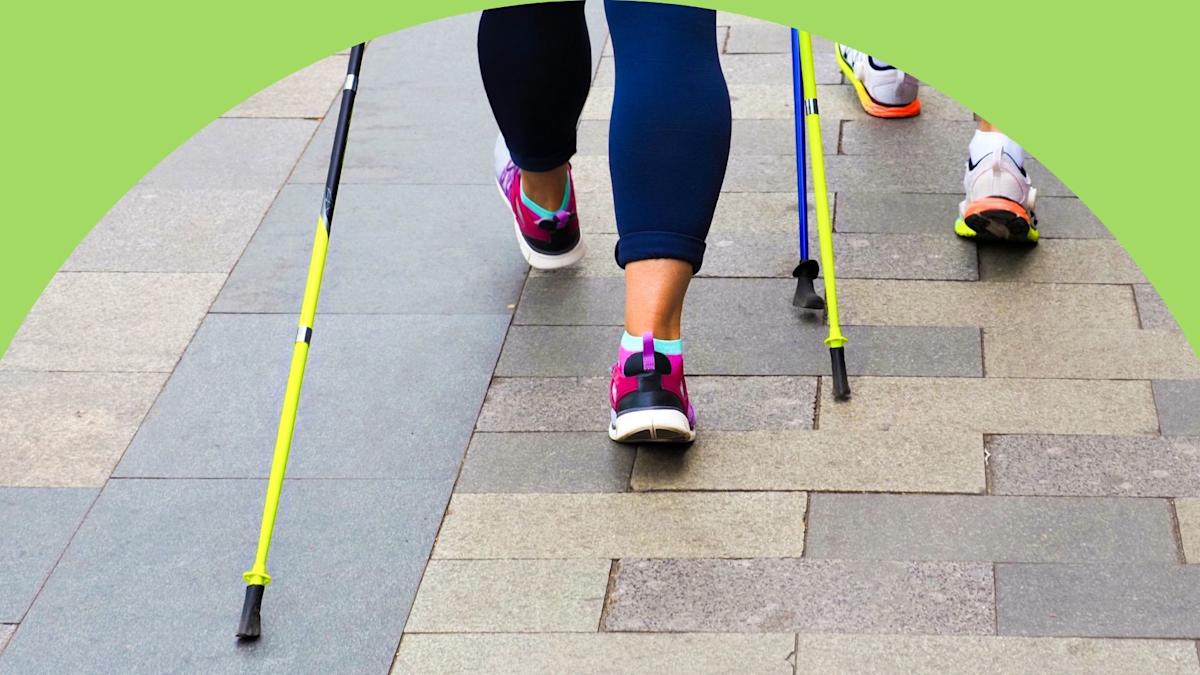
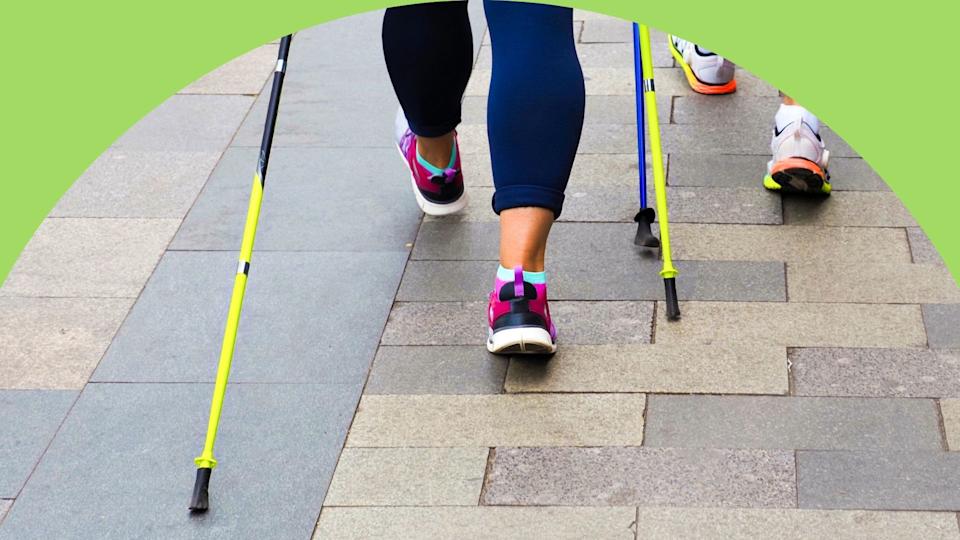
Adding Nordic walking poles to your workout adds upper body muscle engagement that helps boost calorie burn. (Getty Images) (Getty Images)
Walking as a workout delivers more health-positive results than most people give it credit for. Regular walks (it’s a good idea to aim for a daily jaunt of 20-30 minutes at a moderately-intense pace) can improve your mood, enhance sleep and support heart and bone health over the long haul, helping you live longer with stronger overall mental and physical health. Plus, unlike gym-based training, there’s zero barrier to entry — all you have to do is throw on a pair of sneakers and step outside. As long as you have the right gear for the weather, and maybe a good podcast to keep you entertained, walking is just about the easiest form of exercise you can add to your life.
The catch is that the same loop at the same pace can start to feel stale. “Walking is an important factor in your overall health, but your daily walking routine may sometimes feel boring if you’re not switching it up or challenging yourself,” says Christynne Helfrich, a doctor of physical therapy and consultant at Hinge Health. Gradually progressing the intensity of your daily walk matters just as much as it does when you’re strength training. Adding new challenges keeps you engaged and helps your body continue adapting and improving over time.
Small tweaks to your routine can increase muscle engagement, support bone and joint health and burn more calories without overhauling your schedule. So whether you’re feeling a little bored by your daily stroll or you’re looking to improve your heart health and muscular endurance, here are a few easy ways to amp up your routine and get more out of every walk.
Incorporate speed work
You don’t have to sprint to incorporate interval training into your routine. Walking at a faster pace for short intervals can help improve your cardio threshold and cardiovascular health, says Joy Puleo, ACSM, director of education at Balanced Body. “Even adding short intervals of light jogging will do the trick — as little as 20 to 30 seconds for every two minutes of walking can reap excellent results,” she says.
If you’re new to interval training, Devin Trachman, orthopedic physical therapist at Physical Therapy Central, recommends starting by walking at a normal pace for two minutes and then at a brisk pace for one minute, alternating until you finish your walk. “Work towards reducing the normal pace time to 1.5 minutes and increasing brisk walking time to 1.5 minutes, and then eventually you can brisk walk for 2 minutes and do a normal or slower pace for 1 minute,” says Trachman.
When adding intervals, be mindful of how you’re feeling during and after your workout. If it feels too hard or stressful, or you’re experiencing prolonged soreness afterward, ease your routine by taking breaks or splitting your walk into shorter sessions.
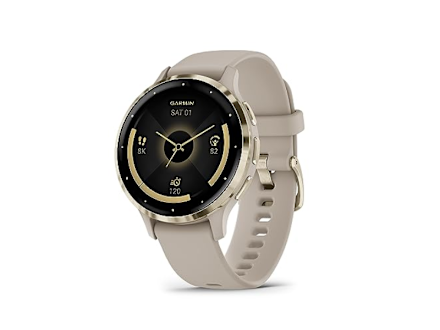
Garmin
Need help keeping track of your intervals? Consider investing in an activity tracker. After testing 18 different models, the Garmin Venu 3S came out on top as our favorite fitness tracker. While it isn’t cheap, it offers an intuitive interface that makes it easy to monitor intervals, speed, distance, heart rate and calories burned. You can even build a custom walking workout in the Garmin Connect app and download it straight to your watch, making it easy to follow an interval training routine.
Wear a weighted vest
Amanda Grimm, a certified personal trainer and running coach with We Run, says that wearing a weighted vest is one of the best ways to boost the intensity of your workout without having to pick up the pace. It also helps burn a few more calories and has been shown to help protect older adults against bone mass loss that can occur during weight loss (though, you’ll want to do weight bearing moves with your vest for the best effects).
“You should start with 10 to 15 minutes when using a weighted vest for the first time,” says Grimm. Which weighted vest to choose depends on your body weight, fitness level and the type of training you’re doing. Trachman recommends starting with a vest that’s 10% of your body weight and seeing how you do. “Then add weight weekly as you become stronger and more comfortable,” she says.
Trachman warns against using a backpack instead of a proper vest, however. “A backpack can cause a shift in your center of gravity and cause gait mechanics to change,” she says. You can choose from a lighter shoulder-holster style if you plan on running or a heavier, full-torso vest for lower-impact walks.
Fit is important too — aim for snug but not restrictive. Also, it’s important to understand that not everyone should use a weighted vest. Grimm advises checking with a health care professional first if you’re pregnant, have a cardiovascular condition or have chronic back, neck or joint issues.
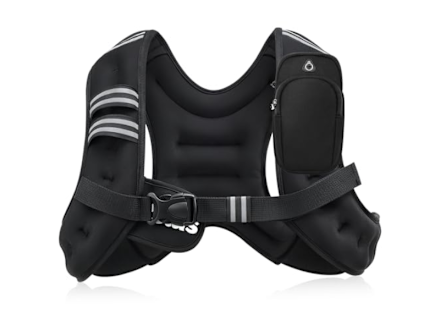
Zelus
With multiple weight options and a convenient removable zippered pouch, the Zelus Weighted Vest is a great choice for both walking and hiking. Its smooth straps, balanced weight distribution and open design make it comfortable to wear — even on warm days.
Try Nordic walking
Nordic walking includes using Nordic walking poles in a way that mimics cross-country skiing, with a full arm swing and push-off motion to propel yourself forward. Using the poles engages your upper body muscles, providing more of a full-body workout than regular walking. One small study found that Nordic walking was more effective than high-intensity interval training (HIIT) or regular moderate walking for improving heart disease patients’ ability to walk longer distances. It was also found to help improve symptoms of depression and overall quality of life.
Limited research also suggests that Nordic walking is especially beneficial for older adults’ cognitive and physical health. Certified personal trainer Josh York says using Nordic walking poles can also increase the number of calories burned, as they help to target the upper body and put additional focus on your core. “Walking poles also make the walk a more aerobic workout, increasing heart rate and lung capacity,” he adds.
Leki
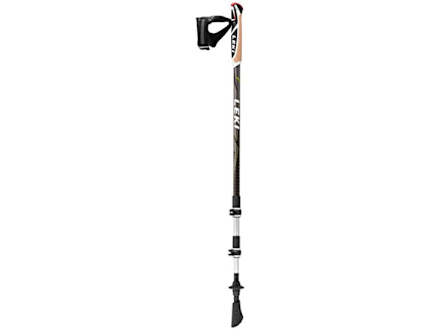
For the full Nordic walking experience, we recommend investing in a pair of Leki Traveller Alu Nordic Walking Poles. While they look similar, Nordic walking poles are typically shorter than hiking or trekking poles and feature a hand-grip system with a wrist strap that allows for a greater range of arm motion. The Leki Traveller Alu poles feature an ergonomic grip specifically designed for Nordic activities to maximize performance. They’re also quick to adjust, lightweight and compact — perfect for walking adventures both near and far.
Take it uphill
Walking on an incline will amp up your walking routine by increasing your effort without running. And going down hills is also beneficial, challenging different muscle groups as you brace against gravity, says Puleo. “Adding inclines and declines will both increase [the] challenge and change up the routine while keeping the mind in tune with the body and elevating heart rate,” she explains.
Adding inclines is a joint-friendly, low-impact way to boost the calorie burn and cardiovascular benefits of a walk. You can find a local hill or use the incline or decline setting on a treadmill or walking pad. “Walking stairs is another way to add inclines and declines to your routine,” adds Puleo.
Sole
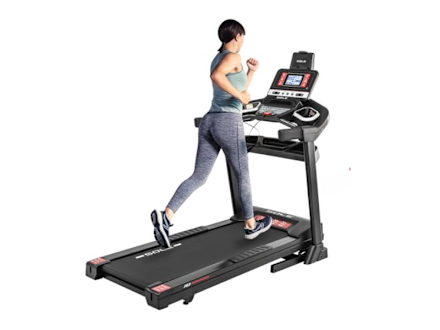
Treadmills offer a convenient way to reap the benefits of a hill workout without needing an actual hill. Dubbed the best treadmill for walking, the Sole F63 offers a roomy deck, high-quality motor and 325-pound weight capacity that our testers appreciated. With a max incline of 15%, it’s perfect for simulating challenging hill climbs. And if you feel like picking up the pace, the 12 mph top speed easily supports jogging or running intervals.
Add weights
Incorporating weight training into your routine can help increase muscular strength and endurance. Helfrich suggests adding free weights such as dumbbells to your walk. “Adding this extra weight will help your muscles get stronger and more resilient so you can adapt to a variety of exercise types and intensities,” she says.
Ankle weights are another great way to amp up a walk. York explains that they force your body to work more muscles by adding extra weight to your legs. “Ankle weights also help improve balance and overall muscle tone,” he adds.
Trachman also recommends wrist weights, saying, “This is a great and simple way to help strengthen your cardiovascular system.” Start with 1- to 3-pound weights, then slowly increase as your strength improves over time.
Bala
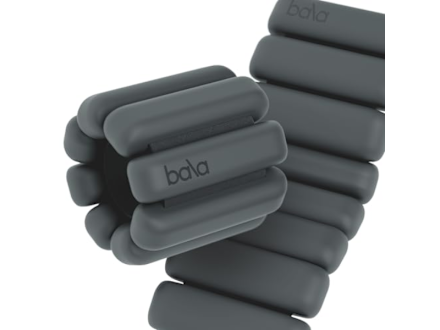
Featured on Shark Tank, Bala Bangles are sleek, adjustable silicone weights designed to be worn on your wrists or ankles, adding a convenient boost of resistance to your walking workouts. Available in three different weights and a wide range of colors, these bands combine function with fashion. Reviewers love their minimalist design, comfortable fit and ease of use. For more options, check out our list of the best ankle and wrist weights for any home workout.
FAQs
Can walking really help me lose weight?
Walking can help you lose weight, especially when paired with attention to what you eat. A meta-analysis in the Annals of Family Medicine found that people who started a walking program lost about 0.1 pounds per week without changing their diet. That’s modest, but walking also helps preserve lean muscle you might otherwise lose while cutting calories, which supports your metabolism over time.
How long should I walk each day for health benefits?
The standard recommendation is about 30 minutes a day, five days a week, but even shorter walks deliver results. Research using UK Biobank data found that a brisk 15-minute walk can lower heart disease risk, though 30 minutes provides greater benefits. Consistency matters more than duration, so three, 10-minute walks spread throughout the day are just as effective as one longer session.
Is walking with ankle weights or a weighted vest safe?
A weighted vest is generally the safer choice. It keeps the load close to your center of mass, which is easier on your joints. Ankle weights sit at the end of the lever (your leg), which can strain hips and knees and alter your gait. A randomized trial involving older adults found that weighted vests were safe and effective for maintaining fitness during weight loss, whereas physical therapists often caution against ankle weights for regular walking.
How do I fit walking into a busy schedule?
Try “exercise snacking” — breaking activity into short bursts throughout the day. Research in the Journal of the American Heart Association found that people who did brief, frequent bouts of movement saw similar mortality benefits to those who exercised in longer sessions. Parking farther away, taking the stairs and holding walking meetings are simple ways to accumulate steps without carving out extra time.
Meet our experts
-
Christynne Helfrich, doctor of physical therapy, OCS, physical therapist consultant at Hinge Health, a digital clinic for joint and muscle pain
-
Joy Puleo, ACSM, master’s degree in applied physiology, Pilates instructor, avid runner and director of education at Balanced Body
-
Devin Trachman, orthopedic physical therapist at Physical Therapy Central
-
Amanda Grimm, certified personal trainer and running coach with We Run
-
Josh York, certified personal trainer and founder of Gymguyz, an in-home personal training franchise
Our health content is for informational purposes only and is not intended as professional medical advice. Consult a medical professional on questions about your health.