

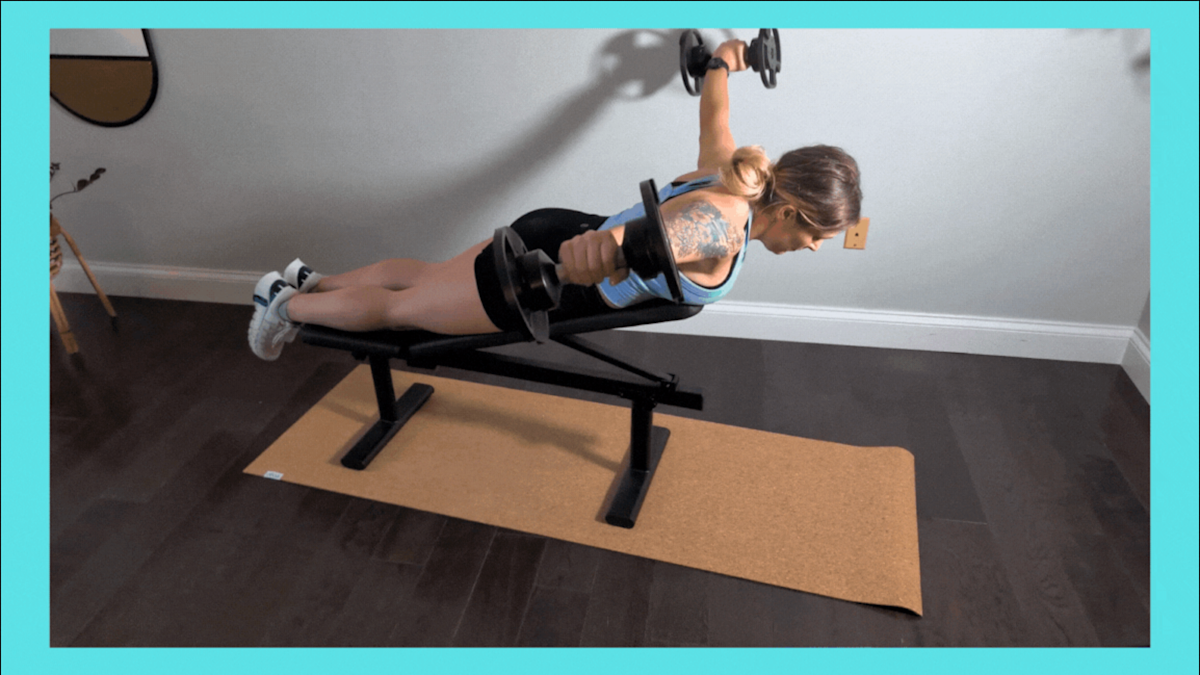
Dumbbell chest and back exercises are a smart choice for a solid upper-body workout you can do just about anywhere. Training these two areas together is time-efficient, as you work major muscle groups in a single session while combining pushing and pulling movements. For example, you must push to work the muscles of your chest during exercises like chest presses or push ups, and you must pull to work the muscles of your back during exercises like lat pull downs or rows. “Chest and back are an ideal pairing when balancing out posture and shoulder mechanics,” says physical therapist and strength coach, Joey Masri.
Alternating between these moves helps prevent muscle imbalances and streamlines your workout through a technique called supersetting. This simply means performing two exercises back-to-back with little to no rest. “Because these muscle groups are antagonists, it allows one to work while the other rests,” explains Reig McConnell, certified personal trainer, nutrition coach and founder of Reig McConnell Coaching. The ability to switch between complementary exercises with little to no rest enables you to maintain a high level of intensity, burning more calories and building strength without keeping you in the gym for hours.
Electing to use dumbbells to work these muscle groups also lets you work through a wider range of motion in positions that are friendlier to your joints. You can press with a slight turn of the hands or row at angles that feel smooth on your shoulders — something that’s more challenging (or impossible) when using a machine with fixed handles or a barbell. There’s another added benefit, too, if you’re pushing yourself particularly hard. “When taking a chest press to failure, it is easier to safely bail when using dumbbells versus a barbell,” says Masri.
For older adults or anyone easing back into fitness, dumbbells are perfect because they allow for more natural movement while building stability and strength. If that sounds like a workout that’s up your alley, start with lighter weights, slow the tempo and focus on control through each repetition.
As a certified personal trainer and strength coach, I’ll walk you through a straightforward workout you can do at home or in the gym. It uses five dumbbell moves to hit your chest and the muscles of your upper back, including your lats, traps and rhomboids. We’ll use supersets to keep the session moving. Before you start, plan on performing two upper‑body workouts per week for best results. Expect strength to increase over the course of 3 to 4 weeks. Visible changes often show up after 8 to 12 weeks if you stay consistent, notes Masri.
How to do this chest and back workout
Plan on setting aside 20 to 30 minutes for this workout, and increase your weight or reps over 6 to 8 weeks as improvements in strength allow. For the best results, aim to train on two non‑consecutive days per week. “Working each major muscle group twice a week, separated by about 72 hours, is the general recommendation,” says Alexander Rothstein, certified strength and conditioning specialist and assistant professor of exercise science at New York Institute of Technology.
When it’s time to get started, don’t jump straight into heavy lifting. Warm up with a few minutes of mobility or light cardio, then do a few light sets of the five dumbbell exercises below. “Think 2-3 sets of 10-15 reps with a light weight that won’t tax you or steal any energy from your working sets,” says McConnell. Doing these light warmup sets “primes the pump” for the meat of your workout, increasing blood flow and preparing your muscles for the work to come.
Complete three rounds of each of the following groups. Perform the exercises in each group back-to-back, then rest for 60 to 90 seconds before starting the next round.
-
Superset (complete three rounds):
-
Incline dumbbell bench press (8–12 reps)
-
One‑arm supported dumbbell row (8–12 reps per side)
-
-
Triset (complete three rounds):
-
Chest‑supported high row (10–12 reps)
-
Dumbbell pullover (12–15 reps)
-
Chest-supported rear delt fly (12–15 reps)
-
To get the most out of every move, use a full stretch on presses and rows. Focus on controlling the weight during the lowering phase rather than letting it drop, and pause for 1 second at the bottom. As you get stronger, progress by adding 2 to 5 pounds when you can hit the top of the rep range with clean form. Or, keep the weight the same and try to add one extra rep to each set the following week.
In addition to a few sets of dumbbells (or an adjustable dumbbell), you’ll also need an adjustable weight bench to complete this routine.
Incline dumbbell bench press
The incline dumbbell chest press is often a bit easier on the joints than a chest press performed on a flat bench.
Incline presses target the upper chest, which helps build strength while taking a path that’s often easier on your shoulders than a standard flat press. It pairs perfectly with rowing exercises to balance your “push” muscles with your “pull” muscles. As Masri notes, this specific angle offers the “best balance between upper chest and front shoulders.”
How to do it
-
Adjust your bench to a slight incline. It shouldn’t be straight up like a chair, but it shouldn’t be flat. If your bench has notches, the first or second “click” up from the bottom is usually perfect (about 15 to 45 degrees).
-
Sit down and plant your feet flat on the floor. Lie back and squeeze your shoulder blades together against the bench.
-
Hold the dumbbells just outside your chest, near your armpits. Your palms should face forward, away from you.
-
Push the weights straight up toward the ceiling. Stop just before your arms are completely straight by keeping a tiny bend in your elbows rather than “locking” them out. This keeps the tension on your muscles, not your joints.
-
Take two to three seconds to lower the weights until they touch the outsides of your shoulders. Only go as deep as feels comfortable. If you feel a pinch or strain, stop a little higher. Control the weight and don’t let it drop.
One‑arm supported dumbbell row
Single-arm dumbbell rows are an excellent way to help prevent and reduce side-to-side muscle imbalances.
This move is a classic for a reason. It builds strength in your lats, the large muscles on the sides of your back and mid-back, while preventing any unnecessary strain on your lower back. Because you work one side at a time, it’s great for fixing those nagging imbalances where one arm is stronger than the other. McConnell explains that this move is flexible enough to match your comfort level and specific goals as you can tweak the starting position and adjust the angle of the dumbbell or the position of your elbow to hit your muscles in slightly different ways. “Supported, unsupported, target upper back, lats, however you want it, you can get it,” he says.
How to do it
-
Place your left knee and left hand on a bench so your back is flat like a tabletop. Plant your right foot firmly on the floor for balance. Hold the dumbbell in your right hand, letting it hang straight down toward the floor.
-
Before you pull, let your arm hang fully so you feel a good stretch in your upper back and shoulder. This is the starting position.
-
Pull the weight up and back, driving your elbow toward your hip pocket rather than straight up to the ceiling. Squeeze your back muscles at the top and pause for a second.
-
Take 2 to 3 seconds to lower the weight back to the starting stretch. Control it and don’t allow it tp yank your arm down.
-
Keep your torso still throughout the move. Avoid twisting your body or jerking the weight up to get it moving.
Chest‑supported high row
_(10).gif)
Target your upper back with the exercise that helps improve your posture. (Rachel MacPherson)
This high row targets the muscles in the middle of your back that help you stand up straight. By lying face down on the bench, you can’t use momentum to cheat, which forces your back and rear delts (the back side of your shoulders) to do all the work. Masri notes that this specific setup is great for “isolating rhomboids and middle traps and reinforcing posture.”
The rhomboids and middle traps are the muscles right between your shoulder blades. Think of them as the anchor for your posture. When you isolate and strengthen them, they naturally pull your shoulders back, which can help correct that rounded-forward “slump” that’s so easy to adopt when you spend your days working at a computer.
How to do it
-
Set your bench to a low or medium incline. Lie face-down with your chest pressed against the pad and your feet planted on the floor for stability or balanced on the bench. Hold a dumbbell in each hand, letting your arms hang straight down toward the floor.
-
Pull the weights up toward your chin or collarbone. Unlike the one-arm row, where you keep your elbows tucked in near your ribs, let your elbows flare out wide to the sides to hit that upper back area.
-
At the top, squeeze your shoulder blades together. Be careful not to shrug your shoulders up toward your ears; keep them relaxed and down.
-
Lower the weights under control until your arms are entirely straight again. Keep your chest pressed to the bench throughout.
Dumbbell pullover
You may be surprised how good the stretch feels across your chest and shoulders as you perform the pullover movement.
This classic exercise is a multitasker: It shapes your chest and back simultaneously, while giving your upper body a satisfying stretch. Start with a lighter dumbbell to get a feel for the movement before adding weight.
McConnell points out that this move offers a unique benefit you usually can’t get without gym machines: a deep stretch that improves flexibility in your shoulders and upper back. He explains that depending on how you hold your arms, you can shift the focus between your chest and back muscles. Plus, it strengthens the smaller “stabilizing” muscles of the shoulder — the hidden support system that keeps your joints moving smoothly and safely.
How to do it
-
Lie flat on a bench or use a very low incline. Plant your feet firmly on the floor.
-
Tighten your abs and keep your ribs pressed down. Don’t let your lower back arch off the bench, as keeping it controlled protects your spine.
-
Hold one dumbbell with both hands. Place your palms flat against the inner face of the weight plate, forming a diamond shape with your hands, and hold it straight over your chest.
-
Keep a soft bend in your elbows and point them slightly outward. Slowly lower the weight backward over your head in a wide arc until you feel a stretch in your chest and under your arms.
-
Bring the weight back up by thinking about squeezing your chest muscles. Stop just before the weight is straight up and down to keep the tension on your muscles, not your joints.
-
If you feel stuck at the bottom and can’t lift the weight back up, simply bend your elbows to bring the weight in close to your chest, then sit up safely.
Chest-supported rear delt fly
Start with a lighter weight dumbbell — you may be surprised how much weaker these muscles are since they’re often overlooked.
The rear delt fly targets the rear delts, rhomboids and the small muscles in your rotator cuff that help keep the joints stable. Strengthening these areas trains your body to hold your shoulders back naturally, helping you fight the dreaded slump and move without discomfort.
How to do it
-
Lie face-down on an incline bench. Hold a pair of light dumbbells.
-
Pull your elbows up and out to the sides, forming a “T” with your body. At the top, your knuckles should be facing the ceiling.
-
Pause for a second at the top to feel the squeeze in your upper back, then lower the weights slowly to a comfortable stretch.
Our favorite dumbbells and benches
To get the most out of this routine, you need weights that allow you to progress. Adjustable dumbbells are the smartest choice for home gyms as they replace an entire rack of fixed weights, saving you space and money.
Here are two of our top picks to get you started. For more options, see our full list of the best dumbbells. You’ll also need an adjustable bench. There are lots of options available, but consider the picks below.
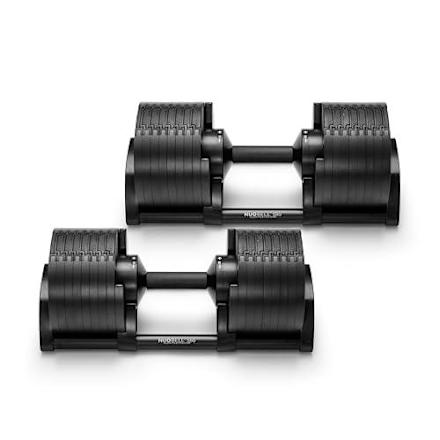
Nüobell
If you want the feel of a commercial gym at home, these are the gold standard. They’re incredibly intuitive to use since you simply twist the handle to switch the weight from 5 to 80 pounds. This speed allows you to transition between sets without breaking your flow. The knurled aluminum handle provides a solid grip even when your hands are sweaty, and unlike other adjustable brands, the bells physically shorten at lighter loads to maintain a natural balance.
They’re also durable enough to last for years, which helps justify the higher price tag. Just note that the plate edges can feel a bit sharp against your palms if you hold the weighted ends for goblet‑style squats.
$780 at Amazon
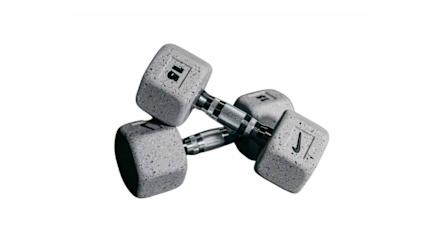
Nike
Yahoo’s Senior Health Editor and resident exercise physiologist, Laura Williams, says if you’re just looking for a couple sets of dumbbells, she loves the look and functionality of these Nike Grind hand weights. Sold in pairs, they offer fantastic grip with coated rubber ends featuring Nike’s proprietary Nike Grind rubber, a recycled byproduct of the brand’s shoe manufacturing process. They hold up well to regular use and the hexagonal shape offers stability during arm-supported exercises (like renegade rows) while also keeping them from rolling away if you set them on the ground.
19+ at Nike Strength
.jpg)
Bells of Steel
If you’re serious about at-home workouts and plan to build your home gym over time, Williams advocates for a functional and flexible bench like this one from Bells of Steel. With a weight capacity of 1,000 pounds, it will grow with you and your routine. It’s also easy to put together (Williams shares it was the easiest of three she assembled in a single day), has wheels to make it easy to move around, offers high-quality padding and a wide range of incline and decline settings.
$382 at Bells of Steel
FAQs
Is it a good idea to train the chest and back together?
Yes. Pairing pushing movements (chest) with pulling movements (back) is a highly effective strategy that saves time. Masri confirms that “chest and back training fit very well together within a workout session.” Rothstein notes that while it isn’t the only way to train, it is a perfectly acceptable approach to hit every muscle group once or twice a week, depending on your schedule.
How should someone structure a chest and back workout?
The best approach is to alternate pressing and rowing moves. This allows one muscle group to rest while the other works, or lets you perform them back-to-back as supersets to complete the workout faster. “They are particularly good to pair together as a superset if a person is strapped for time,” says Masri, who typically prescribes “2 to 3 different super sets… of alternating chest and back exercises.” Aim for 6 to 20 reps per set, depending on the weight. Keep rest periods short and try to increase the weight or reps every 6 to 8 weeks.
What are the benefits of using dumbbells for chest and back exercises?
Dumbbells offer a greater range of motion than fixed machines. They force each arm to work independently, helping to correct imbalances and strengthen the smaller stabilizing muscles in your shoulders. “They require a large amount of stability and allow for a greater range of motion than many machines or barbell exercises,” says Rothstein. Plus, they are generally easier to learn than barbell lifts and easier to track (in terms of monitoring resistance levels and strength gains) than resistance bands.
Are dumbbell exercises enough to effectively train your chest and back?
Absolutely. As long as you use enough weight and keep your form strict, you can build significant muscle and strength with just dumbbells. However, Rothstein suggests that eventually, you should mix it up. “Dumbbell exercises alone could be enough… but I would recommend against only using dumbbells,” he says, noting that using different tools changes the challenge and keeps you progressing over the long term. Use the movements presented here as your foundation, then incorporate other variations as you advance.
What are the top 5 dumbbell exercises for the chest and back, and what are their benefits?
Our routine targets the chest, lats and upper back with five key moves: the incline press, one‑arm row, chest‑supported high row, chest-supported rear delt fly and pullover. The first two are your main strength builders, and as Rothstein notes, “really, the top two exercises would be a chest press and a dumbbell row.” The high row and rear delt fly focus on posture by targeting the upper back and rear shoulders, while the pullover bridges the gap between chest and back with a deep stretch.
Is two chest days a week enough? How long does it take to see chest gains?
Yes, two days is plenty. “Working each major muscle group twice a week, separated by about 72 hours, is the general recommendation,” says Rothstein. Masri agrees that this frequency is “excellent” for gains. As for timing, Masri notes that “most will notice chest strength gains within 3-4 weeks,” while visible muscle changes usually appear “beyond 8-12 weeks of consistent lifting.”
Meet our experts
-
Joey Masri, Doctor of Physical Therapy, Certified Strength and Conditioning Specialist, Orthopedic Clinical Specialist, physical therapist and owner of Vice City Sports Medicine in Miami, FL.
-
Reig McConnell, Certified Personal Trainer, nutrition coach and founder of Reig McConnell Coaching.
-
Alexander Rothstein, Ed.D., Certified Strength and Conditioning Specialist, Assistant Professor of Exercise Science at New York Institute of Technology.
Our health content is for informational purposes only and is not intended as professional medical advice. Consult a medical professional on questions about your health.