

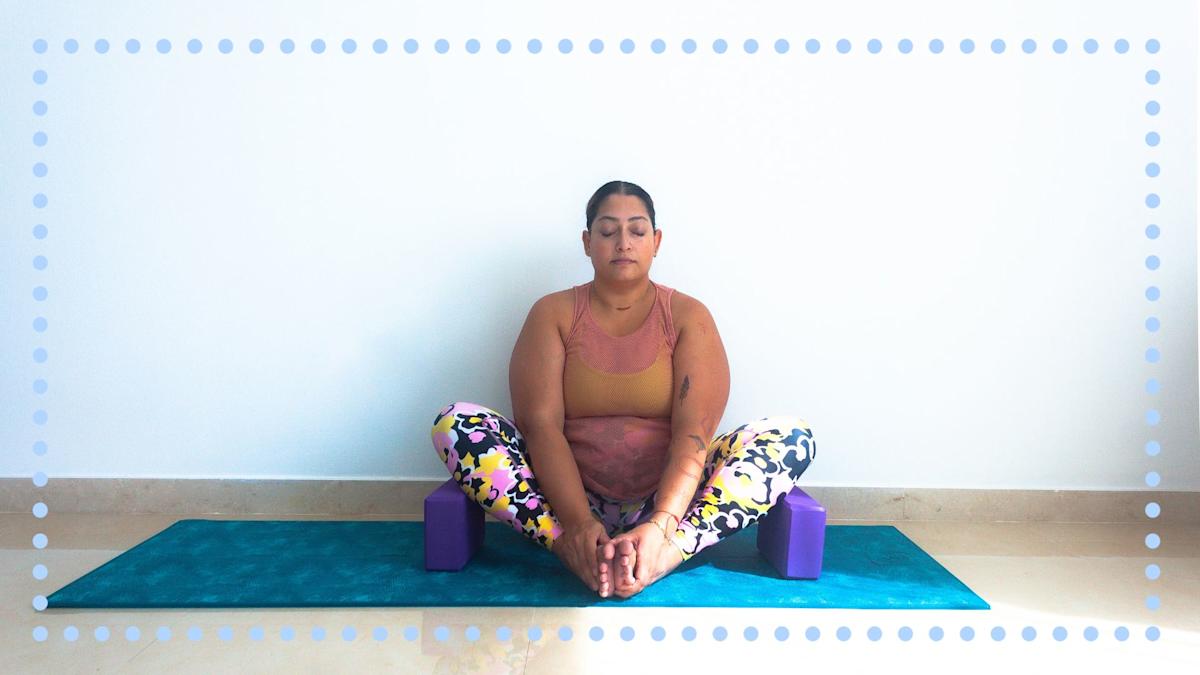
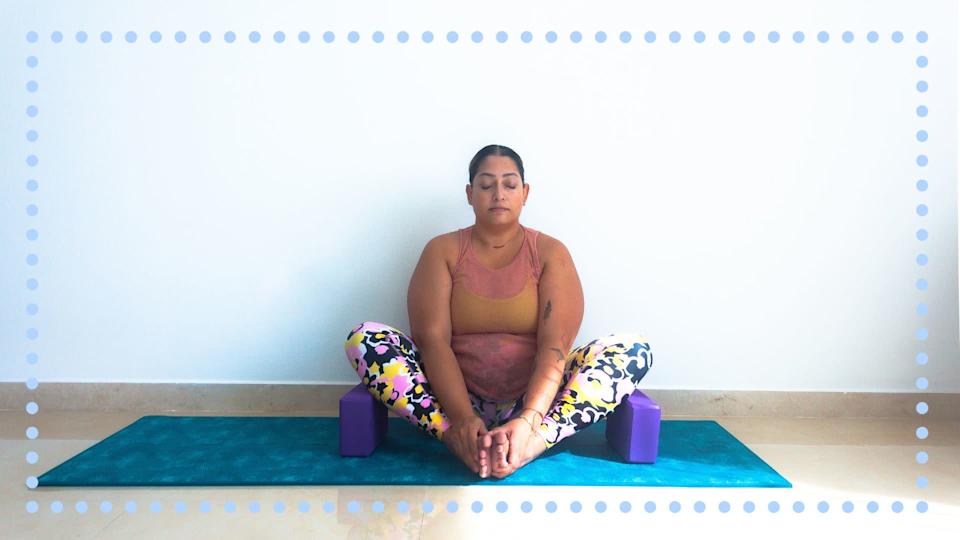
A set of yoga blocks can make this hip-opener more accessible if you have particularly tight hips. (Christabel Lobo)
You’re exhausted, but your brain is wired. You’re lying restless in bed, doomscrolling while the clock mockingly counts down the hours until morning. Sound familiar? If shutting off your mind at night feels impossible, you’re not alone. Sure, you’ve heard all the classic sleep hygiene tips — go to bed at the same time every night, avoid screens, keep your room cool. But what if I told you that swapping your daily sun salutation for a moon salutation might just give you the zzz’s you’ve been daydreaming about? Yes, I’m talking about bedtime yoga.
“Gentle evening yoga gives your buzzing mind something to focus on while releasing stored tension,” says Jem Mantiri, RYT 500. “The combination of slow movement and breathwork signals to your system that it’s safe to shift gears, creating a buffer between the chaos of your day and the stillness you need for sleep.”
But not all yoga poses are created equal when it comes to winding down. Some, like downward dog, can give you an energy boost. Instead, yoga expert Brent Laffoon, founder and president of the Association of Yoga Professionals, says you should focus on poses that include reclined twists and passive hip openers to relax your mind and body. Continue reading to learn which moves can help you hit the off switch and drift into a deep, restorative sleep.
Read more: Find your center with the best yoga mat for 2025, tested and reviewed | Unroll your mat: A beginner’s guide to starting a yoga practice
How yoga helps you sleep better at night
If your body is exhausted at the end of the day but your mind won’t slow down at bedtime, practicing yoga can help settle your thoughts and balance your nervous system. And if your mind tends to stay in “fight or flight” mode, constantly preparing for stressful situations that haven’t happened yet, yoga can help shift you into “rest and digest” mode, making it easier to fall asleep, Laffoon explains.
If you’ve ever finished a yoga class and noticed how quiet your mind felt after, there’s a good reason for that. Yoga helps calm that mental chatter and melts away the tension you didn’t even know you were carrying, making it a natural way to transition into rest mode.
This mindfulness activity focuses your attention on linking breath to movement, which helps center your thoughts and quiet your mind. Another benefit: focusing on your breathing can slow your heart rate and reduce stress hormones, signaling to your body that it’s time to relax.
How to prepare for your yoga practice
If you’re new to yoga, recovering from an injury or have physical limitations, it’s important to listen to your body and never force a pose. (Consider these 5 yoga poses if you have low back pain.) “Yoga is one of the gentlest ways to reintroduce movement because it encourages people to meet their bodies exactly where they are,” says Vania Garcia, a RYT 200 registered yoga teacher in Berlin. “Rather than pushing past limits, yoga emphasizes listening, self-respect and working within what feels available on any given day.”
Modifications can help you move safely and comfortably. Mantiri likes to remind her students that yoga isn’t about the shape you make or being able to touch your toes — it’s about meeting your edge with kindness. Props like yoga blocks, straps and blankets can help support you as you ease into positions. “Yoga blocks improve alignment and act as an extension of the arms, allowing students to stretch safely without strain,” Garcia says. Blocks can also aid in restorative practices, offering additional support for tired or sore bodies. A blanket can gently lift your hips or knees, while a yoga strap extends your reach, allowing you to find proper alignment and actually feel the benefit rather than just survive the pose. Yahoo’s health editor, Laura Williams, notes that straps are especially helpful for deepening restorative poses and hip-opening stretches.
Read more: Better your balance with the best yoga blocks, tested and reviewed
Five yoga poses to do before bed to promote better sleep
Focus on poses that wring out the day’s stress to help calm your mind and body. This sets the right tone for relaxation. Reclined twists and passive hip openers can be especially grounding, and Laffoon says they can have a calming effect on the mind. He recommends supta baddha konasana (reclining bound angle pose) and supta kapotasana (reclined pigeon pose) for releasing tension. Gentle, supported inversions like viparita karani (legs up the wall pose) or halasana (plow pose) are also great yoga poses to help you reset your body and mind before bed, he says.
Before you begin, it’s always recommended that you warm up with a few neck and shoulder rolls, some cat-cow and a few minutes in child’s pose.
1. Child’s pose (balsana)
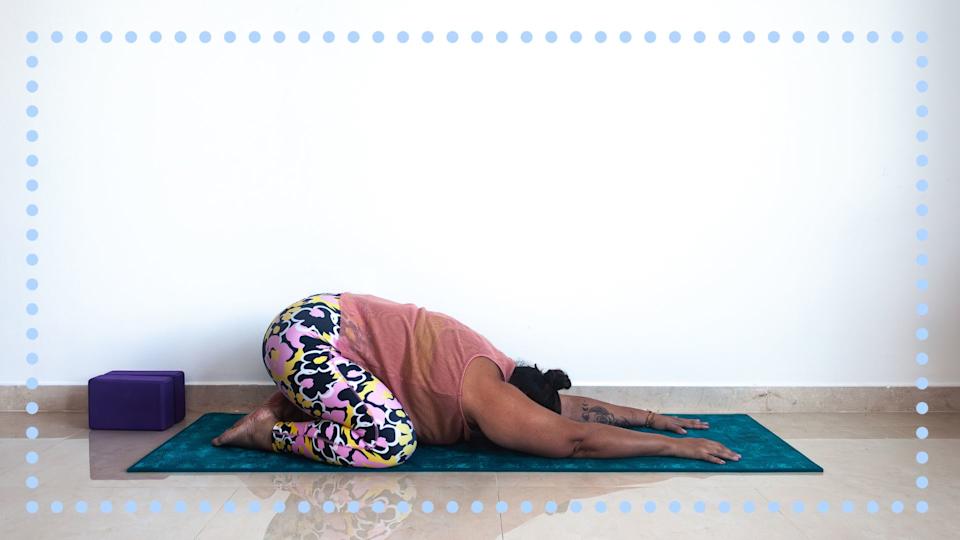
This relaxing pose helps open your hips and chest. (Christabel Lobo)
This is a pose my yoga instructor recommends, and it’s an excellent start (and end) to any bedtime yoga practice. I often find that any time I need to reset, whether it’s during a tough workout or to relieve my lower back and hips from sitting in a chair all day, child’s pose is one of my go-tos.
How to do it:
-
Start on your hands and knees, with your wrists aligned under your shoulders and your knees under your hips.
-
Open your knees wider than hip distance if you want a deeper stretch.
-
Slowly sit back on your heels, hands still on the floor, arms straight and forehead touching the ground.
-
Stretch your arms out in front of you with your palms facing down and let your body melt into the floor.
-
Breathe deeply as you focus on lengthening your spine.
If needed, using a yoga block to support your forehead may make this pose more comfortable.
2. Seated or lying bound angle pose (supta baddha konasana)
A set of yoga blocks can make this hip-opener more accessible if you have particularly tight hips. (Christabel Lobo)
If you sit at a desk all day, your hips and inner thighs are probably screaming for this stretch. It is fantastic for releasing that deep-seated tension. However, gravity can be a bit aggressive if your muscles are super tight. If you find it hard to relax your knees, simply place a yoga block under each one for extra support.
How to do it:
-
Sit down on a mat with your knees bent and your feet flat on the floor. Sit tall with good posture, your ears stacked over your shoulders, your shoulders stacked over your hips. If you’d prefer a deeper stretch, you can lie down flat on your back with your knees bent, feet flat on the floor.
-
Bring the soles of your feet together and slowly let your knees fall to the floor. It will look like a butterfly stretch. If you need extra support, place a block under each knee.
-
If you’re seated, place your hands on your knees or at your ankles. If you’re lying, lay your arms out beside you with palms facing up or down, whatever your preference is.
-
Focus on your breathing while you let the weight of the day melt away.
-
Try staying in this position for a couple of minutes and work your way up to five minutes once you feel comfortable.
3. Reclined pigeon (supta kapotasana)
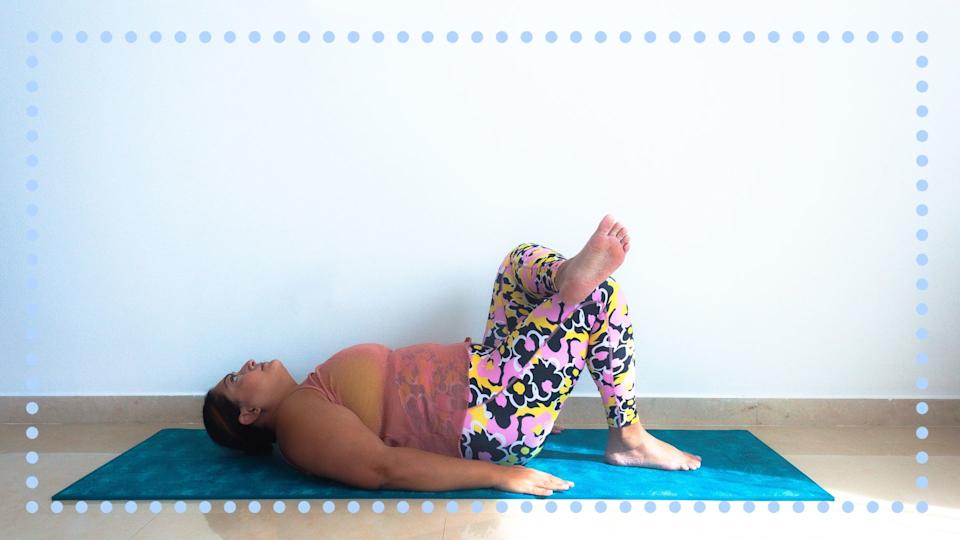
This modified pose (also known as a figure-4 stretch) is another move that encourages deep breathing and looser hips. (Christabel Lobo)
The reclined pigeon pose is a gentle modification of the regular pigeon pose, but it offers the same benefits. It is a great hip opener, provides lower back relief and can even relax tight hamstrings. Your head and neck should remain on the floor during this move. If your current flexibility makes that difficult, simply place a block or pillow under your head for extra support.
How to do it:
-
Lie down on your back with your knees bent and your feet planted flat on the floor.
-
Place one ankle over your opposite thigh, just above your knee. For example, cross your right ankle over your left thigh.
-
Gently press your hand into your top knee to open the hip.
-
If you want a deeper stretch, thread your hands around the back of the grounded leg (the left thigh in this example).
-
Gently pull that leg closer to your chest while keeping your shoulders and head relaxed on the floor.
4. Legs up the wall (viparita karani)
.jpg)
Your body works hard to pump blood back toward your heart all day. This simple, supported inversion gives you a much-deserved break at the end of the day. (Christabel Lobo)
Also known as the “legs up the wall” pose, this move explains itself. Since it involves elevating your legs, it promotes circulation and releases the tension that has built up in your hips and lower back throughout the day. If you need extra support, feel free to place a yoga block under your lower back or bend your legs slightly.
How to do it:
-
Get into position by sitting sideways next to a wall.
-
Swing your legs up so that your heels and hamstrings are resting against the surface.
-
Keep your legs straight up while the rest of your body lies flat on the ground.
-
Let your arms fall out to the sides with palms facing up, or rest them on your stomach or chest.
-
Stay in this position for at least a minute to start, adding more time as you get more comfortable with the pose.
5. Modified plow pose (halasana)
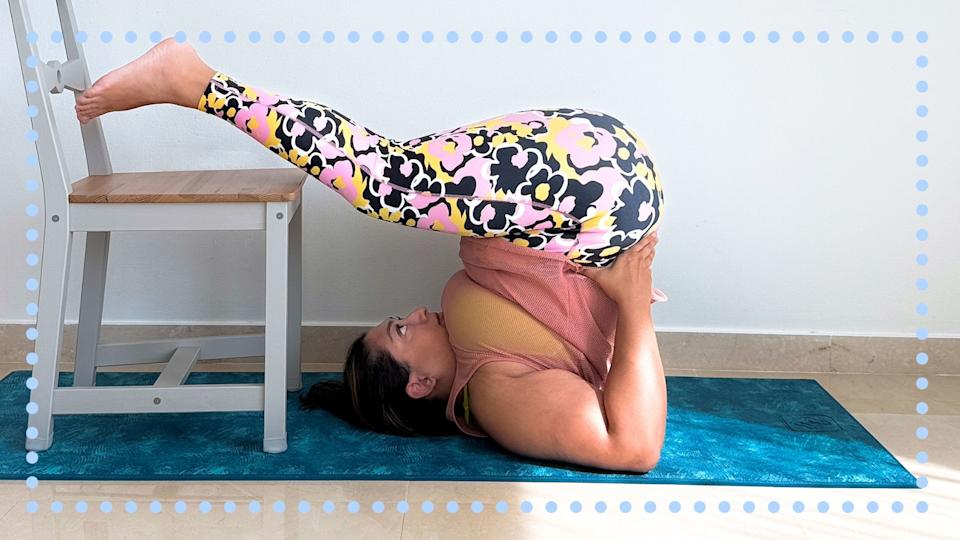
Using a chair to help support the plow pose can help you protect your lower back while stretching your glutes and hamstrings in this inversion. (Christabel Lobo)
Plow pose is one of the more advanced moves on this list, so you might want to stick with the legs up the wall pose until you feel ready to level up. It is a gentle inversion where your legs go over your head. While that sounds intense, it’s very grounding. Once you master legs up the wall, you can try lifting your legs off the wall to prep for this. However, I highly recommend getting help from an experienced yoga instructor when trying this for the first time to avoid injury.
How to do it:
-
Start by lying flat on your back, extending from your head to your feet. If you’re new to the pose, place a sturdy chair behind your head.
-
Keep your arms straight by your sides, palms pressed firmly into the floor.
-
Bend your knees, placing your feet flat on the floor. Press your hips up and bring your hands to your lower back, pressing your elbows into the ground to help support your hips. Slowly lift your legs up toward the ceiling, then guide them over your head.
-
Straighten your legs once they are overhead and slowly lower them behind you until your shins touch the chair. If you’re not using a chair, allow your flexibility to guide this movement. With time and practice, you may be able to touch the ground behind you with the tops of your feet.
-
Keep your arms planted on the floor for stability.
-
Hold this pose for five breaths.
-
Bend your knees and slowly roll your spine back down to the floor one vertebra at a time to release.
FAQs
Does yoga before bed actually make you sleep better?
Yes, and there’s also real-world data to back this up. Some research suggests that more than 5 in 10 adults who practice yoga say it helps them sleep better, and more than 8 in 10 report feeling less stressed overall. Other studies indicate that people who stick with yoga over time — especially during periods of stress or physical change — often report better sleep and fewer nighttime disruptions.
What time should I do yoga before bed?
You don’t need a full hour to reap the benefits. In fact, 10 to 15 minutes of yoga (like the routine above) right before you tuck yourself in is usually perfect. I often do a short session while I’m in bed to help my body settle. The exact timing of your pre-bedtime routine matters less than the vibe of the practice. It should be slow and calming, not a workout. Focus on easy stretches, long holds and steady breathing. If you find that moving makes you feel more alert than relaxed, try doing your routine a bit earlier in the evening. The goal is to create a clear transition from the chaos of the day to the stillness of sleep.
Can yoga replace melatonin or sleep supplements?
If a doctor recommended supplements or medications like melatonin or magnesium, keep taking them. Yoga works best as a partner to your existing routine rather than a replacement. It helps your body naturally prepare for rest. Studies indicate that regular, short yoga sessions can improve sleep quality for people with sleep disorders. Just ensure you’re doing the right kind of yoga. Save the more intense practices like ashtanga and vinyasa for the daytime. At night, focus on gentle stretching and breathwork to signal to your brain that it’s time to sleep.
Can yoga help with insomnia or anxiety-related sleep problems?
Gentle yoga is a great way to unwind if a racing mind is keeping you awake. It isn’t a magic wand, but there is growing evidence that it supports better sleep. One 2013 study found that older adults who practiced regularly had better sleep quality and overall well-being than those who did not. Other studies suggest similar benefits, particularly when yoga is paired with slow, calming breathing rather than more active movement. Mantiri points out that while yoga can be helpful, it isn’t a cure-all. “If someone has clinical insomnia or severe anxiety, they need professional support,” she says. “Yoga works beautifully alongside treatment, but it shouldn’t replace it.”
Meet our experts
-
Vania Garcia, RYT 200 yoga teacher
-
Brent Laffoon, founder and president of the Association of Yoga Professionals
-
Jem Mantiri, RYT 500 yoga teacher
Our health content is for informational purposes only and is not intended as professional medical advice. Consult a medical professional on questions about your health.