


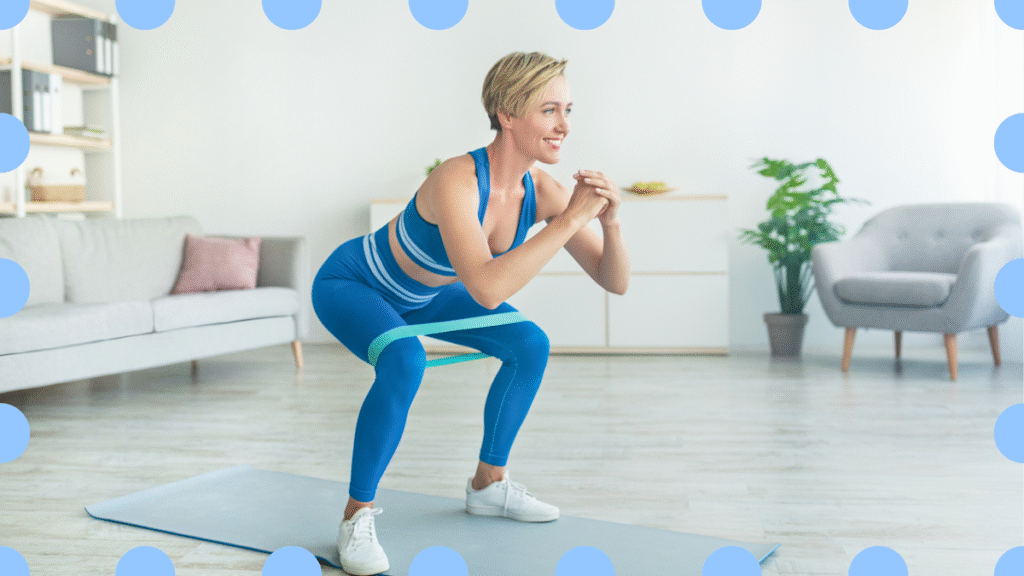
Looping a band around your thighs while doing side-by-side squats is no walk in the park — yes, I’m speaking from experience. But if there’s one way to make your exercises more challenging without adding more weight, it’s using resistance bands and loops. While they may look like fun, colorful rubber bands, they can actually be a pretty intense addition to your workouts.
Resistance bands are small but mighty tools that are great for helping you reach your fitness goals, including increased flexibility, mobility and strength. There are different varieties, including loop bands (a continuous loop), tube bands that typically feature integrated handles at either end and the standard straight, flat bands, which can also be tied into a loop. You can use them to ease into deep stretches and to make challenging exercises more accessible. For instance, you can use one to help you get closer to touching your toes when doing a forward fold, or you can try a band-assisted pull-up to gradually build the necessary strength to perform a pullup on your own.
If you’re new to using resistance bands, start with a lighter band and work your way up to using a heavier one. The lighter bands are stretchier and provide less resistance, while heavy bands resist your movements and are harder to stretch. You can even double-loop the bands or “choke up” on the band (grip it closer to its center) if a heavier band still feels too easy.
To dig into the benefits of resistance bands and how to use them safely, I spoke with Erin Nitschke, EdD, a member of the American Council on Exercise advisory panel, Jordan Duncan, DC, owner of Olympic Spine & Sports Rehabilitation in Silverdale, Wash., and iFit trainer Mecayla Froerer. Below, they share why bands are an effective at-home workout solution and how you can get started with them.
-
Related: The best resistance band for 2025, according to a pro trainer
Benefits of using resistance bands and loops
Enhancing flexibility and mobility
Resistance bands can help improve range of motion by assisting with stretches that target tight muscles, Nitschke says, making them ideal for warm-ups, cool-downs or injury prevention. If you have tight hips, for instance, you can do an adductor stretch where you lie on your back and loop one end of the band around your foot while you use your hand on the same side to hold on to the opposite end of the band. Lift your foot straight up in the air, then let it gently open outward and away from you, closer to the floor to feel a nice stretch on the inside of your upper thigh.
Improving strength
One thing that sets resistance bands apart from other traditional strength training tools like dumbbells and barbells is that bands and loops provide resistance throughout the entire range of motion of any given exercise, Nitschke explains. This means that you’re working against resistance through the pushing and pulling phases of a lift (known as the concentric and eccentric phases) which helps build strength without the need for heavy weights. You can target your entire body with bands, making them an efficient and effective option for home-based workouts.
“You can get a great lower-body workout with bodyweight alone, but adding a mini loop band really takes it up a notch,” says Froerer. “For squats, glute bridges, hip thrusts, frog pumps and lunges, you can position the band above your knees and focus on pushing outward to increase resistance and glute activation.”
Assisting with rehabilitation
If you’re recovering from an injury, resistance bands are a great option. They’re commonly used in physical therapy due to their low impact on joints, Nitschke says. Make sure you’re in control of the movements to prevent further injury, and again, start with the lightest option until you’re used to the bands.
Building stability and balance
If your core lacks the muscle strength to perform movements like sit-ups, bands can help get you closer to that goal. Many band exercises require core engagement to maintain proper form, Nitschke says, which helps build stability and improve posture. When you add a band to standard moves like pushups or squats, the demand on your core and stabilizing muscles increases. Over time, the strength you begin building while performing other exercises can transfer to the exercises you’re not yet able to perform.
Offering convenience
Bands and loops are super lightweight (like a large rubber band). They’re easy to pack in a bag if you’re traveling and to store away at home when not in use. You can even bring them to the gym with you. “I encourage my clients to take these tools when they travel for quick on-the-go routines,” Nitschke says.
7 exercises and stretches to try with resistance bands
Our experts shared seven highly effective exercises and stretches using resistance bands or loops that they regularly use with clients. For standing exercises, make sure you’re in a seated position when positioning the band on or removing it so you don’t lose balance and fall down. We’ve added the recommended number of reps and set for beginners. As you gain more strength, you can add more sets.
Band squats (strengthening)
The goal of this exercise is to strengthen your glutes, quads and hamstrings — and of course, to lift your booty.
-
Place a small, looped band just over your knees so it wraps around your lower thighs, then stand with your feet shoulder-width apart, making sure there’s tension in the band.
-
Lower into a squat for a count of three while keeping your knees tracking in line with your toes and your heels flat on the floor.
-
Begin with one set of 10-15 reps, two days per week.
Banded glute bridges (strengthening and core stability)
This move targets the glutes, strengthens the lower back and engages the core. Froerer likes mini loop bands for this classic move. “You can place the band above your knees for squats, glute bridges, hip thrusts and frog pumps and use it to cue that ‘push out’ motion,” she says. “It helps you hit the glutes harder without needing heavy weights.”
-
Place a small, looped band above your knees and onto your thighs.
-
Lie on your back with your knees bent and feet flat on the floor about hip-width apart. You can place your arms beside you for extra support.
-
When ready, press into your heels to lift your hips, squeezing your glutes at the top.
-
Lower your body and repeat the move.
-
Begin with two sets of 10-15 reps, three days per week.
Bonus: This can also help strengthen your pelvic floor muscles.
Standing lateral band walks (strengthening and mobility)
This move helps strengthen the glutes, hips and thighs while improving hip stability. Your legs may be sore the next day as your muscles adjust to the new workout.
-
For this move, you can place a small, looped band around your ankles or just above your knees.
-
Stand with your knees slightly bent with feet shoulder-width apart. Step sideways in either direction while maintaining tension in the band.
-
Begin with one set of 10-15 reps on each side two or three days per week.
Hamstring stretch with band (flexibility)
This will help relieve tightness in your lower back and legs, as well as increase hamstring flexibility (the muscle that’s holding you back from touching your toes).
-
Lie on your back and loop a resistance band around the arch of one foot.
-
Straighten that same leg toward the ceiling without locking your knee while holding the ends of the band — you can bend your opposite leg if it’s more comfortable.
-
Gently use the band to pull your straight leg toward you for a deep stretch.
-
Hold for 20 seconds per leg.
Band-assisted pull-ups (strengthening)
A long resistance band can help you work toward your first unassisted pull-up. The band gives you a boost so you can practice the full movement and build strength in your back, shoulders, and arms.
One thing to know: the band helps you the most at the bottom of the pull-up (when it’s stretched the most and wants to retract, offering greater assistance as you start pulling toward the bar) and the least at the top. This means that during the pulling phase of the exercise as you move toward the bar, the band’s assistance lessens as it returns to its retracted position and it becomes harder to complete the pullup. Try not to “cheat” and stop short of the bar — you want your chin to clear the top. Focus on pulling your chest as close to the bar as you can on every rep, even if that means doing fewer reps with great form.
-
Loop the band over the bar and pull one end through the other to tighten it.
-
Place the free end of the band under one or both feet or under your knees.
-
Start from a dead hang with straight arms and your core tight.
-
Pull yourself up, driving your elbows down and back. Aim to get your chin over the bar or as close as you can.
-
Lower yourself with control until your arms are straight again.
-
Aim for sets of 4 to 8 strong reps, stopping 1 to 2 reps before you hit total failure so your form stays solid.
You can mix these with slow negative pull-ups (a version where you step or jump to the starting pullup position, then lower yourself down as slowly as you can).
Banded frog pumps (strengthening)
This variation from Froerer puts your glutes front and center while giving your lower back an easier ride. With your knees opened out and the band above them, you have to press out against the band as you lift your hips, which really fires up the outer glutes.
-
Lie on your back with your knees bent and the soles of your feet together so your knees fall open to the sides.
-
Place a mini loop band above your knees on your lower thighs. Rest your arms on the floor by your sides for support.
-
Press your knees gently out into the band, then squeeze your glutes to lift your hips a few inches off the floor.
-
Pause for a second at the top, then lower your hips back down with control while keeping light tension on the band.
-
Begin with two sets of 12 to 15 reps, two or three days per week.
Banded push-ups (strengthening and core stability)
This variation builds on a classic push-up by adding extra resistance across your back. That extra tension makes your chest, shoulders and triceps work harder and challenges your core to keep your body in a straight line. “In order to add external load, a resistance band can be used to further strengthen the muscles targeted in a traditional push-up,” says Duncan. “You simply wrap the band around your back and anchor each end under your hands, then perform push-ups as usual. Different levels of band resistance, from extra light to extra heavy, can be used as a progression.”
-
Wrap a long resistance band around your upper back and bring each end down under your hands.
-
Set up in a high plank with your wrists under your shoulders, legs extended and feet hip-width apart.
-
Brace your core so your body forms a straight line from head to heels.
-
Bend your elbows to lower your chest toward the floor, keeping your elbows angled about 45 degrees from your body.
-
Press through your hands to push back up to the starting position, working against the band’s resistance.
-
Begin with one to two sets of 6 to 10 reps, two days per week, and move to a heavier band as that starts to feel easier.
For another versatile workout tool, don’t miss our best exercise balls roundup, complete with expert tips and workout suggestions. And once you become comfortable using resistance bands, you may wish to add standard weights. Check out our best kettlebell picks and best adjustable dumbbells that were tested by personal trainers.
FAQs
Can resistance bands really build muscle?
Resistance bands can build muscle as long as you train hard. It’s important to use a resistance level and rep count that pushes your sets close to failure. You should finish each set with only about 1 to 5 repetitions in reserve to hit the right intensity. With practice and time, your muscles will adapt and grow stronger, so it’s important to continue to increase the resistance by using thicker bands or adding more reps to continue to reap the benefits of progressive overload. Froerer explains that you can get a great workout with bodyweight alone, but adding a loop band “really takes it up a notch” for moves like squats, glute bridges and lunges by increasing glute activation and resistance as you get stronger.
Are resistance bands as effective as dumbbells or barbells?
Resistance bands can be as effective as dumbbells or barbells for certain exercises, but not others, depending on the movement and goal. For many upper body exercises and moderate loads, bands can match free weights for muscle activation and growth when the effort is equal. Duncan likes bands for pushing classic bodyweight moves further, such as wrapping a band around the back and anchoring it under the hands during push-ups to add load without needing a barbell. For heavy strength work in big compound lifts (like squats, deadlifts or cleans), barbells and dumbbells still have the edge because they are easier to load precisely and significantly.
Can resistance bands improve flexibility and mobility more than stretching?
Bands are great for active mobility because they let lifters move through a range of motion while muscles work against resistance. That helps build strength at end ranges instead of just hanging out in a stretch. Nitschke notes that bands can assist stretches that target tight muscles and are ideal for warm-ups, cool-downs and injury prevention. For long term mobility, a mix of banded mobility drills and traditional stretching usually works best.
How durable are resistance bands and how long do they last?
How long bands last comes down to the material, how often you use them, and how you store them. With regular home workouts and decent care, good bands can keep going for several years. In a busy gym or with heavy use, they may wear out in roughly a year. Check them often for cracks, thinning, or sticky patches, and replace them as soon as you spot any damage.
Meet our experts
-
Erin Nitschke, ACE-certified personal trainer, shares how to use bands for strength, mobility and injury-friendly workouts, along with beginner-friendly band exercises.
-
Jordan Duncan, DC, is the owner of Olympic Spine & Sports Rehabilitation, a sports medicine clinic in Silverdale, Washington, specializing in difficult-to-treat musculoskeletal pain. He explains how to pair bands with classic moves like push-ups to safely increase load.
-
Mecayla Froerer is an iFit trainer who programs at-home strength and incline workouts. She offers practical ways to use mini loop bands and simple equipment to target the glutes and hamstrings.
Our health content is for informational purposes only and is not intended as professional medical advice. Consult a medical professional on questions about your health.