

Most people picture an overnight train as a movie scene: a cozy bunk, a rolling landscape, and sleep that takes care of itself. Regulars know better. Behind that dreamy picture is a quiet code that decides who wakes up rested and who wakes up wrestling a suitcase in a closet-sized room.
These 25 rules cover everything from the single outlet in your room to a tip most first-timers never think to leave. A few are surprisingly simple, and one or two might change how you book your next trip. Here’s what the regulars and the rail guides actually say, starting from the bottom of the list.
#25 – They Sort Out Meals Before the Train Even Rolls
#25 – They Sort Out Meals Before the Train Even Rolls (Image Credits: Gemini)
Most people don’t realize the dinner question is already settled. Dining car meals are included for every ticketed passenger in a private room, along with non-alcoholic drinks. Regulars still don’t leave it to chance. They sort out the details at the door.
Advertisement
Advertisement
Insider Tip: Meal hours differ by route and season. Ask your attendant for the exact dining car times on your train and you’ll rarely get caught out.
One Amtrak Vacations guide advises that you ask your sleeping car attendant to make your meal request, which is then delivered directly to your room. That one sentence at boarding saves a lot of guessing later. It also shows who really runs the car. But that’s nothing compared to what we found about #24…
#24 – The Small Rolling Bag Is the Real Status Symbol
#24 – The Small Rolling Bag Is the Real Status Symbol (Image Credits: Gemini)
Walk down a sleeper car and you can spot the first-timers by their luggage. A smaller rolling case is best, because sleeping car rooms are tight. Regulars know that room is measured in inches.
Bring a bigger bag and you may end up leaving your room to tear it apart in the vestibule. The fix is to check the rest. On one Empire Builder trip, each passenger could check up to two pieces of luggage free of charge. Policies can change, so confirm yours before you pack. Still, the next rule is the one that costs people the most…
#23 – Anything Valuable Sleeps Where They Sleep
#23 – Anything Valuable Sleeps Where They Sleep (Image Credits: Gemini)
Luggage racks sit at the end of the car, and regulars treat them like a coat check with no ticket. One traveler who looked into theft on Amtrak concluded that the greatest risk is someone digging through your bags while you sleep. That’s one person’s research, not an official statistic. It matches common sense, though.
Advertisement
Advertisement
The Psychology Behind This: A staffed car feels safe, and that feeling makes people careless. Regulars flip the instinct: if losing it would ruin the trip, it stays in the room.
Trains Magazine suggests your in-room bag hold valuables, toiletries, a change of clothes, reading material and headphones. Everything else can ride elsewhere. So what goes in that bag besides the obvious? That brings us to #22…
#22 – They Never Trust the Snack Situation
#22 – They Never Trust the Snack Situation (Image Credits: Gemini)
Even with meals included, regulars carry their own food. Trains Magazine says to bring favorite snacks to tide you over between meals, or in case you don’t like the meal options. Meals run on a schedule, and hunger doesn’t.
Drinks are a quieter surprise. The same guide notes that Amtrak only carries Coke products. If you’re loyal to something else, you’ll want to bring it. Delays can also push meals around, as one rider found out the hard way.
Worth Knowing
Private-room fares include dining car meals and non-alcoholic drinks.
Snacks cover the gaps between meal times, or a menu you don’t love.
Only Coke products are carried onboard, so pack your own favorite if it’s something else.
Shelf-stable picks like nuts, fruit and crackers travel best in a small room.
Advertisement
Advertisement
We’ll get to that delay story at #16, but first…
#21 – The Straight-Plug Power Strip Nobody Thinks About
#21 – The Straight-Plug Power Strip Nobody Thinks About (Image Credits: Gemini)
Here’s the secret to staying charged. A roomette has only one outlet, so you’ll have to juggle multiple devices. Phones, headphones, and a tablet all want that one socket.
Try This: Charge everything fully before boarding. Then rotate devices overnight so the one outlet does less work, and bring a short cable you can reach from the bunk.
There’s a catch. Depending on the car, the outlet may be recessed, so your power strip needs a straight wall plug, not a flat one. A bulky flat plug simply won’t fit. Speaking of comfort gear, the next one starts arguments…
#20 – They Bring Their Own Pillow, and Don’t Apologize
#20 – They Bring Their Own Pillow, and Don’t Apologize (Image Credits: Gemini)
Amtrak provides bedding, so packing a pillow sounds silly. Regulars do it anyway. Amtrak provides blankets and pillows, but you can bring your own for a better night’s sleep.
Advertisement
Advertisement
The logic is about control. Having your own means you don’t rely on the attendant to supply an extra blanket or pillow. Skeptics call it dead weight in a tiny room. Regulars say one decent night’s sleep is worth the space. Now for the dining car, where the real insider moves happen at #19…
#19 – Sleeper Passengers Quietly Get Dining Car Priority
#19 – Sleeper Passengers Quietly Get Dining Car Priority (Image Credits: Gemini)
Most people don’t realize sleeping car tickets come with a head start at dinner. One veteran rider writes that sleeping car people get first dibs on dining car reservations. Regulars book early rather than hoping a table opens.
Insider Tip: Dinner is the meal most likely to fill up. Take the earlier seating you’re offered, since a late one leaves less room for delays.
Breakfast works differently. Amtrak Vacations lists it as running 6:30 to 9:30 am with no reservations, with lunch at 11:30 am to 2:30 pm. That source is a few years old, so check current times onboard. Next up is a rule about money that many riders get wrong at #18…
#18 – The Attendant Is Tipped Like It’s a Real Job (Because It Is)
#18 – The Attendant Is Tipped Like It’s a Real Job (Because It Is) (Image Credits: Gemini)
Think of your attendant as a hotel staffer who also works a moving train. Every car has an attendant who shows you to your cabin, takes down your beds at night and folds them up in the morning. That’s a lot of invisible work.
Advertisement
Advertisement
One experienced rider puts it bluntly: you must tip your sleeping car attendant. Amtrak doesn’t set an amount, so regulars plan for it in their trip budget. Here’s the part that surprises people more, at #17…
#17 – They Tip the Dining Server Even on a “Free” Meal
#17 – They Tip the Dining Server Even on a “Free” Meal (Image Credits: Gemini)
Included meals don’t mean included gratuity. Travel UpClose says that even though meals come with the room, it’s courteous to leave a gratuity of 15 to 20 percent of what the meal would have cost.
Why It Works: The ticket price covers the food, but the server is still working a full dining car. A tip is how that effort gets noticed and paid for.
Regulars do the math in their heads from the menu prices. It’s a small habit that tells you who’s ridden before. Still, nothing tests a regular’s patience like the next item, #16…
#16 – They Plan for the Train to Be Hours Late
#16 – They Plan for the Train to Be Hours Late (Image Credits: Gemini)
Here’s the truth about long-distance rail: schedules are a suggestion. One blogger reported that the train ended up nine hours late, so they slept at the train station. That’s one trip, not an average, but it’s why regulars build in slack.
Advertisement
Advertisement
Another rider noticed a quieter cost. Delays meant she missed the dining service her fare had included. So regulars skip the tight connection, the same-day wedding, and the nonrefundable dinner reservation. Now, where you sit matters more than most people realize, as #15 shows…
#15 – Upstairs Is Quieter, but Not Everyone Agrees It’s Worth It
#15 – Upstairs Is Quieter, but Not Everyone Agrees It’s Worth It (Image Credits: Gemini)
On double-decker Superliner cars, the upper level is where sleeper regulars aim. Amtrak Vacations says that upstairs, you can look forward to a much quieter, smoother ride. It also notes ten roomettes and four bedrooms on the upper level.
Editor’s Note: The upper deck trades convenience for calm. You climb stairs with your gear, and luggage and showers sit below. For a long night, the quiet usually wins.
The tradeoff is real, though. One reviewer’s sleeping car had its shower on the lower level. Some riders hate the stairs and call upstairs overrated. Regulars know both sides. And speaking of quiet, the next rule is a social one at #14…
#14 – They Treat 10 p.m. Like a Hard Line
#14 – They Treat 10 p.m. Like a Hard Line (Image Credits: Gemini)
The hallway outside a roomette is a thin wall between strangers. One rider’s guide says that the whole train has Quiet Hours between 10 pm and 7 am. Regulars don’t wait to be reminded.
Advertisement
Advertisement
They finish phone calls early, keep their voices low in the corridor, and avoid slamming the door. A bunk and a thin partition don’t leave much privacy, so courtesy does the work. It’s the quiet currency of sleeper life.
At a Glance
Quiet Hours run from 10 pm to 7 am, a full nine hours.
Phone calls wrap up before the hallway goes still.
Corridor voices stay low, because partitions are thin.
Doors close gently, never with a slam.
Next comes the small kit that makes all that quiet possible, at #13…
#13 – Earplugs and an Eye Mask Come Before Pajamas
#13 – Earplugs and an Eye Mask Come Before Pajamas (Image Credits: Gemini)
Trains rattle, hum, and sometimes blow a horn at crossings. Regulars commonly pack earplugs and an eye mask. These aren’t official Amtrak rules, just widespread habits among people who sleep on trains.
Advertisement
Advertisement
The Science Behind This: Light is one of the strongest cues your body clock uses. Blocking it helps your brain treat a moving, unfamiliar room as nighttime.
Station lights and passing headlights can flash through a window at any hour. The mask handles that while earplugs soften the rest. It’s cheap insurance against a wrecked night. Now, the bag that holds all this deserves its own rule, at #12…
#12 – The “Tonight Bag” That Saves a 2 a.m. Scramble
#12 – The “Tonight Bag” That Saves a 2 a.m. Scramble (Image Credits: Gemini)
Regulars never dig through a big suitcase in a tiny room. They keep a small tonight bag within reach. Trains Magazine recommends an in-room bag with toiletries, a change of clothes, reading material, headphones and slippers.
Slippers matter more than you’d think. The hallway floor and the shared bathroom aren’t places for bare feet. Having everything in one bag also keeps a cramped roomette from turning into a clothes explosion. Next up is the one thing most people get wrong about space, at #11…
#11 – They Know the Top Bunk Is for Sleeping, Period
#11 – They Know the Top Bunk Is for Sleeping, Period (Image Credits: Gemini)
Regulars have no illusions about the upper berth. One roomette review says the upper bunk has enough room for sleeping and that is all. There’s no sitting up and no reading in comfort.
Advertisement
Advertisement
Try This: Do your reading, snacking, and window-watching before the bed is made up. Once the bunks come down, the room is for sleeping.
That reviewer also found that the only place to put luggage was on the beds. So regulars keep gear minimal. A tidy room is a comfortable room. The next rule is about the one shared facility everyone worries about, at #10…
#10 – They Treat the Shower Like a Shared Resource
#10 – They Treat the Shower Like a Shared Resource (Image Credits: Gemini)
Roomette riders don’t get a private bath. One review notes that the sleeping car has one shower in it. That makes timing a quiet skill.
Regulars ask the attendant when the car is calmest rather than rushing in with everyone else. They also carry a small bag with their own toiletries. Bedrooms are a different story, which we’ll dig into at #3. But first, the layover trick that long-distance riders swear by, at #9…
#9 – They Use the Station Lounge Like a Secret Hotel Lobby
#9 – They Use the Station Lounge Like a Secret Hotel Lobby (Image Credits: Gemini)
Long layovers are where regulars shine. One rider describes a station lounge where you can lounge on a sofa, have coffee, take a shower, or stow your luggage while you explore. That beats a plastic chair in a waiting hall.
Did You Know: Sleeper tickets are classed as first class, and that is what opens the door to lounge access at stations that have one.
Not every station has a lounge, so regulars check before they go. Amtrak’s rules and station lists can change, so confirm in advance. Next up is a small ask that makes a big difference at #8…
#8 – They Ask for Station Help Instead of Wrestling Their Bags
#8 – They Ask for Station Help Instead of Wrestling Their Bags (Image Credits: Gemini)
Pride doesn’t carry suitcases. A veteran rider points out that your sleeping car attendant will make sure you have Red Cap assistance at stations if you need it. Just ask.
Regulars use this on long platforms and during transfers. Station staff also help with checked luggage. The attendant attaches bag tags, and the bags go directly to the baggage car. Few people realize how much of the hauling can be handed off. Now, let’s talk about the nightly ritual at #7…
#7 – They Time the Bed Like a Pro
#7 – They Time the Bed Like a Pro (Image Credits: Gemini)
The bed doesn’t appear on its own. Your attendant takes down the beds at night and folds them up in the morning. Regulars know that timing affects how the whole evening goes.
Why It Works: Once the bed is down, the seats are gone. Asking for it after dinner and your last stretch of window time means you never lose a seat you still need.
They tell the attendant their preference early, so the bed goes down after dinner, not before. In the morning, the same cue works in reverse. A little planning keeps the tiny room usable. The next rule fights boredom, at #6…
#6 – They Download Everything Before the Signal Dies
#6 – They Download Everything Before the Signal Dies (Image Credits: Gemini)
Cross-country routes pass through long stretches of remote country. Cell service can be patchy there, and onboard connectivity is not something to bank on. So regulars load movies, books, podcasts, and offline maps before boarding.
That habit has a hidden benefit. With nothing to scroll, many riders say they finally look out the window. Regulars treat the gap as part of the trip. Now for one of the most underrated parts of the whole experience, at #5…
#5 – They Accept the Shared Dining Table
#5 – They Accept the Shared Dining Table (Image Credits: Gemini)
Dining cars can be a social surprise. One reviewer on a 45-hour trip recalled that they were seated with another couple for most, but not all, meals. It’s community seating, and regulars go with it.
The Psychology Behind This: Strangers stuck together on a long journey often open up faster than they would at home. A shared table becomes the trip’s best story.
You might get a retired rancher, a student, or a family heading home. Regulars say these talks are half the reason they keep coming back. Speaking of free things, #4 is one most people miss…
#4 – They Use the Free Drinks Station Without Shame
#4 – They Use the Free Drinks Station Without Shame (Image Credits: Gemini)
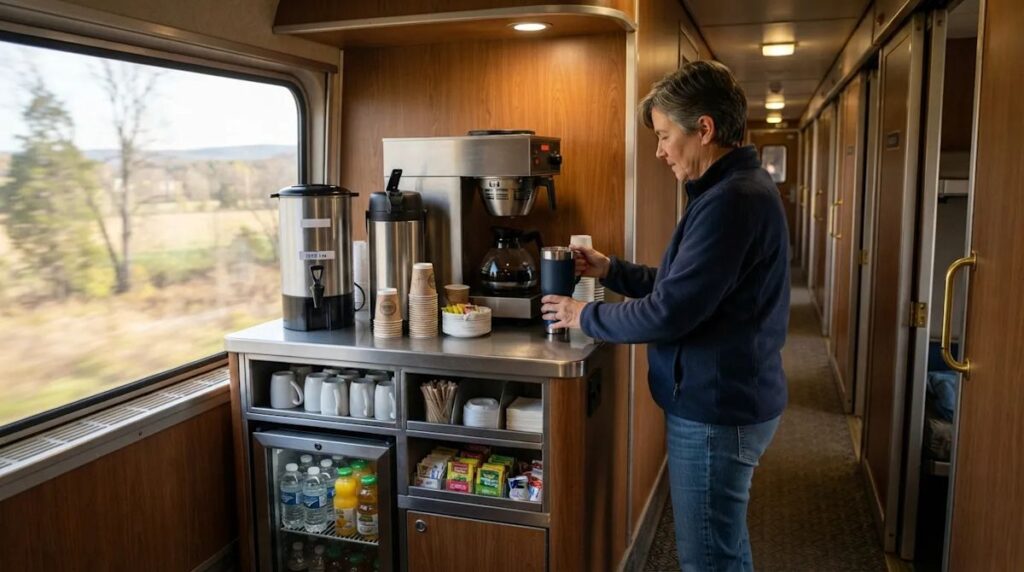
Sleeping car passengers have a perk hiding in plain sight. According to one guide, coffee, tea, bottled water and juice are located in every sleeping car. There’s no charge, and no need to order.
Regulars fill a mug at dawn and a water bottle before bed. It saves them the walk to the cafe car, and with all meals included in the dining car, one traveler noted they never needed the cafe anyway. The next one divides riders sharply, at #3…
#3 – The Roomette-vs-Bedroom Debate That Splits Rail Fans
#3 – The Roomette-vs-Bedroom Debate That Splits Rail Fans (Image Credits: Gemini)
Most people book the roomette because it’s cheaper. A Bedroom, by contrast, offers twice the square footage, a wider lower bed, and an enclosed private toilet and shower. For some riders, that changes the whole trip.
Editor’s Note: This is a real split. Plenty of riders happily book roomettes for short hops. For multi-day crossings, the extra space starts to look less like a luxury.
One blogger went so far as to say don’t upgrade to the roomette unless you’re on a really long trek, and then upgrade to a full bedroom. Another reviewer said they’d happily ride in a roomette again. Both are real opinions, so decide by trip length.
Quick Compare
Roomette: Lower price, one outlet, a shared shower down the car, and an upper bunk that is for sleeping only.
Bedroom: Twice the square footage, a wider lower bed, and a private enclosed toilet and shower.
Best fit: Roomettes for shorter hops, bedrooms for the multi-day crossings.
Now for the rule that changes how you see the whole journey, at #2…
#2 – They Stay Up for the Scenery and Sleep Less Than They Planned
#2 – They Stay Up for the Scenery and Sleep Less Than They Planned (Image Credits: Gemini)
Here’s the part first-timers rarely expect. Crossing the continent takes upwards of 40 to 50 hours on routes like the California Zephyr, Empire Builder, or Southwest Chief. That’s a lot of landscape to watch.
By The Numbers: A 40-to-50-hour trip is roughly two full days. Regulars plan which stretches they want to see awake and which they’ll happily sleep through.
One rider wrote that she ate in the dining car, gazed at the mountains in the viewing lounge, and slept as little as she could to avoid missing a thing. Regulars plan around the best stretches. And the final rule is the one that actually makes everything else work, at #1…
#1 – They Treat the Attendant Like the Heart of the Whole Car
#1 – They Treat the Attendant Like the Heart of the Whole Car (Image Credits: Gemini)
Every other rule on this list leans on one person. One traveler’s review said the attendant took care of their room throughout the trip. Regulars know that this person is the difference between a rough night and a smooth one.
They learn the name, say thanks, and ask questions early. Another guide says the attendant will look after you on your journey. The truth is simple: ride enough sleeper trains and you stop thinking of the car as a room. You start thinking of it as a small town with one very busy mayor.
The surprise about sleeping cars isn’t the bunk. It’s the culture around it. Regulars pack small, protect their valuables, bring their own snacks and plugs, tip generously, and expect the schedule to slip. Some rules are practical and some are plain courtesy, but they all share one idea: the train rewards the people who prepare for how it really works.
So what’s the one thing you’d never board an overnight train without?
Source link