

You think the driver is just waiting for you to find a seat. Actually, the assessment started days earlier, when the job sheet landed on their desk.
By the time the doors hiss open, a good coach driver may already have a decent read on your group, your luggage and even your mood. Some of the clues are obvious. Others are so small you would never guess anyone was watching, and a couple are surprisingly tender.
#15 – The Job Sheet Is Basically a Spoiler for Your Whole Day
#15 – The Job Sheet Is Basically a Spoiler for Your Whole Day (Image Credits: Gemini)
The first clue is on paper. Drivers typically get a job sheet with the pickup time, headcount, destination, and often the group’s name and a contact number. In a few lines, it tells them whether today is a school run, a retirees’ day out or a wedding shuttle.
Advertisement
Advertisement
The group name alone can set the tone. A football supporters’ club, a garden society and a hen party each paint a very different picture before anyone has said a word. One line on a job sheet can change how a driver plans the entire day. And the next clue is even more telling.
#14 – School Trip or Hen Party? The Group Type Predicts the Mood
#14 – School Trip or Hen Party? The Group Type Predicts the Mood (Image Credits: Gemini)
Drivers sort groups into types almost without trying. School trips mean noise and head counts. Seniors’ outings mean slower boarding and more toilet stops. Sports fans and party groups mean songs, snacks and the occasional spill.
Here’s the part that starts arguments in the canteen. Some drivers swear a school trip is the easiest job of the week because the teachers keep order. Others say a grown-up group in a good mood is far simpler, and experienced drivers genuinely disagree about which one is harder. Either way, the group type shapes the day, and the next factor is all about space.
Did You Know: In Britain, coach drivers need a category D licence and a Driver Certificate of Professional Competence. It’s a professional qualification that has to be kept up to date, not just a bigger version of a car licence.
#13 – One Extra Passenger Can Sink the Whole Booking
#13 – One Extra Passenger Can Sink the Whole Booking (Image Credits: Gemini)
A coach is not a city bus. Passengers on a coach are generally expected to have their own seat, so the driver checks the headcount against the vehicle’s capacity before anything else. A full-size touring coach commonly carries around fifty people, and not every one of those seats is available.
Advertisement
Advertisement
Some seats go to a tour guide, a crew member or a wheelchair space. That turns “just one more person” into a real problem. An extra passenger can turn a friendly booking into a legal issue, because the driver simply can’t squeeze someone in. And luggage causes even bigger headaches.
Fast Facts
Full-size touring coaches usually seat somewhere between the mid-40s and high-50s, depending on the layout.
A wheelchair position in the layout can take the place of regular seats.
Standing is not an option on most coach hires, so every passenger needs a seat.
The official seat count on the vehicle is what counts, not how much room it looks like there is.
#12 – Your Suitcases Give Away How Stressful the Day Will Be
#12 – Your Suitcases Give Away How Stressful the Day Will Be (Image Credits: Gemini)
Bags say a lot. A group heading to an airport or cruise port needs a hold packed like a jigsaw puzzle. A day-trip group with small backpacks barely needs the hold at all.
Operators also work with weight and space limits that can’t be ignored. A coach’s hold is finite, and a few oversized items can crowd out everyone else’s luggage. That’s why drivers and operators like to ask about bags in advance, and why the next item is where things get serious.
Advertisement
Advertisement
Insider Tip: Soft bags tend to pack tighter than hard cases. If you’re organizing a group, tell the operator about any bulky items such as golf clubs, buggies or instruments before the day, not at the door.
#11 – A Quiet Ramp Request Can Rewrite the Whole Schedule
#11 – A Quiet Ramp Request Can Rewrite the Whole Schedule (Image Credits: Gemini)
Drivers look for anyone who may need a ramp, a lift or extra boarding time. In the U.S., over-the-road buses are covered by accessibility rules under the Americans with Disabilities Act. In Britain, accessibility rules apply to coaches too, and operators usually ask for notice.
The reason is practical. Lifts take time, securing a wheelchair takes training, and the schedule has to allow for both. A surprise mobility need on the day can delay an entire departure, which is why smart organizers flag it early. But there’s another clock ticking in the driver’s head, too.
By The Numbers: Under the U.S. over-the-road bus rules, large operators had to provide accessible service from late 2000, and small operators from late 2001. These requirements have been around for decades.
#10 – Your “Easy” Itinerary May Be Quietly Impossible
#10 – Your “Easy” Itinerary May Be Quietly Impossible (Image Credits: Gemini)
Drivers are legally limited in how long they can work behind the wheel. Under the GB and EU rules, a driver needs a 45-minute break after 4.5 hours of driving. In the U.S., federal rules for passenger-carrying drivers cap driving at 10 hours after eight consecutive hours off duty.
Quick Compare
GB/EU: a 45-minute break after 4.5 hours of driving, and a standard daily driving limit of 9 hours.
U.S. passenger carriers: up to 10 hours of driving, after 8 consecutive hours off duty.
U.S. on-duty window: no driving after the 15th hour on duty.
Advertisement
Advertisement
So when an itinerary promises a six-hour run with a quick sandwich stop, the driver spots the problem straight away. Some “simple” trips simply can’t be done as planned. Often the real culprit is a planner who crammed in one stop too many. And speaking of stops…
Editor’s Note: Packed itineraries are usually the organizer’s fault, not the driver’s. Breaks are a safety rule and they exist for a reason, so a driver who sticks to them isn’t being difficult.
#9 – Every Group Has a Secret Boss, and the Driver Finds Them Fast
#9 – Every Group Has a Secret Boss, and the Driver Finds Them Fast (Image Credits: Gemini)
Every group has a leader, and drivers hunt for them quickly. It might be the teacher, the tour guide, the club secretary or the loudest friend holding a clipboard. That’s the person who gets the pickup times, the changes and the dreaded “we’re running late” call.
It sounds small, but it prevents chaos. Fifty passengers can’t all give the driver directions, and one point of contact keeps the day on track. When nobody steps up, the whole trip tends to feel louder and messier. But the next clue has nothing to do with people’s personalities. It’s about their coats.
#8 – Shorts or Scarves? Your Outfit Predicts the Thermostat War
#8 – Shorts or Scarves? Your Outfit Predicts the Thermostat War (Image Credits: Gemini)
Drivers glance at clothing for a reason. Passengers in shorts and sandals will want the air conditioning on, while those in coats and scarves will complain about the draft. Temperature is one of the classic onboard disagreements, and every driver has a story about it.
Advertisement
Advertisement
Coaches also swing between sun-baked windows and a chilly hold. You simply can’t please everybody on a full coach, and drivers know it. Most aim for the middle and brace for comments anyway. But some passengers climb aboard with a different worry.
The Psychology Behind This: Part of the friction is control. Passengers can’t adjust the temperature themselves, so small discomforts feel bigger than they would at home.
#7 – The Seatbelt Speech Changes Depending on Who’s Aboard
#7 – The Seatbelt Speech Changes Depending on Who’s Aboard (Image Credits: Gemini)
Before pulling out, drivers think about who is on the coach. A load of excited children, or older passengers who move slowly, calls for a different safety briefing than a group of commuters would. Where belts are fitted, passengers are expected to use them.
In Britain, operators have to make sure passengers are told about wearing seatbelts, and the driver or crew usually handles it. It’s an announcement that’s easy to tune out, which is exactly why drivers often change their tone to suit the crowd. A joke for a lively group, a calm word for a nervous one. And the next signal is physical.
Advertisement
Advertisement
By The Numbers: In the U.S., federal rules require lap-and-shoulder belts on new motorcoaches built after November 28, 2016. Older coaches may still be in service without them.
#6 – The Passenger Who Will Turn Green by Mile Ten
#6 – The Passenger Who Will Turn Green by Mile Ten (Image Credits: Gemini)
Motion sickness is common, and drivers learn to spot the signs. A pale face, a nervous glance at the road and a quiet “does it get bumpy?” at the door are all giveaways. Many drivers gently steer these passengers toward the front.
The front offers a clear view of the road, which often helps. One quiet seat swap at the start can save the whole journey, and nobody has to make a fuss. Drivers would much rather solve it before departure than at the side of a motorway. And the next item is even less glamorous.
The Science Behind This: Motion sickness is thought to come from a mismatch between what your eyes see and what your inner ear feels. Looking at a fixed point in the distance often eases it.
#5 – The Toilet Stop Is the Real Itinerary
#5 – The Toilet Stop Is the Real Itinerary (Image Credits: Gemini)
Experienced drivers can forecast bathroom breaks from a group’s profile. Older groups, big coffee drinkers and long, early pickups all point to more stops. Some coaches have a toilet on board, but many groups still expect regular breaks.
Advertisement
Advertisement
Here’s a take that sparks arguments. Plenty of drivers will tell you the toilet stop is the real schedule, and the sights are just what happens in between. Planners who ignore this tend to run late and wonder why. But another habit separates the veterans from the rookies.
Worth Knowing
Under GB and EU rules, the 45-minute break can be split into a 15-minute stop followed by a 30-minute one.
A well-planned group stop can double as the driver’s legal break, so it isn’t wasted time.
An onboard toilet doesn’t always mean unlimited use, because policies vary by operator.
Stops at busy services can take far longer than planned once a full coach floods the queue.
#4 – The Cooler Bag at the Door Says Everything
#4 – The Cooler Bag at the Door Says Everything (Image Credits: Gemini)
Drivers watch for alcohol at the door. A group arriving with cooler bags and loud cheers sends a clear signal before anyone is seated. Operators set their own policies, and some hire contracts mention cleaning charges.
Under conduct rules for public service vehicles in Britain, crews can generally refuse someone who is drunk or behaving dangerously. A driver can turn a passenger away before departure, because the safety of everyone on board comes first. Most would rather have a quiet word early than a scene at 60 miles an hour. And the next clue is about timing.
Advertisement
Advertisement
Try This: If you’re organizing a party trip, ask the operator about its alcohol and cleaning policy before booking day. It avoids awkward surprises at the door.
#3 – Who Shows Up Early Tells the Driver How the Day Will Go
#3 – Who Shows Up Early Tells the Driver How the Day Will Go (Image Credits: Gemini)
The first arrivals set the tone. A group that turns up ten minutes early usually runs smoothly, and one that straggles in late often keeps straggling all day. Drivers notice which kind they have.
Lateness isn’t harmless. A driver can’t just put their foot down to catch up, because modern digital tachographs record driving time and speed. Minutes lost at the start are often lost for good. And the last two items are the ones drivers talk about most.
Why It Works: Loading luggage in reverse order of the stops, last stop first, means nobody has to dig through the hold at the first drop-off. Early arrivals make that possible.
#2 – The Way You Climb Those Steep Steps Is a Quiet Safety Check
#2 – The Way You Climb Those Steep Steps Is a Quiet Safety Check (Image Credits: Gemini)
Coach steps are steep, and drivers watch every boarding. Someone gripping the rail with both hands, hesitating at the bottom or juggling too many bags is giving away information. Drivers will often step in with a hand or a friendly word.
Advertisement
Advertisement
It’s more than good manners. A slow climb can hint at balance problems the passenger hasn’t mentioned, and drivers use it to decide who sits where. A seat near the door can make the whole day easier. And the final item is the one that stays with them.
Why It Stands Out
It’s the only moment when the driver sees every passenger up close, one at a time.
The check takes seconds and nobody has to announce it.
A friendly hand at the bottom step feels like courtesy, not a medical assessment.
Catching a wobble at the door is far easier than dealing with a fall on the move.
#1 – The Solo Passenger Gets Noticed First, and It Matters
#1 – The Solo Passenger Gets Noticed First, and It Matters (Image Credits: Gemini)
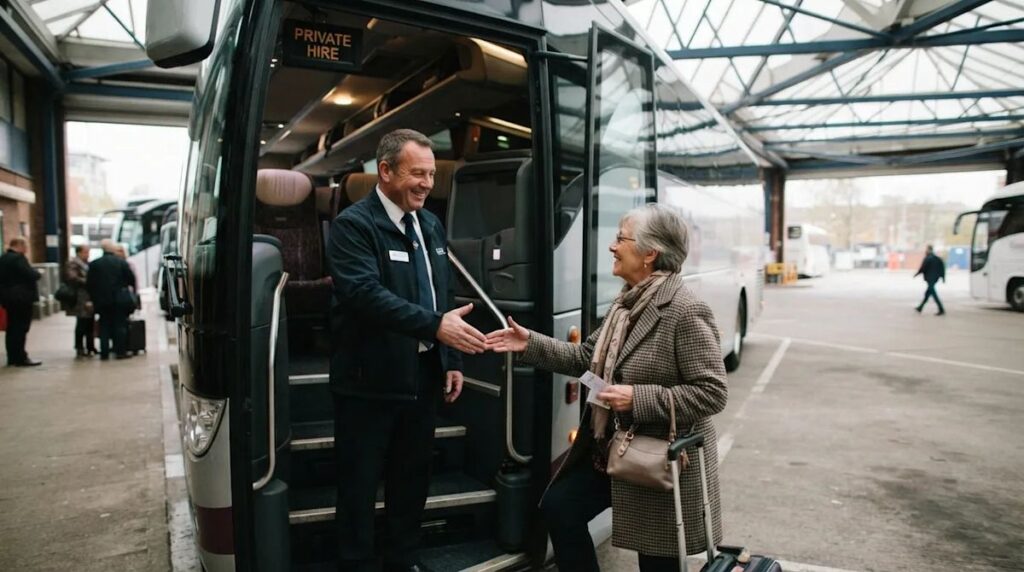
The thing drivers notice most quietly is the person traveling alone. It might be a widow on a day trip, a nervous first-time traveler or someone sitting apart from the group. Many drivers make a point of saying hello to these passengers first.
The Psychology Behind This: People who feel noticed early often relax faster. A simple greeting at the door can change how the whole trip feels.
It costs nothing, and the driver’s welcome may be the only friendly face that passenger sees all day. That’s the part of the job no job sheet will ever capture.
So the next time you board a coach, remember that the person behind the wheel has probably been reading the room since before you arrived. They counted the seats, checked the hold, watched the steps and gauged the mood. Which of these 15 surprised you most?
Source link