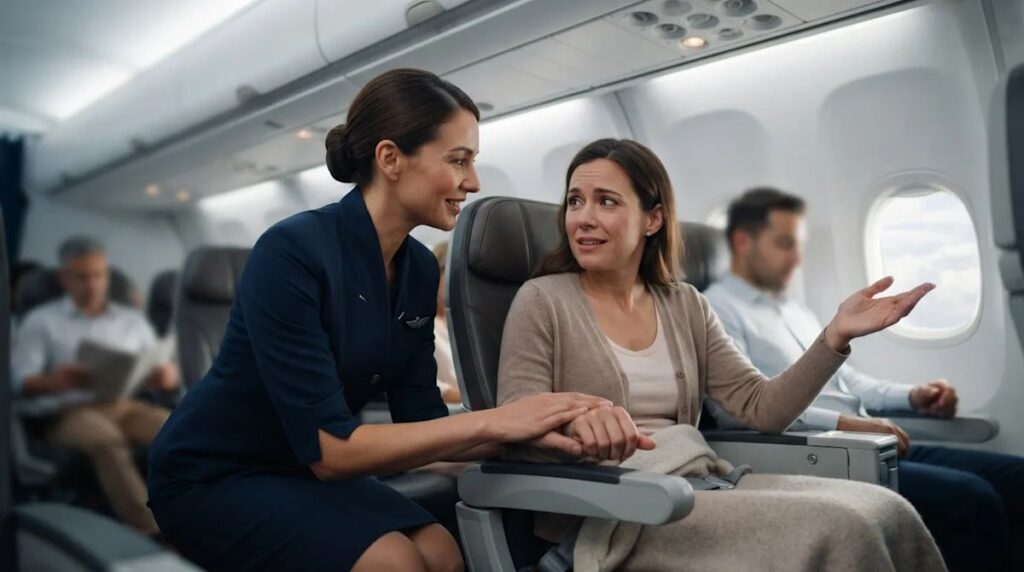


Most people board a plane convinced that flight attendants run on a rigid rulebook, where nearly every favor earns a polite “sorry, we can’t.” The reality is a lot friendlier. Crews say yes to a surprising number of small asks, often with a smile and sometimes before you finish the sentence.
The difference between a yes and a no usually comes down to timing and wording. Some of these requests are tiny. A couple can change your entire flight. And the one waiting at #1 is something most passengers never dare say out loud.
#15 – Ask for the Whole Can and a Cup of Ice, and Crews Often Hand Both Over
#15 – Ask for the Whole Can and a Cup of Ice, and Crews Often Hand Both Over (Image Credits: Gemini)
Asking for the full can of soda sounds like a rookie move, but it’s one of the easiest yeses in the sky. Many airlines pour a small cup and take the can back to the cart. Still, crews will often leave it if you ask politely, especially when the cart is running low or turbulence makes pouring a mess. A cup of ice for your own water bottle is just as routine.
Advertisement
Advertisement
The reason it matters is the air itself. Cabin humidity is often cited as below 20 percent, far drier than most people’s homes, so staying hydrated is a real issue on longer flights. Crews would rather hand you a second drink than watch you sit there parched. Policies vary by airline and fare, so treat it as a friendly ask, not a right.
Try This: Ask on the first pass of the cart, not the last. Early in service, crews have the most flexibility with cans, ice, and refills before supplies get tight.
#14 – Warm Water for a Baby Bottle Is a Request Crews Hear Constantly
#14 – Warm Water for a Baby Bottle Is a Request Crews Hear Constantly (Image Credits: Gemini)
Parents often brace for an eye roll when they ask a flight attendant for help with a baby bottle. They almost never get one. TSA allows formula, breast milk, and juice for infants in reasonable quantities, even above the usual 3.4-ounce liquid limit. That means crews see these bottles on nearly every flight with a baby aboard, and a cup of warm water is usually easy to arrange.
Don’t expect a bottle warmer. Crews typically hand over a cup of warm water for you to set the bottle in, and the standard advice is to test a few drops on your wrist before feeding. Some airlines have stricter rules about heating liquids, so ask early, before the cart blocks the aisle. A calm request before takeoff beats a frantic one mid-descent.
Fast Facts
The standard TSA carry-on limit is 3.4 ounces (100 ml) per liquid container.
Infant formula, breast milk, and juice are allowed in reasonable quantities above that limit.
Tell the security officer at the checkpoint that you’re carrying them, since they may be screened separately.
On board, a cup of warm water is the usual workaround, not a true bottle warmer.
#13 – Moving to an Empty Row Is Usually Fine, Just Not at the Wrong Moment
#13 – Moving to an Empty Row Is Usually Fine, Just Not at the Wrong Moment (Image Credits: Gemini)
Most travelers assume switching seats is a flat no, and crews do admit it’s a pet peeve when it’s done wrong. The classic mistake is hopping into an open row while boarding is still happening. Once the door is closed and the seatbelt sign goes off, many crews are happy to let you shift within your own cabin.
Advertisement
Advertisement
The timing rule is practical. On smaller regional jets, weight distribution matters, so crews may ask you to stay put until the aircraft is stable. Moving into a paid extra-legroom seat is the one move they will almost always shut down. Asking first beats sneaking over every time.
By The Numbers: The FAA requires at least one flight attendant per 50 passenger seats on larger aircraft. A 180-seat jet needs at least four, so crews are counting heads and juggling tasks.
#12 – A Bag of Ice for a Sprain or Headache Is a Classic Yes
#12 – A Bag of Ice for a Sprain or Headache Is a Classic Yes (Image Credits: Gemini)
Passengers rarely think to ask, but crews keep ice in the galley and first-aid supplies on board. A twisted ankle from a sprint through the terminal or a pounding headache is exactly what a bag of ice is for. Crews often wrap it in a napkin or towel so it’s easier to hold against your skin.
Aircraft are required to carry first-aid kits, and crews are trained to handle minor issues. For anything that looks serious, they follow set medical procedures, and they may call for a doctor on board. For a minor bump, a quiet request at your seat is usually all it takes.
Advertisement
Advertisement
The Science Behind This: Cold narrows blood vessels near the skin and can reduce swelling and numb pain in minor injuries. That’s why ice is the standard first response for bumps and sprains.
#11 – A Seatbelt Extender Is Free, Private, and Nothing to Be Embarrassed About
#11 – A Seatbelt Extender Is Free, Private, and Nothing to Be Embarrassed About (Image Credits: Gemini)
Plenty of passengers who need an extender suffer through a too-tight belt because they dread asking. Crews say they hand these out all the time, and most airlines provide them at no charge. Quietly asking at boarding, or pressing the call button discreetly, is usually all it takes.
There’s a safety twist. The FAA doesn’t allow passengers to bring their own extenders, because they must be approved by the airline for that specific aircraft. That makes the crew the only legitimate source. Asking before takeoff also keeps things private, since nobody is waiting behind you in a packed aisle.
Editor’s Note: This is the request crews most want passengers to stop agonizing over. A fastened belt is a safety item, not a personal judgment, and asking quietly takes about ten seconds.
#10 – Standing and Stretching in the Galley Is Often Tolerated
#10 – Standing and Stretching in the Galley Is Often Tolerated (Image Credits: Gemini)
Plenty of travelers think leaving their seat means a stern look from the crew. In reality, once the seatbelt sign is off, stretching your legs near the galley or restrooms is usually fine. The rule of thumb is to keep it brief and step aside the moment a cart or crew member needs the space.
Advertisement
Advertisement
Health agencies back this up. The CDC advises moving around during long trips to help reduce the risk of blood clots. Many crews would much rather see you stretch than stiffen up for six hours. The FAA also advises keeping your belt fastened whenever you’re seated, since turbulence can arrive without warning.
Quick Compare
Usually fine: a short stretch near the galley once the seatbelt sign is off.
Usually fine: a walk to the restroom between service passes.
Usually not: standing while the seatbelt sign is on or turbulence hits.
Usually not: camping in the aisle while a cart is rolling through.
#9 – Asking for Extra Snacks at the End of Service Often Works
#9 – Asking for Extra Snacks at the End of Service Often Works (Image Credits: Gemini)
Most people assume what’s on the cart is all they get. On many flights, though, crews have leftover pretzels, cookies, or crackers once service is finished. Asking quietly in the last stretch of the flight tends to work far better than asking in the middle of the rush.
Policies vary by airline, and some keep strict inventory counts. Short flights may have very little extra. Even so, crews generally say a polite request for a hungry kid or a passenger stuck through a long delay rarely gets a no. Be flexible, and say thanks even if it’s the plain option.
Advertisement
Advertisement
Why It Works: Crews load catering based on estimates, and unclaimed snacks usually go unused. A specific, polite request after service is easy to grant and costs them almost nothing.
#8 – A Fragile Gift, Cake, or Hat May Get a Safe Spot in the Closet
#8 – A Fragile Gift, Cake, or Hat May Get a Safe Spot in the Closet (Image Credits: Gemini)
Passengers carrying something delicate often assume the overhead bin is their only option, and they spend the flight dreading the slam. Crews can sometimes stow a boxed cake, a wrapped gift, or a good hat in a closet or galley compartment, space permitting. Premium cabins usually have more room for this than economy.
The FAA requires carry-on items to be stowed securely for takeoff and landing, so crews care about safe placement, not just convenience. If there’s room, many will happily protect your item rather than watch a bin door crush it. It’s never guaranteed, and a full flight can make it impossible.
Insider Tip: Ask while boarding, when closet space is still open. Once the cabin fills and coats pile in, the odds drop quickly.
#7 – Telling the Crew About a Severe Allergy Gets More Action Than You’d Think
#7 – Telling the Crew About a Severe Allergy Gets More Action Than You’d Think (Image Credits: Gemini)
Passengers with severe allergies often assume the crew will brush off the concern. Many will actually take it seriously. Crews may check on your seat area, and some can make a polite announcement asking nearby passengers to avoid opening certain snacks. The details depend on the airline.
Advertisement
Advertisement
Here’s the part most people don’t realize. The U.S. has no federal rule requiring airlines to offer peanut-free flights, so policies vary widely from carrier to carrier. Some allergy advocates also argue that buffer zones can create false confidence. The best move is to speak up at the gate, ask about pre-boarding, and wipe down your seat area yourself.
Worth Knowing
Raise it at the gate first, since that’s where pre-boarding is arranged.
Keep your epinephrine in your carry-on, never in a checked bag.
Wipe the tray table, armrests, and seat-back pocket area before you settle in.
Treat any announcement as a courtesy, not a guarantee.
#6 – Crews Will Often Help Connecting Passengers Get Off First
#6 – Crews Will Often Help Connecting Passengers Get Off First (Image Credits: Gemini)
If you’re racing a tight connection, it’s easy to assume the crew can’t do a thing. They can’t hold the plane or the next flight. But they can often pass along your concern, and many will ask other passengers to stay seated so connecting travelers can exit first.
Gate agents and airline operations make the real calls on connections. Still, pilots can often relay information through airline channels, and crews frequently announce connecting gates before landing. A calm, specific request that names your flight and gate gets far better results than a panicked one.
Advertisement
Advertisement
Did You Know: Crews usually have limited information about other flights. Giving them your exact flight number and time helps them pass accurate details to the people who can act.
#5 – You Can Ask to Be Woken for Meals or Landing
#5 – You Can Ask to Be Woken for Meals or Landing (Image Credits: Gemini)
Plenty of travelers sleep through the cart, then wake up hungry and annoyed. A short, polite request before dozing off, like “please wake me for the meal,” is something crews can usually honor. Some airlines also offer do-not-disturb cards or similar signals.
The surprise is how crews decide whether to wake you. Safety checks come first, since they need to confirm belts are fastened before landing or turbulence. A blanket piled over your belt often leads to a gentle nudge, because they can’t see it. Leaving the buckle visible helps you sleep longer.
Try This: Lay your seatbelt on top of your blanket before you doze off. Crews can see it’s fastened without waking you.
#4 – Asking for a Sick Bag Before You Need It Is a Smart Move
#4 – Asking for a Sick Bag Before You Need It Is a Smart Move (Image Credits: Gemini)
Most people wait until they feel awful to ask for a bag, and by then it’s almost too late. Crews would much rather you ask early. Sick bags are usually in the seat pocket, but crews can bring extras, a cold towel, or a drink like ginger ale if they have it on board.
Advertisement
Advertisement
Motion sickness is common, and crews have seen it more times than they can count. Many travelers say seats over the wing feel steadier, and crews often suggest focusing on a fixed point or opening the air vent. Asking early gives them time to help before it turns into a cleanup job.
At a Glance
Ask for: an extra bag, a cold towel, water, or ginger ale if available.
Try: aiming the air vent at your face and fixing your eyes on one steady spot.
Snack smart: plain crackers or pretzels are usually easier on a queasy stomach than something greasy.
Speak up early: the first wave of nausea is the easiest to help.
#3 – Kids Can Often Peek Into the Cockpit, Just Not Mid-Flight
#3 – Kids Can Often Peek Into the Cockpit, Just Not Mid-Flight (Image Credits: Gemini)
Everyone assumes the cockpit is off-limits, and in the air, it is. After 9/11, cockpit doors were reinforced and kept closed and locked during flight. But on the ground, before boarding or after landing, many pilots happily invite curious kids to take a look at the wall of buttons and screens.
It’s always the pilots’ decision. Delays, security, and tight turnarounds can make it impossible. Still, crews say a polite request as you deplane gets a yes more often than parents expect. Some airlines also hand out kids’ wings or small souvenirs, though that varies by carrier.
Advertisement
Advertisement
Did You Know: The rule is about security in flight, not a ban on pilots meeting passengers. On the ground, the decision is largely up to the captain.
#2 – Birthday, Honeymoon, or First Flight? Crews Often Make It Known
#2 – Birthday, Honeymoon, or First Flight? Crews Often Make It Known (Image Credits: Gemini)
Passengers assume announcing a celebration on a plane is too cheesy to be allowed. In truth, many crews love it. A quiet word at boarding about a birthday, a honeymoon, or a child’s first flight can lead to a mention over the intercom, a handwritten note, or a small treat.
It isn’t a promise. Airlines handle it differently, and busy or delayed flights may skip it. Crews say it works best when you ask politely and early, before service starts. For a job full of safety checks and cart traffic, a moment like this is a welcome break.
#1 – Telling Crews You’re a Nervous Flyer Often Changes the Whole Flight
#1 – Telling Crews You’re a Nervous Flyer Often Changes the Whole Flight (Image Credits: Gemini)
Plenty of anxious travelers white-knuckle the armrest in silence, convinced the crew will think they’re overreacting. The truth is the opposite. Crews are trained to deal with nervous passengers, and a quiet “I’m a bit scared of flying” often leads to a check-in, a calm explanation of strange noises, and a heads-up before turbulence.
The facts help too. Aircraft are engineered to handle turbulence far beyond what most flights produce, and FAA guidance says injuries mostly happen to people who aren’t buckled in. Many crews say they’d far rather know about your fear at boarding than discover it mid-flight. Telling one person can make the whole cabin feel smaller and safer.
The Psychology Behind This: Anxiety tends to feel bigger when it’s hidden. Naming it to someone who sees flights every day can make an unknown feel routine.
Crews aren’t hunting for reasons to say no. Most of these requests cost them almost nothing and make the flight easier for everyone, which is why asking early, politely, and specifically works so often. Every airline has its own rules, so none of this is guaranteed, but the odds are better than most passengers think.
Which of these would you have assumed was off-limits?
Source link