

☰Cited 8 sources
Every winter, thousands of snowbirds roll into Florida, Arizona, and Texas, pay the number on the rate sheet, and never think twice. Meanwhile, the person in the next site may be paying noticeably less for the same patch of gravel. Often the only difference is one polite question at the front desk.
Here are 14 charges that are softer than they look, from a half-price federal discount to a monthly rate that may never appear on a sign. One of them costs less than a tank of gas and can pay for itself in a single week. Another popular “deal” may not be worth buying at all, and you’ll find out which one below.
#14 – The “Senior Rate” Nobody Mentions at Check-In
#14 – The “Senior Rate” Nobody Mentions at Check-In (Image Credits: Photo)
Many parks keep their best nightly rate off the sign out front. Campspot’s deal pages show individual parks listing AARP and AAA discounts, often right next to Good Sam and military rates. Each park sets its own policy, which is exactly why you have to ask.
Advertisement
Advertisement
The question is simple: “Do you have a senior, AARP, or membership rate?” Some parks stack several discount types on one page, and the front desk may only apply the one you name. Don’t expect a fixed percentage. It varies from park to park, so ask what it is before you book.
At a Glance
Rates worth naming: senior, AARP, AAA, Good Sam, and military
Every park sets its own policy, so there is no universal discount
Ask before you book, so you know the real nightly price
Name the specific card you hold, since the desk may apply only that one
#13 – The Extra Person and Extra Vehicle Charge That Isn’t Set in Stone
#13 – The Extra Person and Extra Vehicle Charge That Isn’t Set in Stone (Image Credits: Picture)
Plenty of parks add a nightly fee for a second tow vehicle, a visiting grandchild, or a guest car. Policies differ widely from park to park, so there is no standard rule to point to. That is exactly why these fees get bent more often than you’d think.
Ask whether your toad or tow vehicle counts as a second vehicle. Ask whether a short visit is charged by the night or by the day. The most common mistake is assuming the fee is automatic and never asking. The worst answer you’ll get is a plain “no.”
Advertisement
Advertisement
The Psychology Behind This: A specific, friendly question is easier to say yes to than a vague hint about wanting a deal. Staff can often act on a clear request, like “is the second vehicle included?”, in a way they can’t act on a shrug.
#12 – Pet Fees That Some Parks Quietly Waive
#12 – Pet Fees That Some Parks Quietly Waive (Image Credits: Picture)
Pet fees are some of the strangest charges in camping. Some parks charge per pet per night. Others charge once per stay, and some charge nothing at all. The amount on a website is a starting point, not a final price.
If you travel with one small, well-behaved dog, say so up front. Ask whether the fee is per night or per stay, and whether it still applies on a long booking. The same dog can cost two very different amounts at two parks ten miles apart. Staff sometimes have discretion, especially for a longer winter stay.
Fast Facts
Three common setups: per pet per night, once per stay, or no fee at all
The number on a website may not match what the office actually charges
Mention the size and number of your pets when you ask
A longer winter booking gives staff more reason to bend
#11 – The Wi-Fi and Cable Add-On You May Be Paying For Twice
#11 – The Wi-Fi and Cable Add-On You May Be Paying For Twice (Image Credits: Picture)
Some resorts bundle Wi-Fi and cable into the rate. Others bill them separately. Either way, the add-on is easy to miss when you reserve online and click straight through.
Advertisement
Advertisement
Ask what is actually included and where the signal reaches. A site at the far edge of a park may get a weak connection even when the office is fast. Resort-style parks may also exclude certain fees from membership discounts. KOA’s own guide notes that resort fees are typically excluded from its Rewards discount.1
Insider Tip: Ask whether the Wi-Fi works at your specific site or only near the office. If it doesn’t, you may be better off using your own cellular hotspot than paying a daily fee for a signal you can’t use.
#10 – Early Arrival and Late Checkout Fees on a Slow Day
#10 – Early Arrival and Late Checkout Fees on a Slow Day (Image Credits: Editorial photo)
Check-in and checkout times look rigid. In the off-season, they often aren’t. A park that is half empty on a Tuesday has little reason to charge you for an extra hour or two.
Snowbirds who drive long days often roll in early. Call the day before, or ask at the desk, whether the site is ready and whether any early-arrival charge applies. A park with empty sites has far more room to bend than one that is sold out. Be kind about it, and ask before you pull in, not after you’ve already parked.
#9 – The Cancellation Fee That Some Members Never Pay
#9 – The Cancellation Fee That Some Members Never Pay (Image Credits: Image)
Plans change on the road. Weather, a repair, a sick friend. A cancellation charge stings, and it’s one fee a membership can erase. KOA waives its standard $10 cancellation fee for Rewards members who cancel more than 48 hours ahead.2
Advertisement
Advertisement
Other parks set their own cancellation terms, so read them before you book. If you have to cancel, call early and ask politely whether the fee can be waived. A call made well ahead of arrival gets a very different reception than one made the same morning.
Did You Know: KOA’s Rewards program also extends a perk to friends. Guests camping at the same KOA at the same time as a member can get 10% off the site rate for up to four nights.
#8 – Good Sam’s 10%: Handy for Some, Overhyped for Others
#8 – Good Sam’s 10%: Handy for Some, Overhyped for Others (Image Credits: Image)
Good Sam connects members to over 2,000 RV parks and campgrounds across North America, with a 10% discount at those locations. Many parks honor it if you simply ask at the desk. Some booking pages even list a promo code.
Here’s the friction. The discount does not apply at national or state park campgrounds, or at most private campgrounds outside the network.3 Some RVers argue it’s overrated if you mostly stay at independent parks. Check that your park actually participates before you pay for a membership. If it does, the math can work.
Advertisement
Advertisement
By The Numbers: One 2026 breakdown lists the paid Standard tier at $39 a year. At a $40 nightly rate, 10% saves $4, so that works out to roughly ten nights to break even.
#7 – The KOA Card That Works Nowhere Else
#7 – The KOA Card That Works Nowhere Else (Image Credits: Photo)
KOA runs its own program, and it doesn’t play with the others. KOA parks do not accept other RV discount clubs such as Good Sam or Passport America, so KOA Rewards is the only route to a reduced rate there. Members get 10% off the daily registration rate at more than 500 participating KOAs.
At 10% off, a $39 fee is recovered after $390 of registration charges.1 A snowbird who stays at KOAs only once or twice a year may never get that money back. If you’re a regular, it pays off quickly. If you’re not, skip it.
Editor’s Note: Memberships are a bet on your own travel habits. Count how many nights you actually spent in these networks last season before you renew anything on autopilot.
#6 – Passport America’s Half-Price Promise and Its Fine Print
#6 – Passport America’s Half-Price Promise and Its Fine Print (Image Credits: Accompanying image)
Passport America’s discount dwarfs Good Sam’s: 50% off, versus 10%. That number is the reason it has such a loyal following among retirees on a tight budget. Half off sounds like the jackpot.
Advertisement
Advertisement
But one comparison notes the 50% discount comes with strings. Typical restrictions involve dates, length of stay, or blackout periods, and they vary by park.4 A half-price rate that doesn’t apply to your dates is worth exactly nothing. Some RVers say the discount is only as good as its fine print.
Try This: Before you drive out of your way for a half-price stay, call the park and ask three things: does the discount apply to my dates, for how many nights, and on which site types?
#5 – The Weekday Switch That Changes the Bill
#5 – The Weekday Switch That Changes the Bill (Image Credits: Accompanying image)
Retirees have something working travelers don’t: the freedom to pick the day. KOA’s guide notes that arriving Sunday instead of Friday at a resort near a national park can change the rate noticeably. Same site, same view, different price.
Don’t just ask, “How much is a site?” Ask, “What’s your lowest rate for these dates, and does it change if I arrive two days later?” Shifting arrival by a day or two can matter more than any membership percentage. Pricing differs by park and season, so compare a few options before you book.
Quick Compare
Good Sam: 10% off at over 2,000 parks, but not at national or state parks
KOA Rewards: 10% off nightly rates at more than 500 KOAs
Passport America: 50% off, with date and length-of-stay limits
Senior Pass: 50% off federal campsites, $80 for life
#4 – The Electric Meter on Long Winter Stays
#4 – The Electric Meter on Long Winter Stays (Image Credits: Photo)
A monthly rate can look like a bargain. Then the electric bill arrives. Many parks charge for electricity separately on long stays, which means the number on the rate sheet isn’t your real total. How they meter it varies, so ask.
Advertisement
Advertisement
Ask how electricity is billed, what the per-kilowatt-hour rate is, and whether there’s a cap. Two parks with the same monthly price can end up far apart once winter heating and summer-style air conditioning are counted. Get the answer in writing if you can.
Why It Works: Asking for the per-kilowatt-hour rate up front lets you compare parks on real cost rather than the advertised price. It also tells staff you’re a careful long-stay guest.
#3 – State Park Senior Rates That Depend on Where You Camp
#3 – State Park Senior Rates That Depend on Where You Camp (Image Credits: Picture)
Some state parks cut camping fees for older campers, and the details differ sharply. Arkansas, for example, gives campers 62 and older 50% off campsites Sunday through Thursday and 25% off on weekends.5 That can turn a midweek stay into a bargain.
The catch is residency. Florida’s 50% camping discount, for instance, is described as going to residents who are 65 or older. A snowbird from out of state may not qualify, even in the state where they spend the entire winter. Always ask a ranger or the reservation line whether non-residents are eligible.
Worth Knowing
Arkansas: 50% off Sunday through Thursday and 25% off weekends for campers 62 and older
Florida: the 50% discount is described as limited to residents 65 and older
Age cutoffs differ from state to state, so check yours
Ask the reservation line about non-resident eligibility before you book
#2 – The Monthly Rate That Can Beat Every Membership
#2 – The Monthly Rate That Can Beat Every Membership (Image Credits: Editorial photo)
For a snowbird, the real prize is often the monthly rate. Many parks offer a lower price for a stay of a month or more, and some only quote it if you ask. It’s the most natural request in the world for someone planning a whole winter in one spot.
Advertisement
Advertisement
There’s a hidden catch. KOA says its Rewards discount applies only to nightly rates, so a discounted weekly or monthly stay gets no extra discount.2 The monthly rate may beat the membership discount, and you can’t always combine them. Do the arithmetic both ways.
Insider Tip: Ask for the monthly rate, then multiply thirty nights by the nightly rate with your best membership discount. Compare the two totals, including electricity, before you commit.
#1 – The $80 Card That Cuts Federal Campsites in Half
#1 – The $80 Card That Cuts Federal Campsites in Half (Image Credits: Editorial photo)
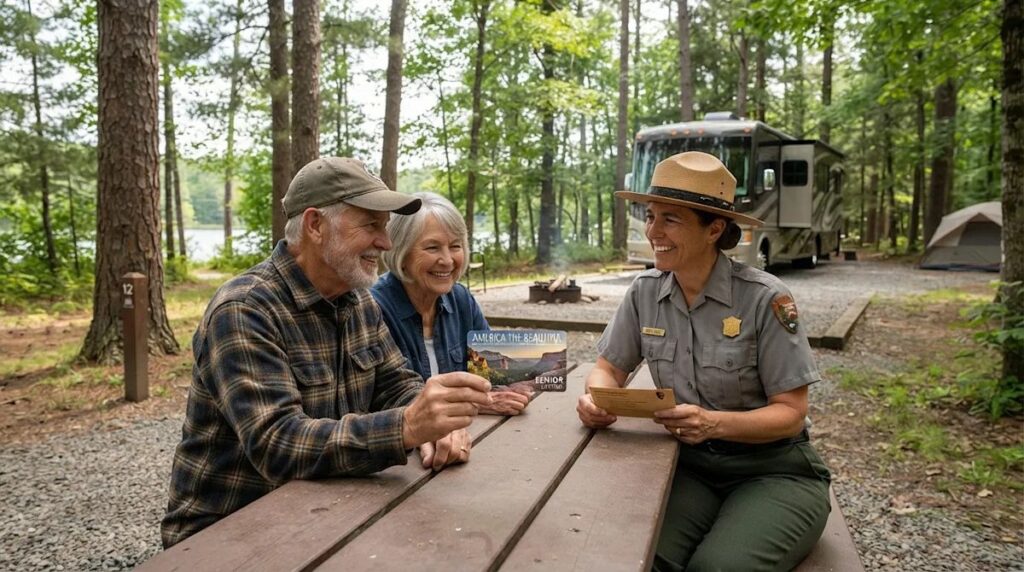
The America the Beautiful Senior Pass is for U.S. citizens or permanent residents age 62 or over. It costs $80 for life or $20 for a year.6 It gives a 50% discount on campsites at Corps of Engineers campgrounds, and other federal agencies are covered too.7
A $30-a-night Forest Service campground becomes $15. At $28 a night, one week of camping saves $98, which is more than the lifetime pass costs. One limit: the discount applies only at sites run directly by a federal agency, and each agency handles it a little differently, so ask the campground office to confirm what’s covered.8 Buying in person carries no processing fee, while buying online adds $10.
Advertisement
Advertisement
By The Numbers: Each annual Senior Pass you trade in takes $20 off the $80 lifetime price. Turn in four and the lifetime pass is free, even if the annual passes have already expired.
Most of these savings need nothing but a question. The biggest ones are an $80 lifetime pass for federal campgrounds and a monthly rate you may have to request out loud. Memberships help only if you actually stay where they work, so confirm each discount with the park before you pay, and read the fine print on anything that sounds too good.
Which fee have you actually talked down at a front desk, and what did you say to get it done?
Sources:
Source link