
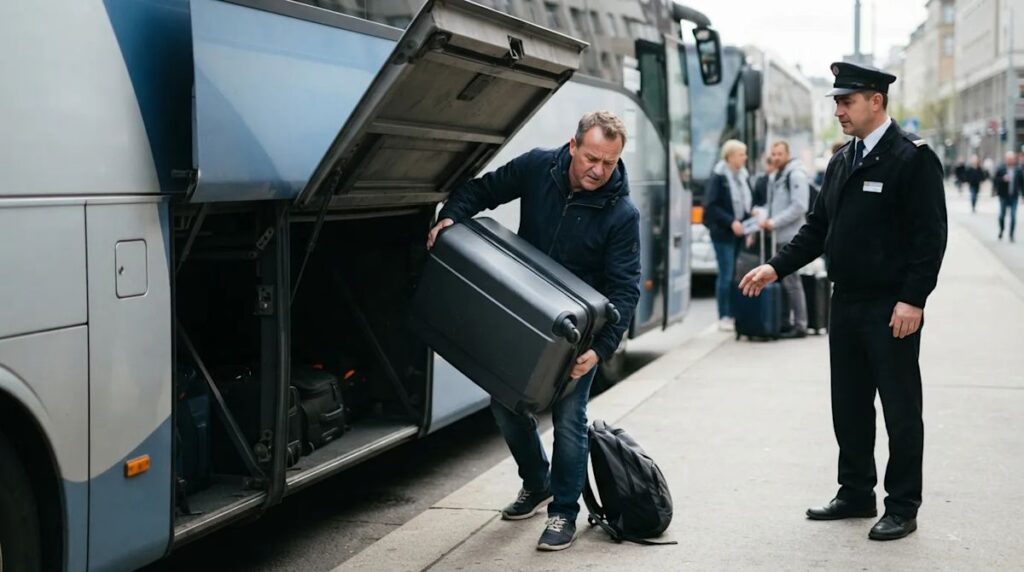


A bus ticket feels like a simple deal: bring what fits, and somebody will find room for it. The written rules are tighter, stranger, and far less forgiving than most travelers realize. Operators on both sides of the Atlantic publish firm weight caps, size limits, and a few safety bans, and they tend to surface right at the curb with a line of people watching.
Some of these rules ban a bag you’ve happily flown with for years. One can lock your most important papers where you can’t touch them for hours. Here’s what the operators’ own rulebooks say, counting down to the one that costs people the most.
#13 – The “Standard” Allowance Isn’t Standard at All
#13 – The “Standard” Allowance Isn’t Standard at All (Image Credits: Gemini)
That number printed on your ticket doesn’t travel with you from one operator to the next. FlixBus’s European terms cap the free checked bag at 20 kg and the small hand bag at 7 kg. National Express’s FAQ lists one large hold item up to 20 kg plus one soft hand item up to 10 kg. Even that is a moving target, because an older National Express post advertised two 20 kg suitcases per adult.
Advertisement
Advertisement
Across the Atlantic, the math changes again. Current guides describe Greyhound’s U.S. allowance as a 25 lb carry-on and a 50 lb checked bag. A 20 kg limit works out to roughly 44 lb. That means a bag that’s legal on a U.S. Greyhound could be about 6 lb overweight on a European FlixBus.
Quick Compare
FlixBus (Europe): 20 kg hold bag, 7 kg hand bag
National Express (UK): 20 kg hold item, 10 kg soft hand item
Greyhound (U.S.): 50 lb checked bag, 25 lb carry-on, per current guides
Next, a limit most people forget exists at all.
#12 – Your Carry-On Gets Judged by Weight Too
#12 – Your Carry-On Gets Judged by Weight Too (Image Credits: Gemini)
Plenty of travelers assume only the big bag counts. In reality, the small one has a cap as well. National Express allows one soft hand item up to 10 kg. FlixBus’s European limit is lower, at 7 kg.
Advertisement
Advertisement
Nobody may be rolling out a scale at the door, either. One 2026 Greyhound guide notes that drivers may simply estimate carry-on weight by eye. A cruise-travel forum poster went further and claimed drivers can judge a bag’s weight by hand. That’s anecdotal, but it fits the picture. Your “light” bag may be sized up in about two seconds.
Did You Know: FlixBus’s European hand-bag size is 42 x 30 x 18 cm. The IATA airline carry-on guideline is 56 x 45 x 25 cm. Your airline carry-on habit can oversize you on a bus.
Next up: a bag that glides through airports but can get stopped at the coach door.
#11 – The Rolling Bag That Flies Fine May Be Banned in the Cabin
#11 – The Rolling Bag That Flies Fine May Be Banned in the Cabin (Image Credits: Gemini)
Your trusty wheelie bag has probably cruised through plenty of airports. On some coaches, it won’t make it past the door. National Express says briefcases, hard-shelled cases, wheelie bags, and hard-framed backpacks aren’t allowed on board for safety reasons. They have to go in the hold.
Advertisement
Advertisement
That has a visible consequence. The charger, medication, or snacks you wanted within reach end up sealed under the floor with the case. The bag you’d normally call your carry-on may not be allowed to be one. Some travelers call the rule overkill. Operators point to safety.
Editor’s Note: If you’re heading out on a coach with this kind of rule, a soft duffel or backpack is arguably the smarter companion. It fits the places the rules actually allow.
The next one is a rare rule that actually works in your favor.
#10 – The Stroller and Wheelchair Exception Few People Know About
#10 – The Stroller and Wheelchair Exception Few People Know About (Image Credits: Gemini)
National Express carries folding pushchairs free in the hold, on top of the standard luggage allowance. Fully collapsible wheelchairs travel free in the hold too, and they don’t count toward the hold allowance. For a parent juggling a toddler and a diaper bag, that’s a real break.
Advertisement
Advertisement
The key word is collapsible. A bulky, non-folding setup is a different conversation. Older Greyhound guidance also listed strollers as allowed beyond the checked-bag limit and car seats alongside a carry-on, with no extra charge. For families, the stroller may be the one item that doesn’t eat into your bag count. Check your operator’s current terms before you rely on it.
Worth Knowing
Folding pushchairs ride free in the hold on National Express, on top of your allowance.
Fully collapsible wheelchairs travel free and don’t use up hold space allowance.
Older Greyhound guidance allowed strollers beyond the checked-bag limit.
Folding is the magic word. Bulky, non-folding gear is treated differently.
Then there’s the fee that doesn’t guarantee anything.
#9 – Paying Extra Doesn’t Guarantee Your Bag a Spot
#9 – Paying Extra Doesn’t Guarantee Your Bag a Spot (Image Credits: Gemini)
Many travelers figure that if they pay the fee, the bag goes. Not necessarily. National Express says excess luggage is subject to availability and caps extras at three pieces per passenger. Older Greyhound guidance likewise says the number of extra checked bags depends on space in the baggage compartment.
Advertisement
Advertisement
That puts the final call on a very physical limit: the size of the hold. On a full coach, your willingness to pay may not matter at all. Some passengers argue that a paid bag should always travel. The operators’ terms say otherwise.
Insider Tip: If you know an extra bag is coming, add it during booking rather than counting on room at the curb. Excess space is handled as an available-space option, not a promise.
Tour coaches can be a different game entirely.
#8 – Tour and Charter Coaches May Play by Tougher Rules
#8 – Tour and Charter Coaches May Play by Tougher Rules (Image Credits: Gemini)
Scheduled services aren’t the only coaches out there. Tour and charter trips can have their own limits. One poster on a cruise-travel forum claimed that touring coaches cap passengers at one 20 kg case plus hand luggage, with no option to pay for more. The poster’s reasoning was that a full coach plus luggage gets close to its legal vehicle weight.
Advertisement
Advertisement
That’s one traveler’s account, not an official rule, so treat it with caution. But the logic is real, because every bag adds to the load. A tour operator’s own terms can be stricter than any scheduled service you’ve used. The same poster said the standard National Express allowance had been two 20 kg cases until a year or two earlier. Rules like these get rewritten.
Now for the price that changes depending on when you pay.
#7 – The Same Extra Bag Costs More When You Wait
#7 – The Same Extra Bag Costs More When You Wait (Image Credits: Gemini)
Timing changes the price. National Express’s FAQ lists £10 per item for a single journey when pre-booked online with your ticket. The same page gives an on-the-day example of £15 for a single and £30 for a return, for one case that’s over the weight limit.
These figures come from the operator’s own help pages, and prices may have changed since. The pattern is what matters. The curb is the most expensive place to discover you have too much luggage. One 2026 guide also says FlixBus customers can add excess baggage online up to 15 minutes before departure at the standard online rate. Confirm that with the operator before you count on it.
Advertisement
Advertisement
By The Numbers: The £30 on-the-day return fee in National Express’s example is double its £15 single. Round trips can double the cost of one overweight bag.
Next, the “it’s only one bag” myth.
#6 – “It’s Just One Bag” Doesn’t Get You a Pass
#6 – “It’s Just One Bag” Doesn’t Get You a Pass (Image Credits: Gemini)
You might think one overweight case gets waved through because it’s only one case. It doesn’t. National Express treats a single case over 20 kg as excess luggage and charges accordingly. Passengers also have to help the driver load anything over 20 kg, so you may end up hoisting your own bag into the hold.
In the U.S., the stakes look similar. One 2026 Greyhound guide says a checked bag over 50 lb may be charged extra or denied entirely. Another says the fee scales with both the excess weight and the distance traveled. An overweight bag can be refused outright.
Advertisement
Advertisement
Try This: Weigh your packed bag at home. If it’s close to the limit, move the bulky items into your hand bag. One guide suggests a jacket or small blanket carried in your hand bag can free up checked space.
A bag can pass the scale and still fail.
#5 – Dimensions Can Sink a Bag That Passes the Scale
#5 – Dimensions Can Sink a Bag That Passes the Scale (Image Credits: Gemini)
A bag can pass on weight and still fail on size. FlixBus’s terms set 80 x 50 x 30 cm per free bag, with slightly different shapes allowed if height, width, and length add up to no more than 160 cm. National Express lists a standard hold item of 75 x 50 x 32 cm.
U.S. rules work on a similar principle. Greyhound guides describe a checked bag of about 62 inches when you add length, width, and height. According to National Express’s FAQ, oversized bags travel only at the driver’s discretion, and only after the fee is paid. A big duffel that isn’t heavy can still fail the test.
Advertisement
Advertisement
Insider Tip: Measure length, width, and height, and add all three together. If the total is over your operator’s limit, expect a conversation at the hold door.
The next rule hits in the middle of a trip.
#4 – Some Stops Won’t Touch Your Hold Luggage at All
#4 – Some Stops Won’t Touch Your Hold Luggage at All (Image Credits: Gemini)
This one catches people mid-trip. National Express’s conditions say that at some stops, safety rules prevent loading or unloading the hold. Passengers boarding or leaving there can only bring hand luggage.
That’s a concrete consequence, and one that’s easy to overlook. If your suitcase is in the hold, it may simply not be available at certain stops. You can’t hop off and grab it. The practical lesson is to check your stop and what you’ll need before the coach pulls away. This is spelled out in the operator’s terms, not hidden folklore.
At a Glance
The catch: Safety rules at certain stops block hold loading and unloading.
What still works: Hand luggage only for anyone boarding or leaving there.
Where it’s written: National Express’s own conditions of carriage.
The takeaway: What’s in the hold may be out of reach until your final stop.
Then comes the shortcut that gets turned away.
#3 – Boxes and Loose Items Can Get Turned Away
#3 – Boxes and Loose Items Can Get Turned Away (Image Credits: Gemini)
Coaches feel casual, but the bags aren’t. Greyhound Australia’s policy says luggage must be a standard suitcase, backpack, or duffel. Boxes, oversized items, and loose articles aren’t allowed, and bags must be closed, easy to handle, and labeled with your name and contact details. That policy is Australian, but similar logic shows up elsewhere.
Labeling is also on FlixBus’s list, which recommends putting your name and address on your bag. The tied-up cardboard box that seemed like a clever shortcut can end up as a no. A box doesn’t count as luggage under some operators’ rules.
The Psychology Behind This: Bus travel feels informal, so many people assume the rules are too. The written terms read as firm caps, which is why a relaxed vibe at the curb can vanish at the hold door.
Two quieter rules can raise your bill without anyone saying a word.
#2 – How Many Bags You Bring Can Cost More Than How Much They Weigh
#2 – How Many Bags You Bring Can Cost More Than How Much They Weigh (Image Credits: Gemini)
Five small bags can cost more than two bigger ones. One 2026 guide advises consolidating into fewer, well-packed bags, since the fee structure penalizes bag count as much as total weight. Another says Greyhound, owned by Flix since 2021, now uses dynamic pricing on extra bags. Those are secondary sources, so check the operator’s current fee table.
Tickets matter too. National Express says its excess allowance applies per ticket. With multiple tickets, you buy excess for each ticket that exceeds the standard allowance. Splitting a pile of bags across several tickets doesn’t automatically work. Both rules reward packing smart before you leave the house.
Fast Facts
National Express applies its excess allowance per ticket, not per group.
Extras are capped at three pieces per passenger and depend on space.
Greyhound has been owned by Flix since 2021.
One 2026 guide says extra-bag pricing on Greyhound is now dynamic, so check the live fee table.
The last one is about what’s inside the bag, and it’s the one that costs people the most.
#1 – The Bag You Can’t Reach Is the One You Shouldn’t Trust With Valuables
#1 – The Bag You Can’t Reach Is the One You Shouldn’t Trust With Valuables (Image Credits: Gemini)
The most expensive packing mistake isn’t an overweight bag. It’s putting the wrong things in the hold. National Express’s conditions say small valuables and important papers should not go in the hold under any circumstances. They belong in hand luggage. The operator also strongly advises against bringing large valuable items as hold luggage.
FlixBus gives the same advice. It tells passengers to carry valuables such as identification and electronics in their small bag. There’s a responsibility angle too. Except for luggage in the hold, National Express says you must look after your belongings at all times during the journey. Operators put the burden on you, not the hold.
Why It Works: Your hand bag stays with you the whole trip, while the hold stays out of reach until you arrive. Documents, medication, and chargers belong upstairs.
Put it all together and the pattern is clear. Weight caps apply to hand bags as well as suitcases. Rolling bags may be banned in the cabin. Extra space is never a sure thing, and booking early costs less than paying at the curb. And valuables belong with you, not in the hold.
Operators publish all of this. Most of us just don’t read it until the bus is idling and the hold door is open. Which one would have caught you out?
Source link


